
 View full infographic +
01 / 60
BYD: one group, several identities
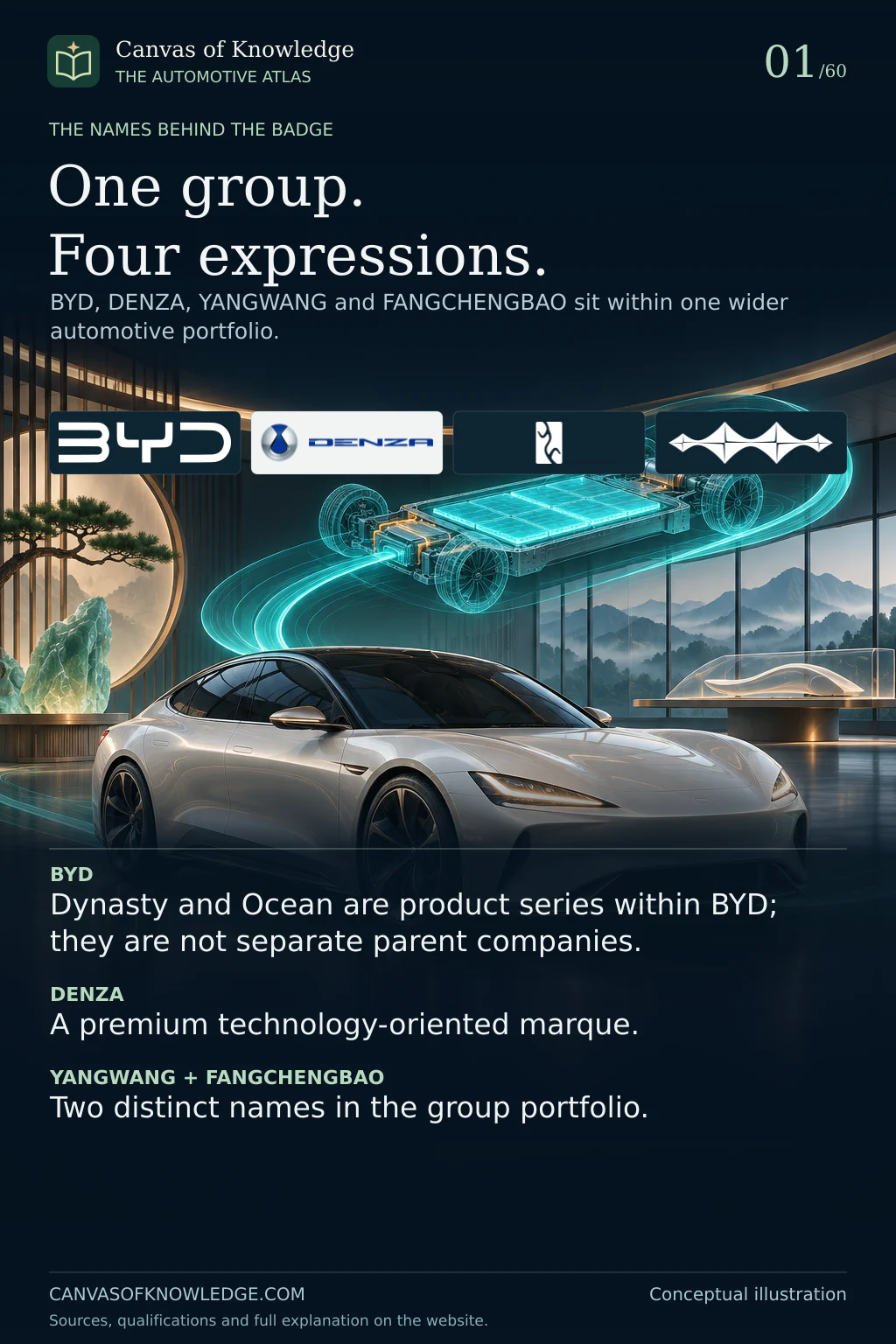
BYD, DENZA, YANGWANG and FANGCHENGBAO sit within one wider automotive portfolio.
Explore the technology & sources →Meet the names reshaping the car. Look beneath the bodywork. Follow the ideas from Chinese engineering to a connected global industry.
Six chapters connect brands, batteries, charging, motion, intelligent vehicles and patents. European and North American examples appear where the engineering overlaps. Sources and model-specific qualifications accompany every story.
Open any poster to enlarge it. Read its explanation, inspect the evidence or download the individual image.
60 infographics across 6 chapters
Chinese groups, marques and the suppliers behind them.
View full infographic +BYD, DENZA, YANGWANG and FANGCHENGBAO sit within one wider automotive portfolio.
Explore the technology & sources →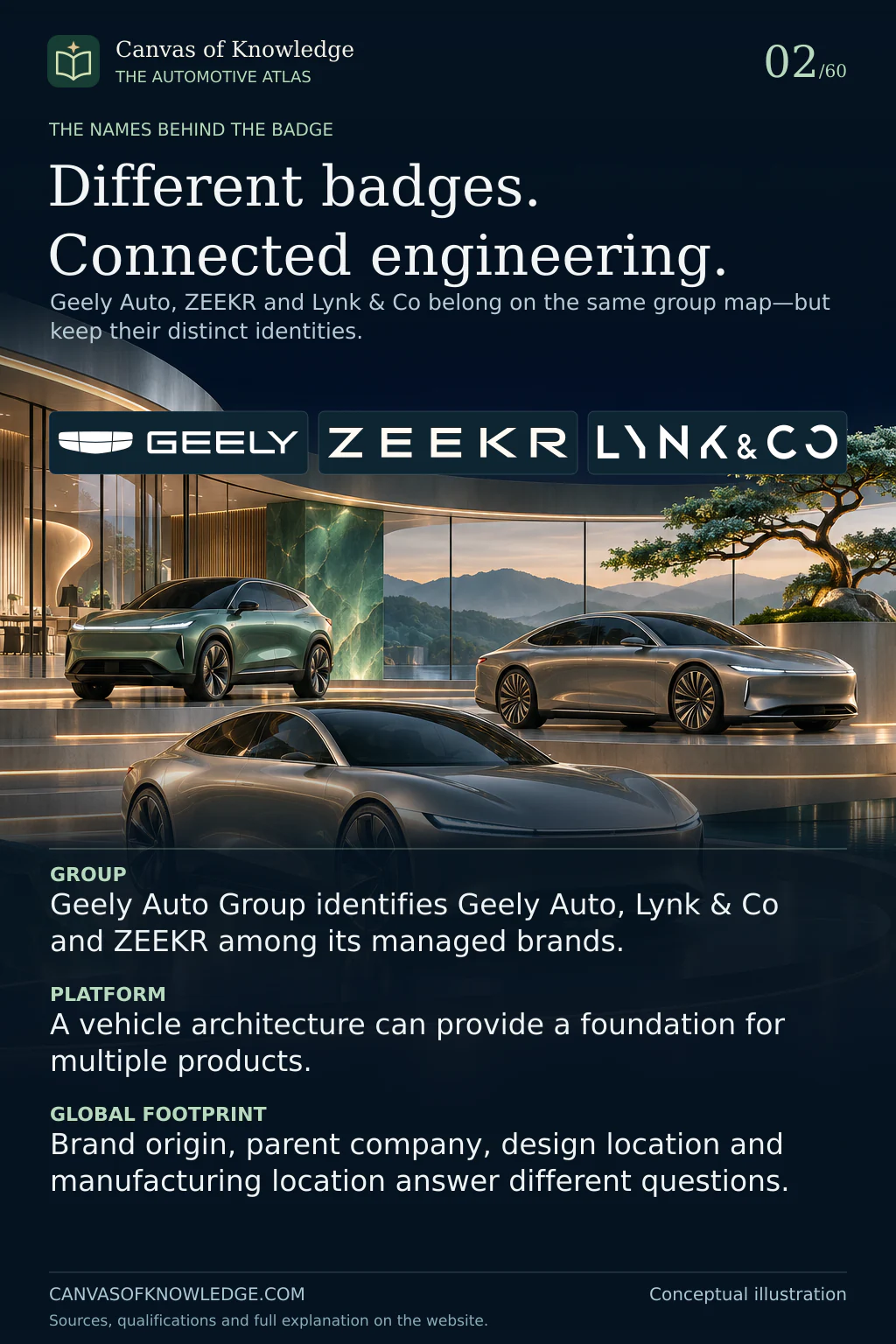 View full infographic +
Geely Auto, ZEEKR and Lynk & Co belong on the same group map—but keep their distinct identities.
Explore the technology & sources →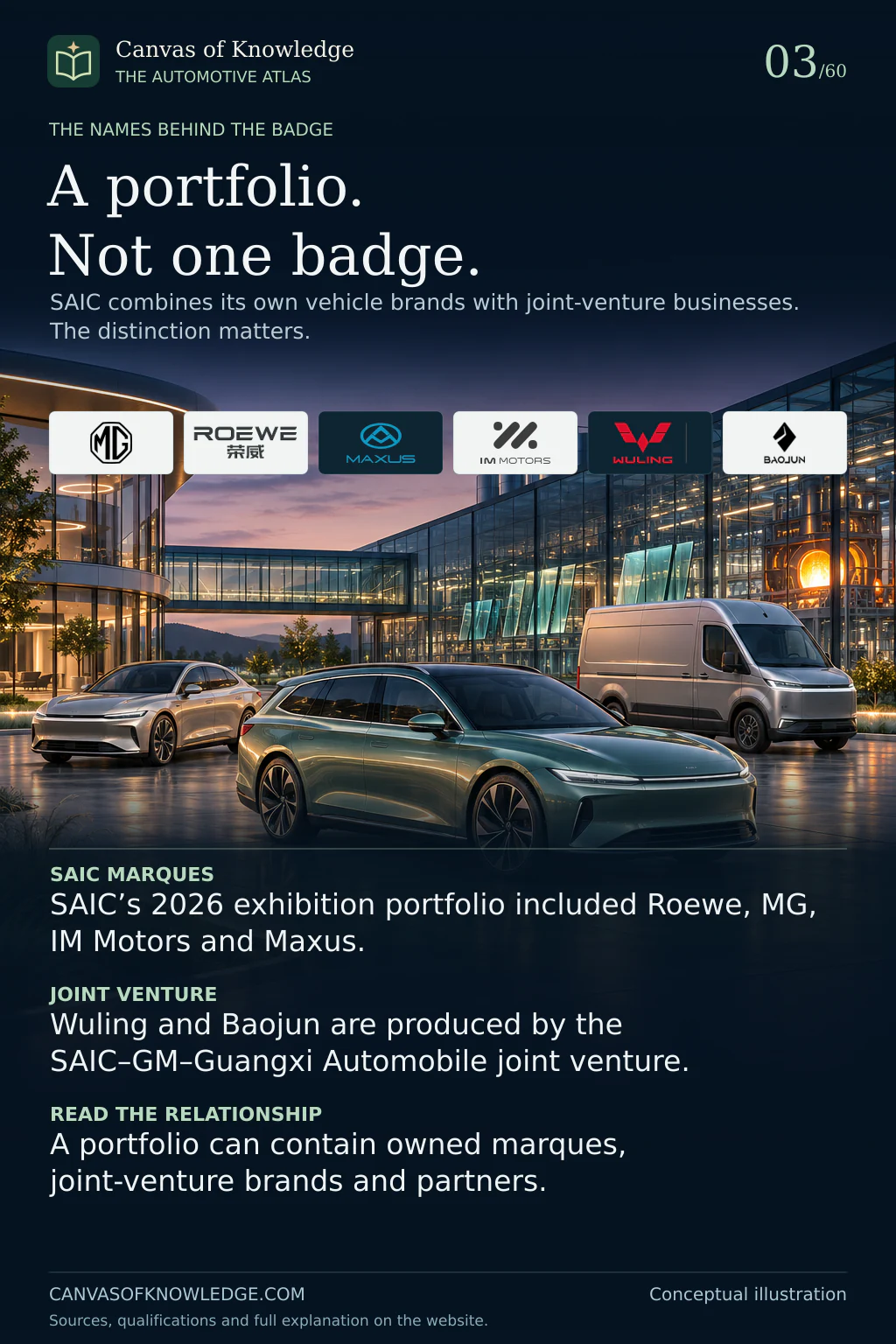 View full infographic +
SAIC combines its own vehicle brands with joint-venture businesses. The distinction matters.
Explore the technology & sources →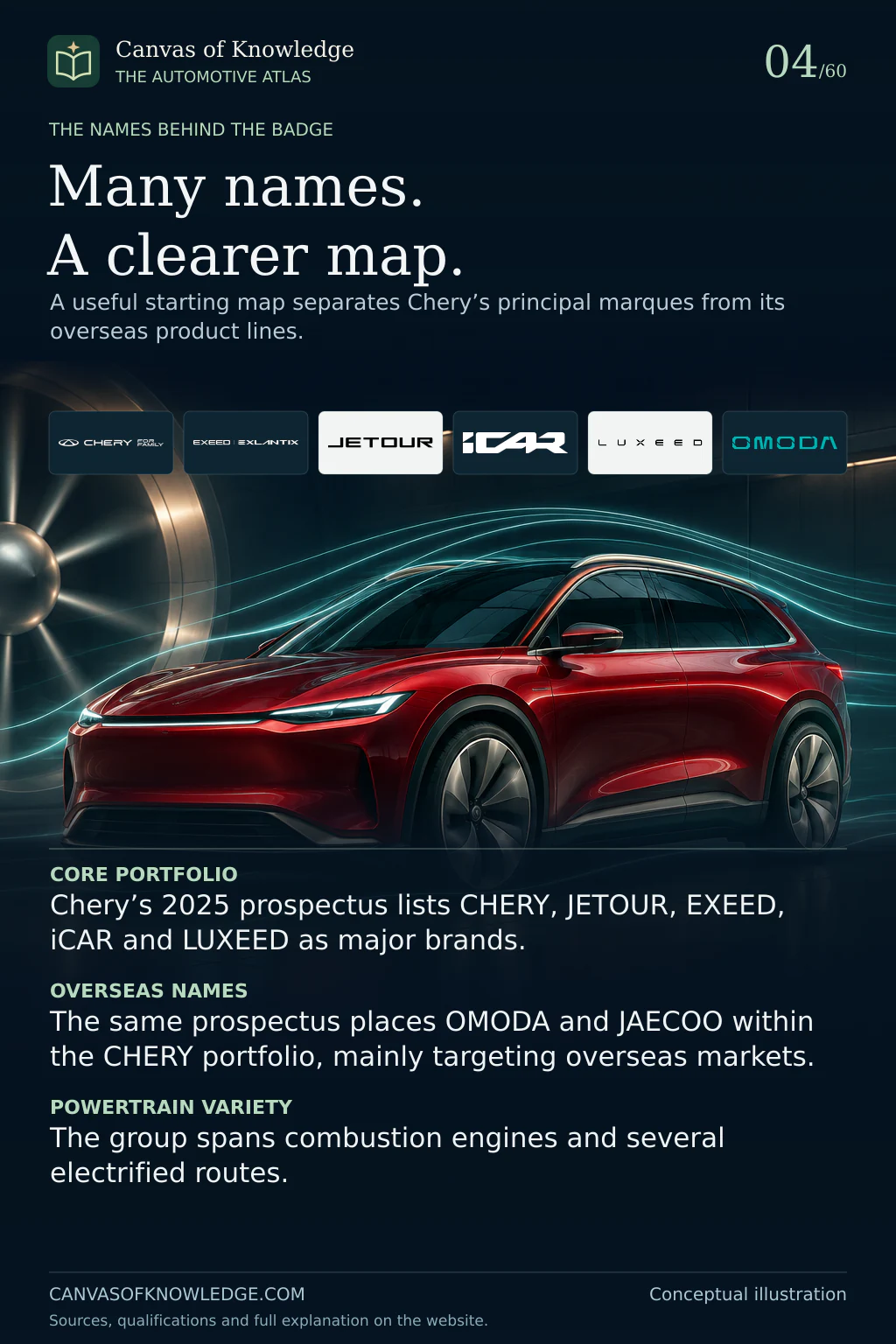 View full infographic +
A useful starting map separates Chery’s principal marques from its overseas product lines.
Explore the technology & sources →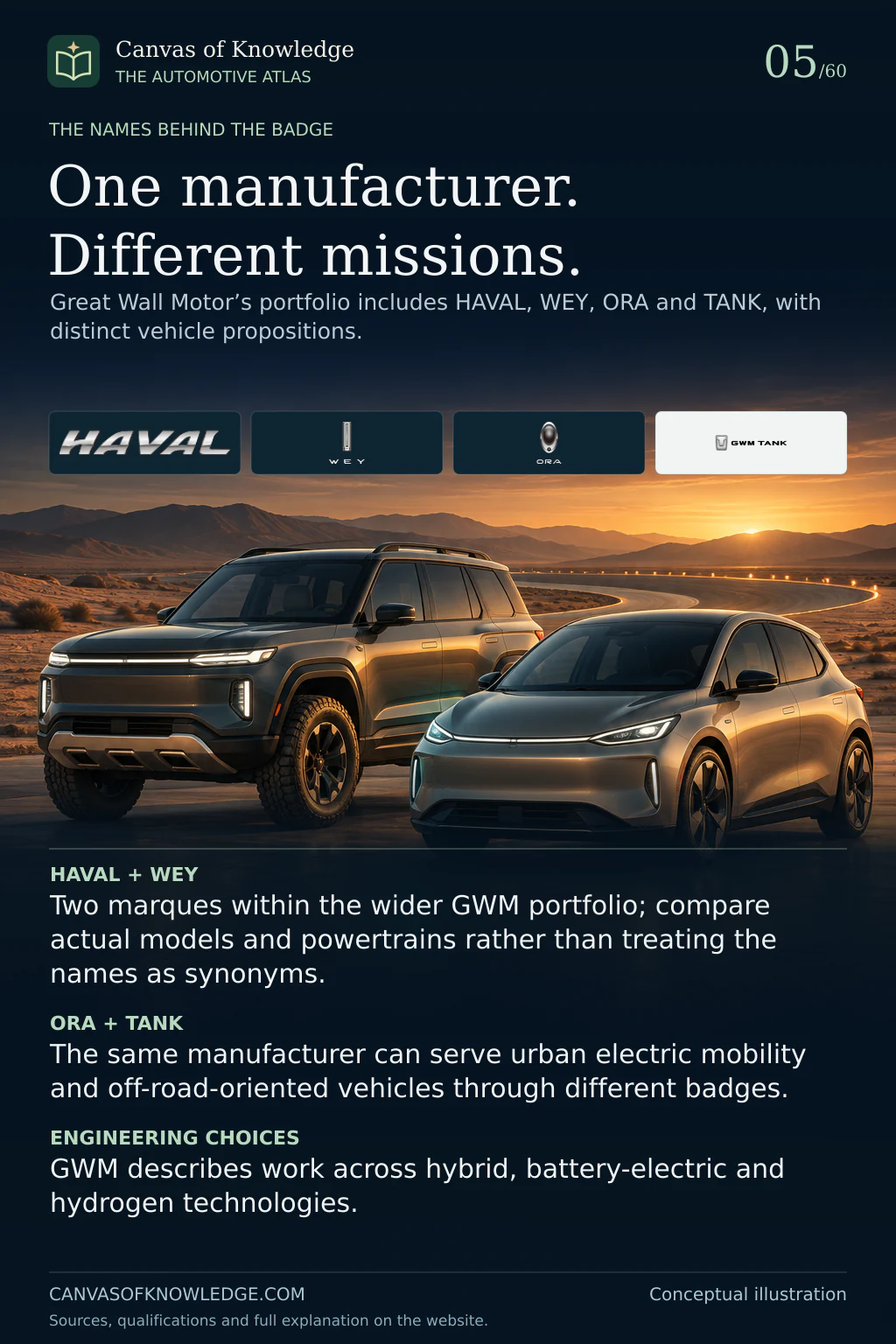 View full infographic +
Great Wall Motor’s portfolio includes HAVAL, WEY, ORA and TANK, with distinct vehicle propositions.
Explore the technology & sources →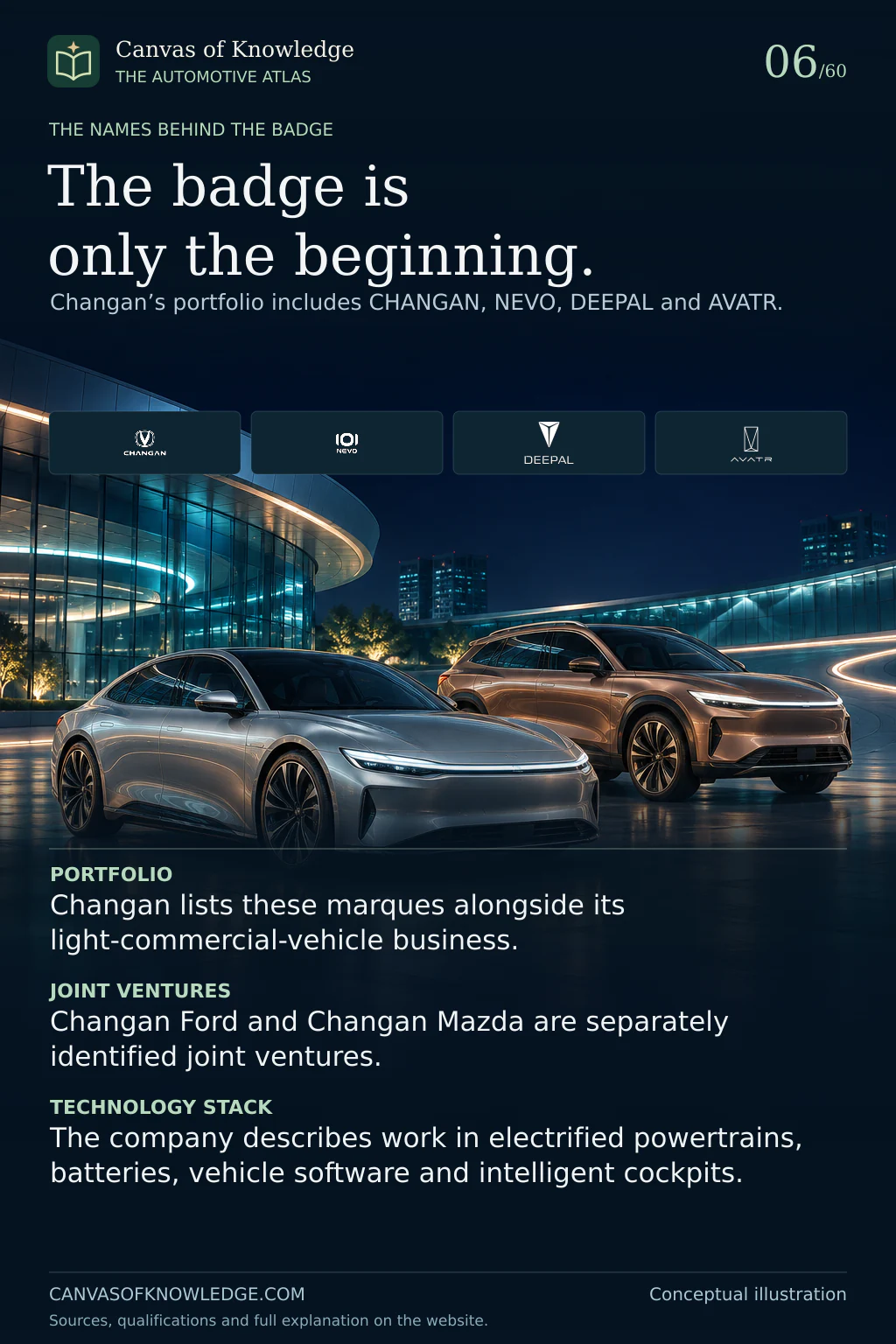 View full infographic +
Changan’s portfolio includes CHANGAN, NEVO, DEEPAL and AVATR.
Explore the technology & sources →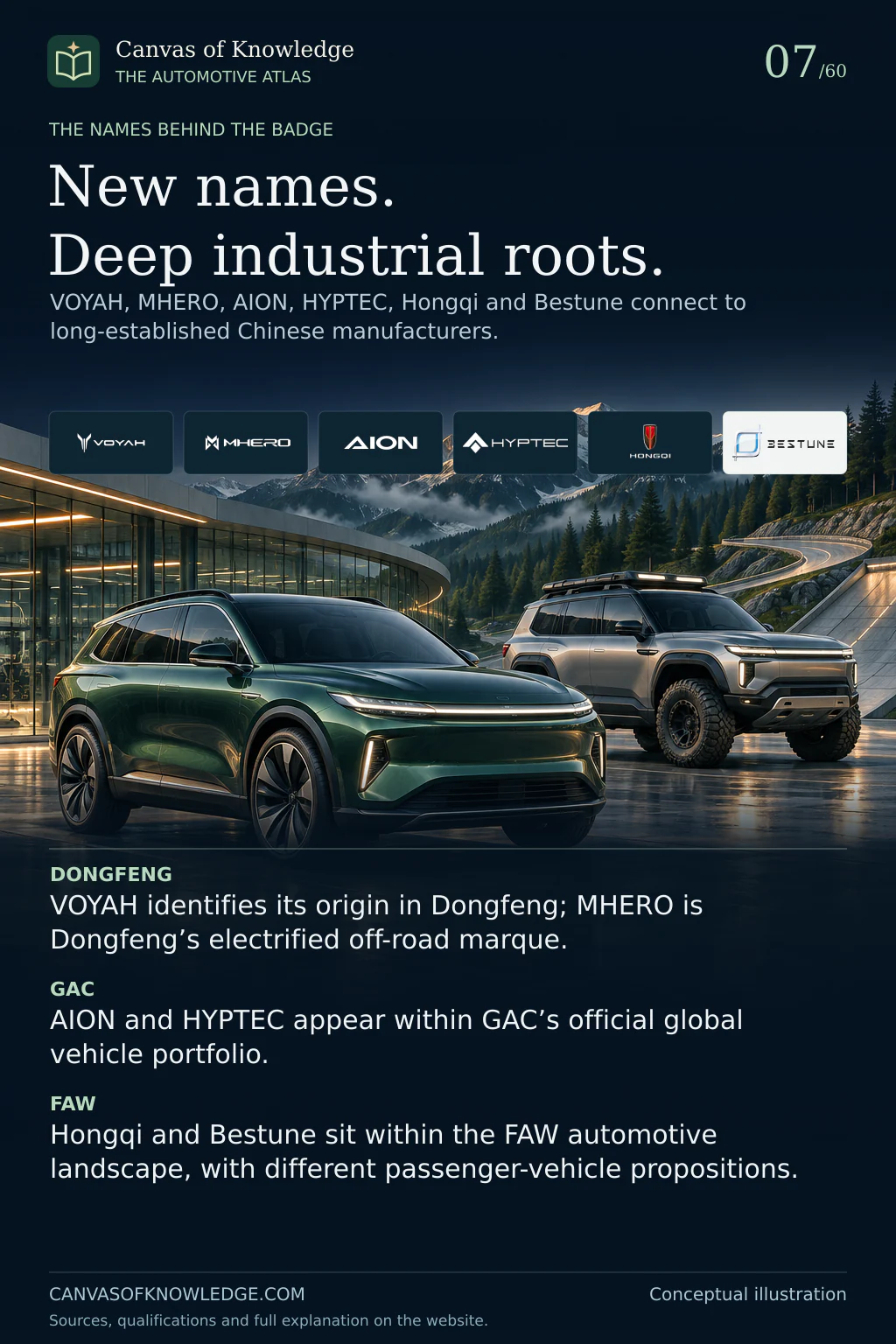 View full infographic +
VOYAH, MHERO, AION, HYPTEC, Hongqi and Bestune connect to long-established Chinese manufacturers.
Explore the technology & sources →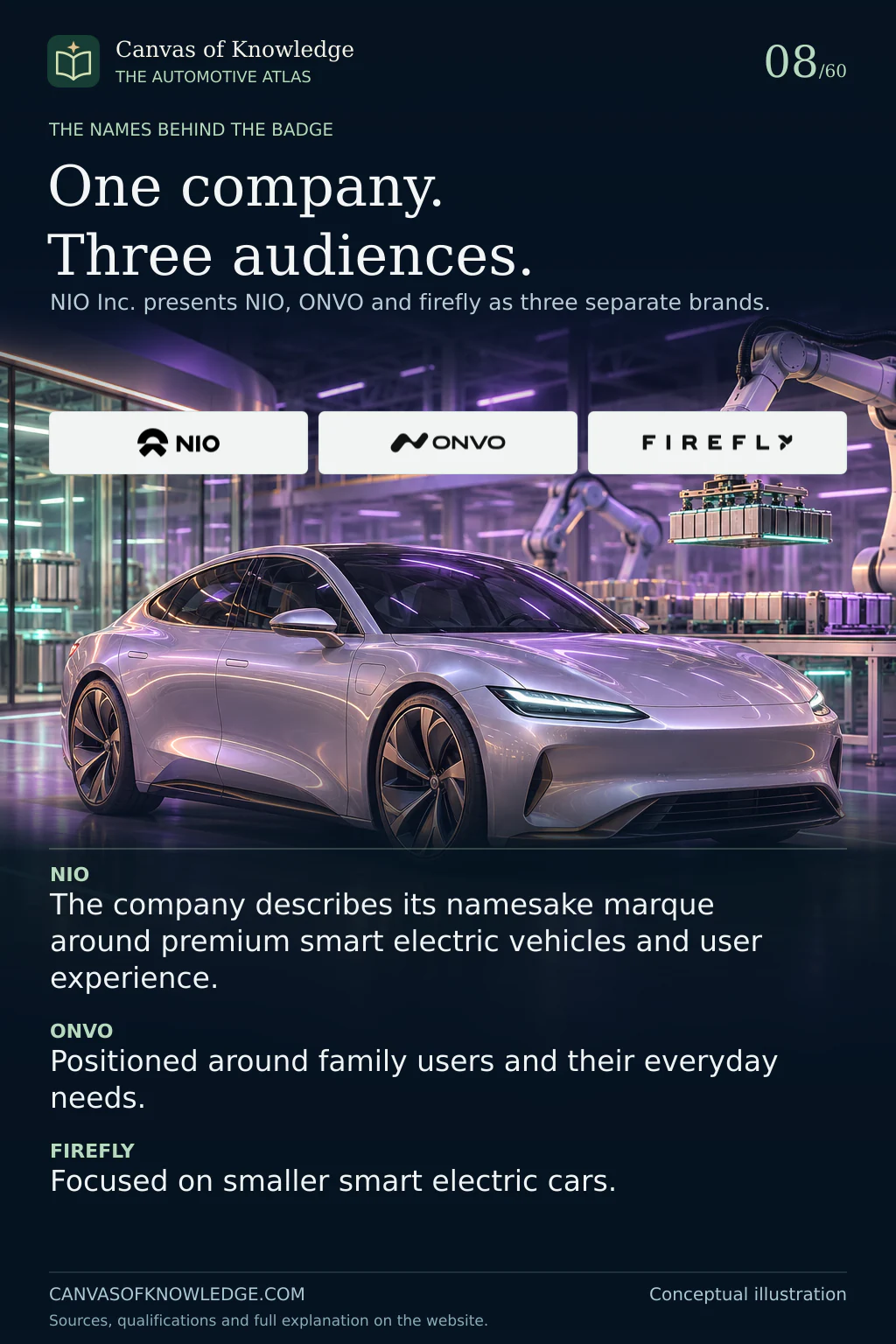 View full infographic +
NIO Inc. presents NIO, ONVO and firefly as three separate brands.
Explore the technology & sources →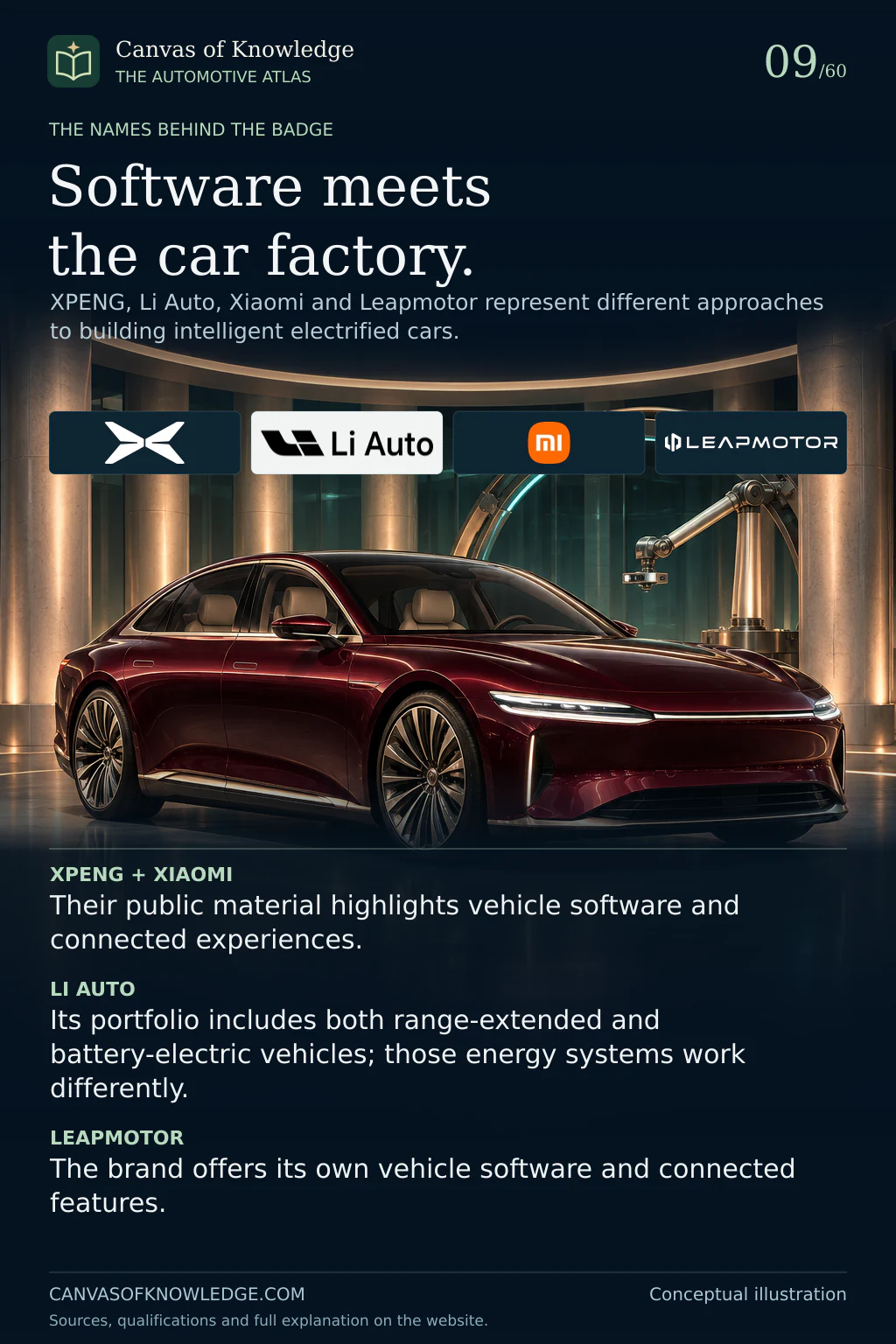 View full infographic +
XPENG, Li Auto, Xiaomi and Leapmotor represent different approaches to building intelligent electrified cars.
Explore the technology & sources →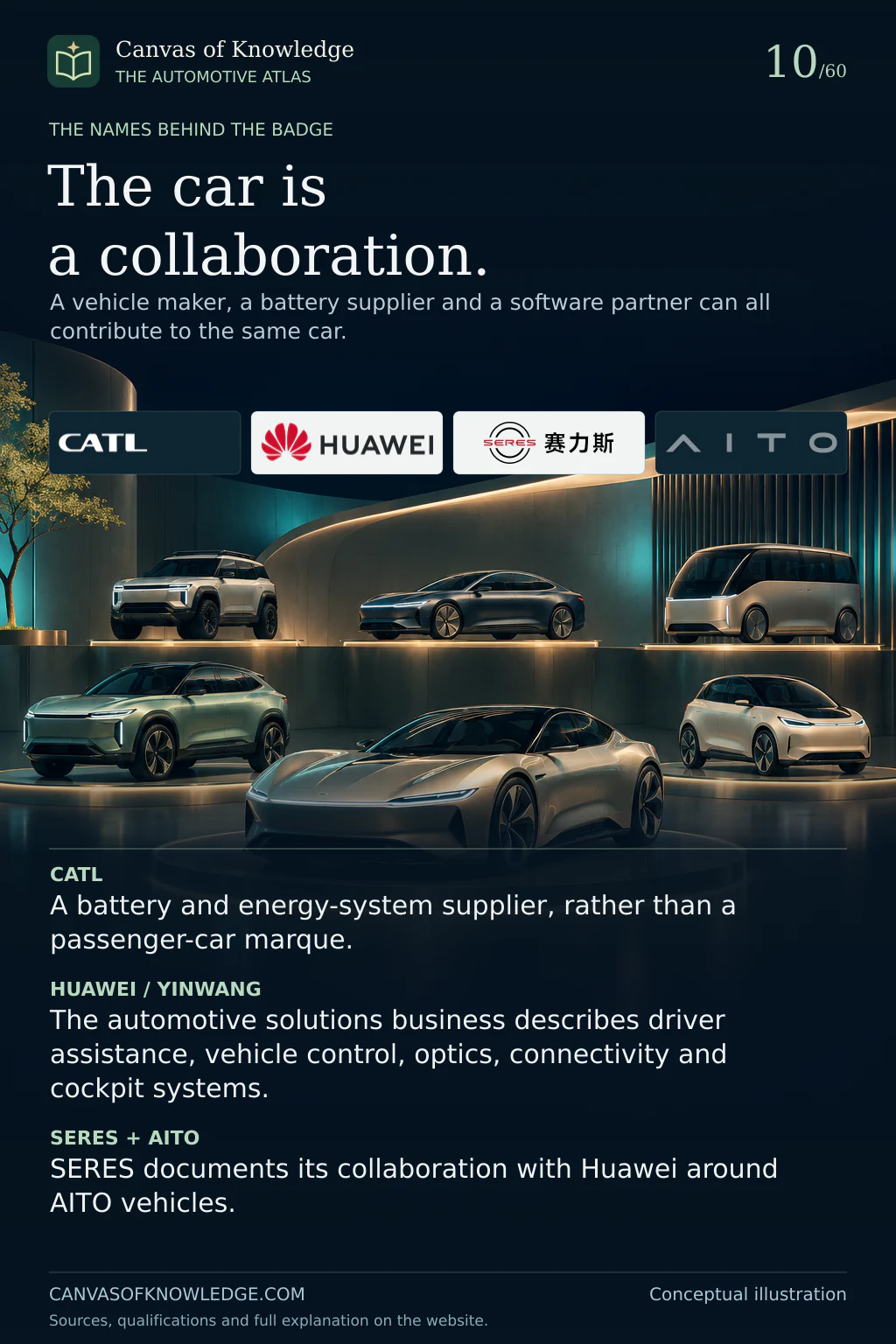 View full infographic +
A vehicle maker, a battery supplier and a software partner can all contribute to the same car.
Explore the technology & sources →Chemistry, structure, thermal control and material recovery.
 View full infographic +
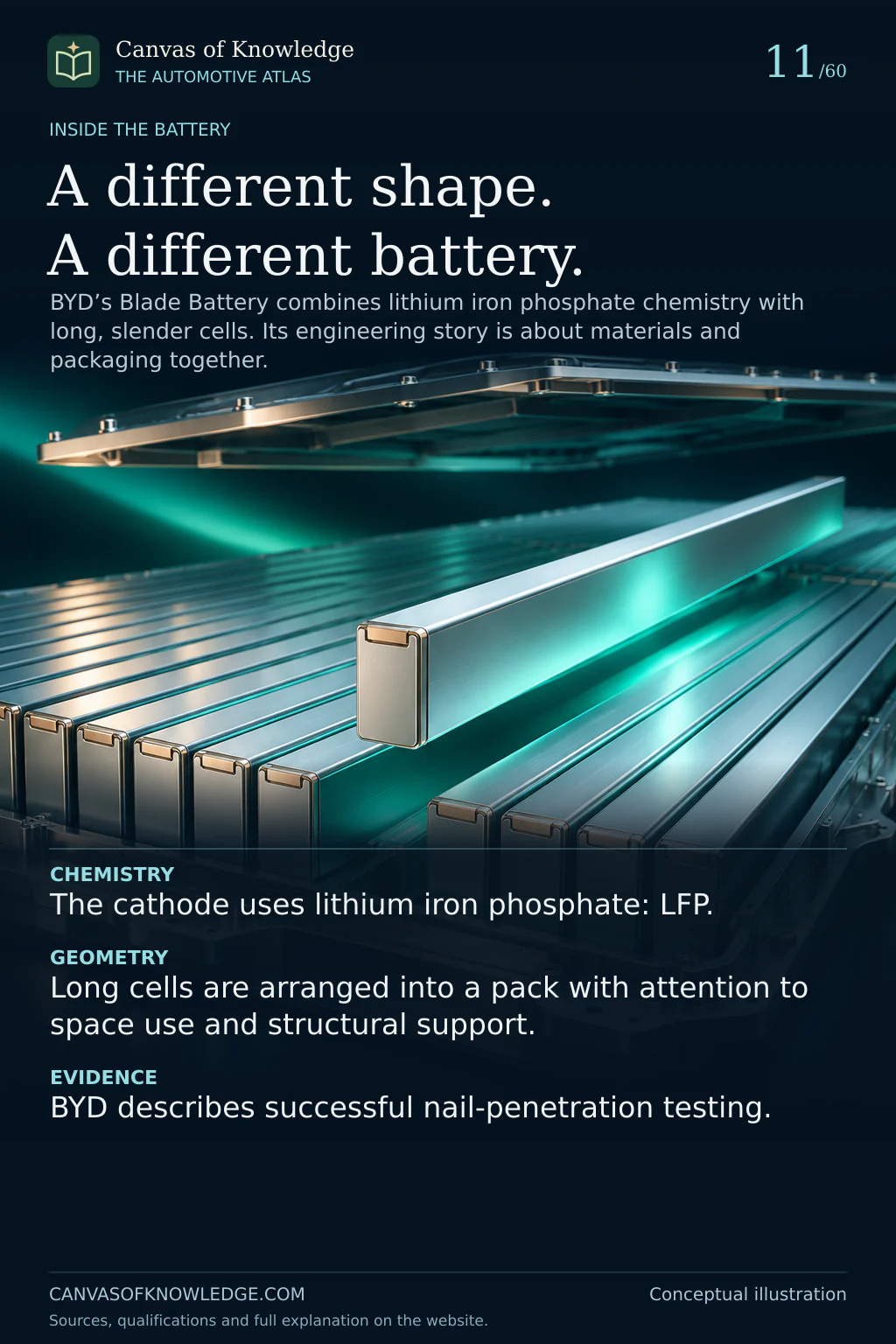
BYD’s Blade Battery combines lithium iron phosphate chemistry with long, slender cells. Its engineering story is about materials and packaging together.
Explore the technology & sources →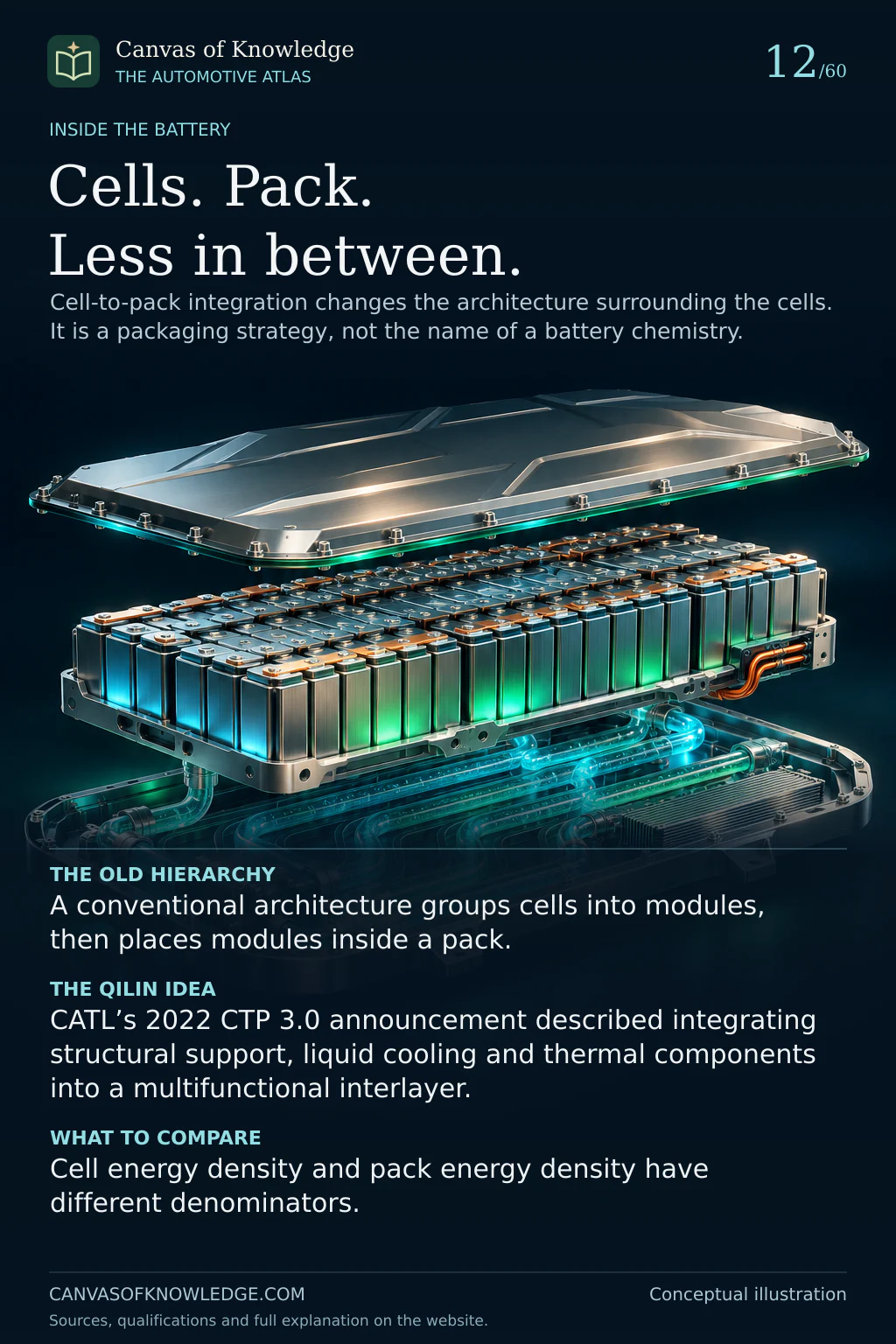 View full infographic +
Cell-to-pack integration changes the architecture surrounding the cells. It is a packaging strategy, not the name of a battery chemistry.
Explore the technology & sources →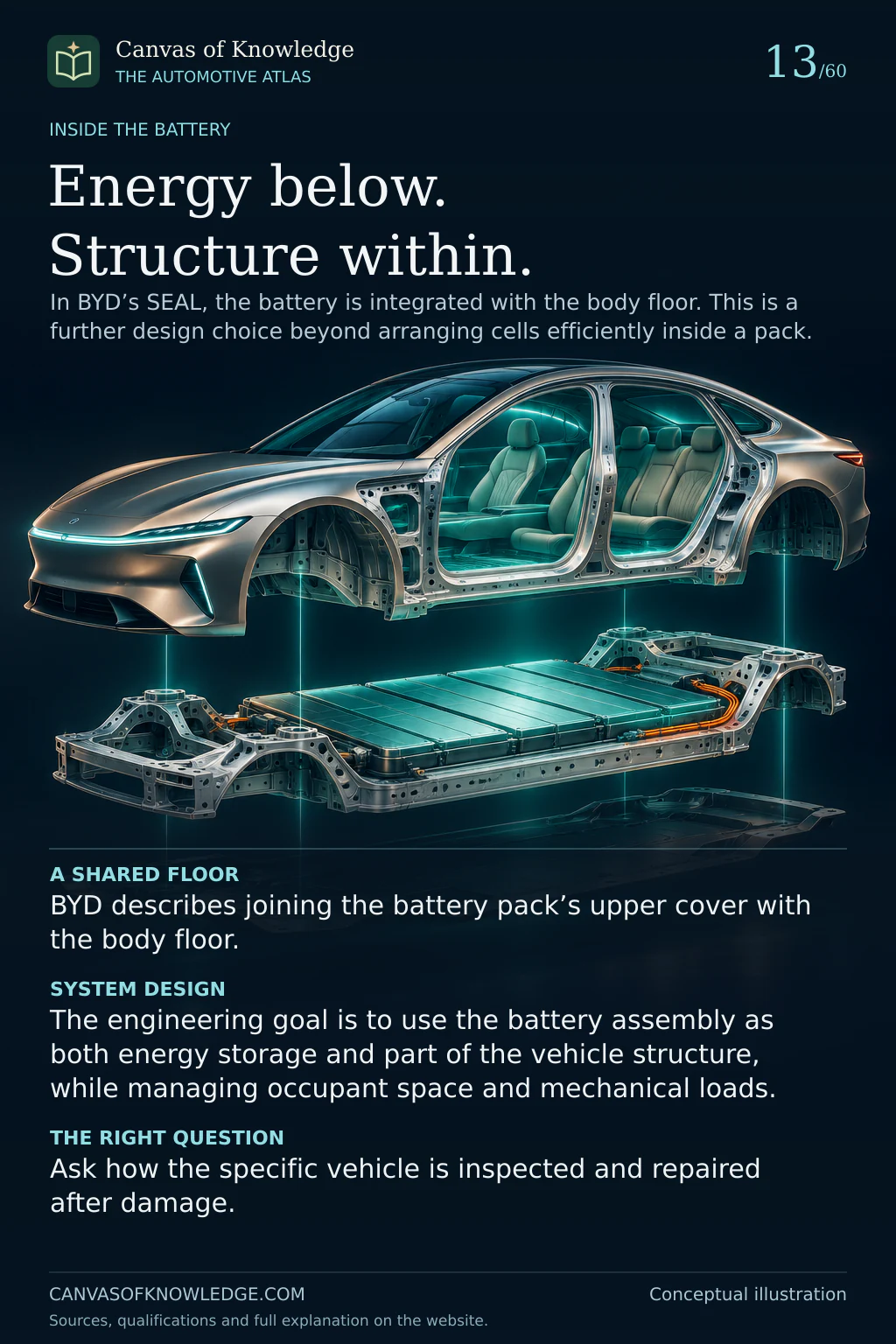 View full infographic +
In BYD’s SEAL, the battery is integrated with the body floor. This is a further design choice beyond arranging cells efficiently inside a pack.
Explore the technology & sources →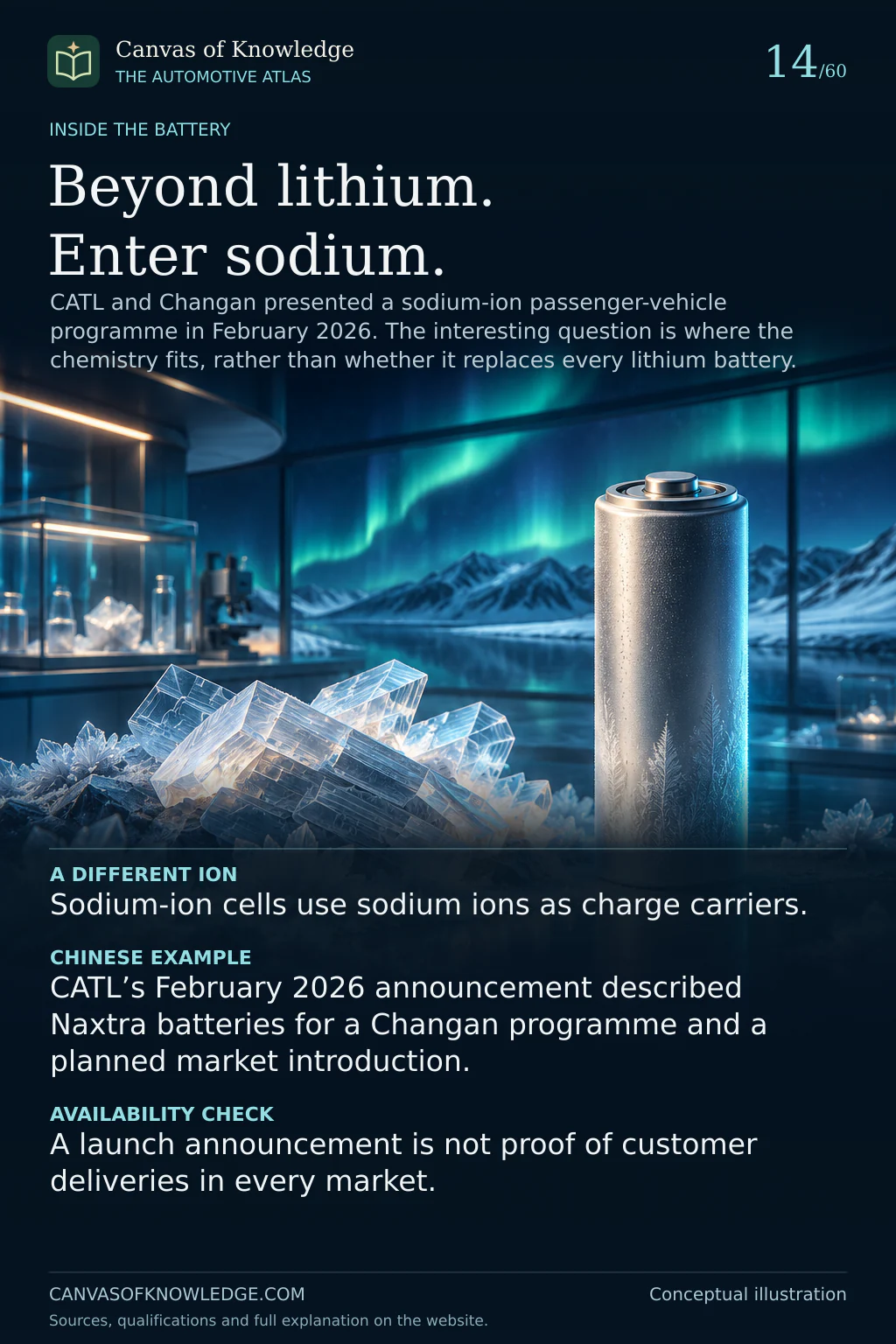 View full infographic +
CATL and Changan presented a sodium-ion passenger-vehicle programme in February 2026. The interesting question is where the chemistry fits, rather than whether it replaces every lithium battery.
Explore the technology & sources →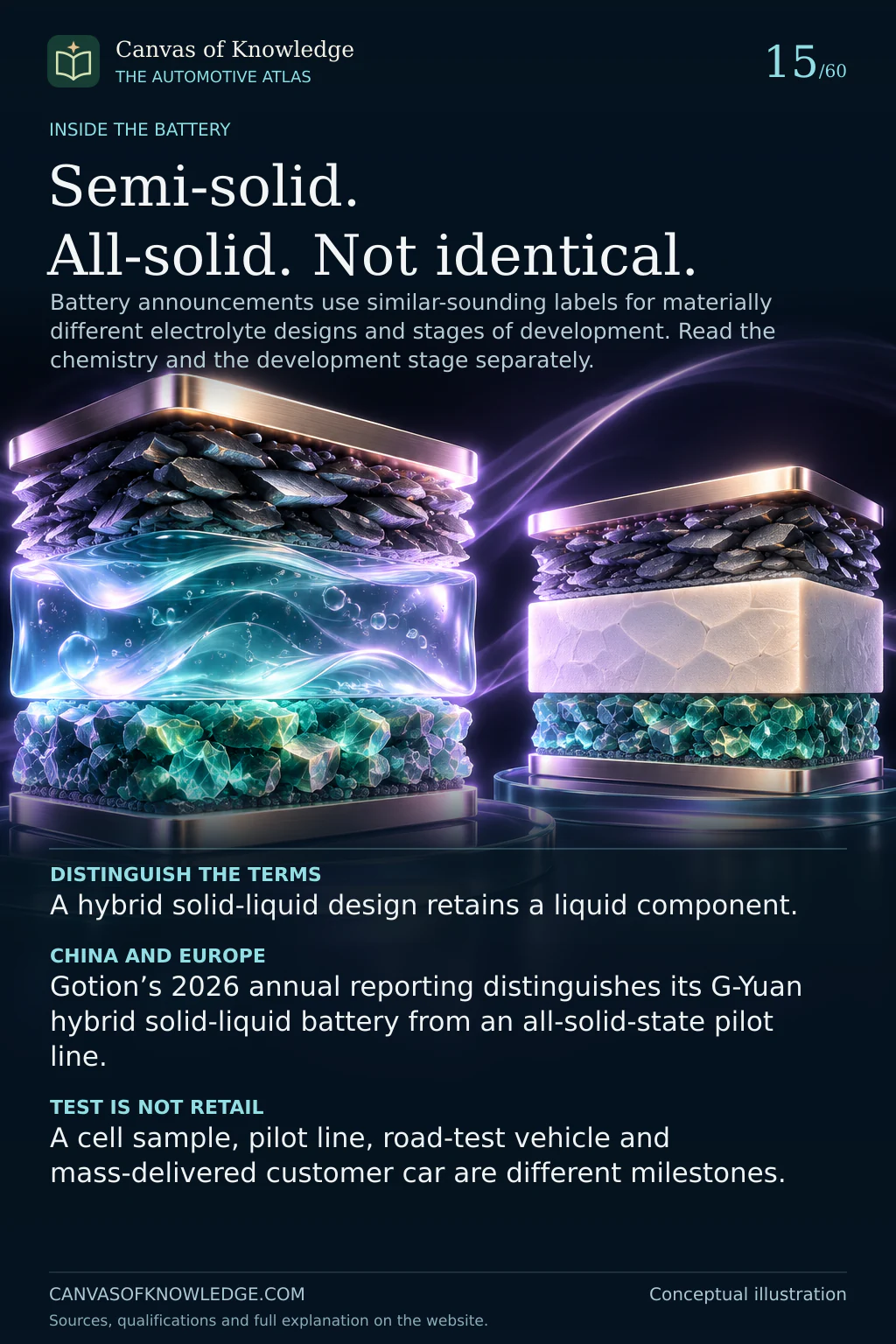 View full infographic +
Battery announcements use similar-sounding labels for materially different electrolyte designs and stages of development. Read the chemistry and the development stage separately.
Explore the technology & sources →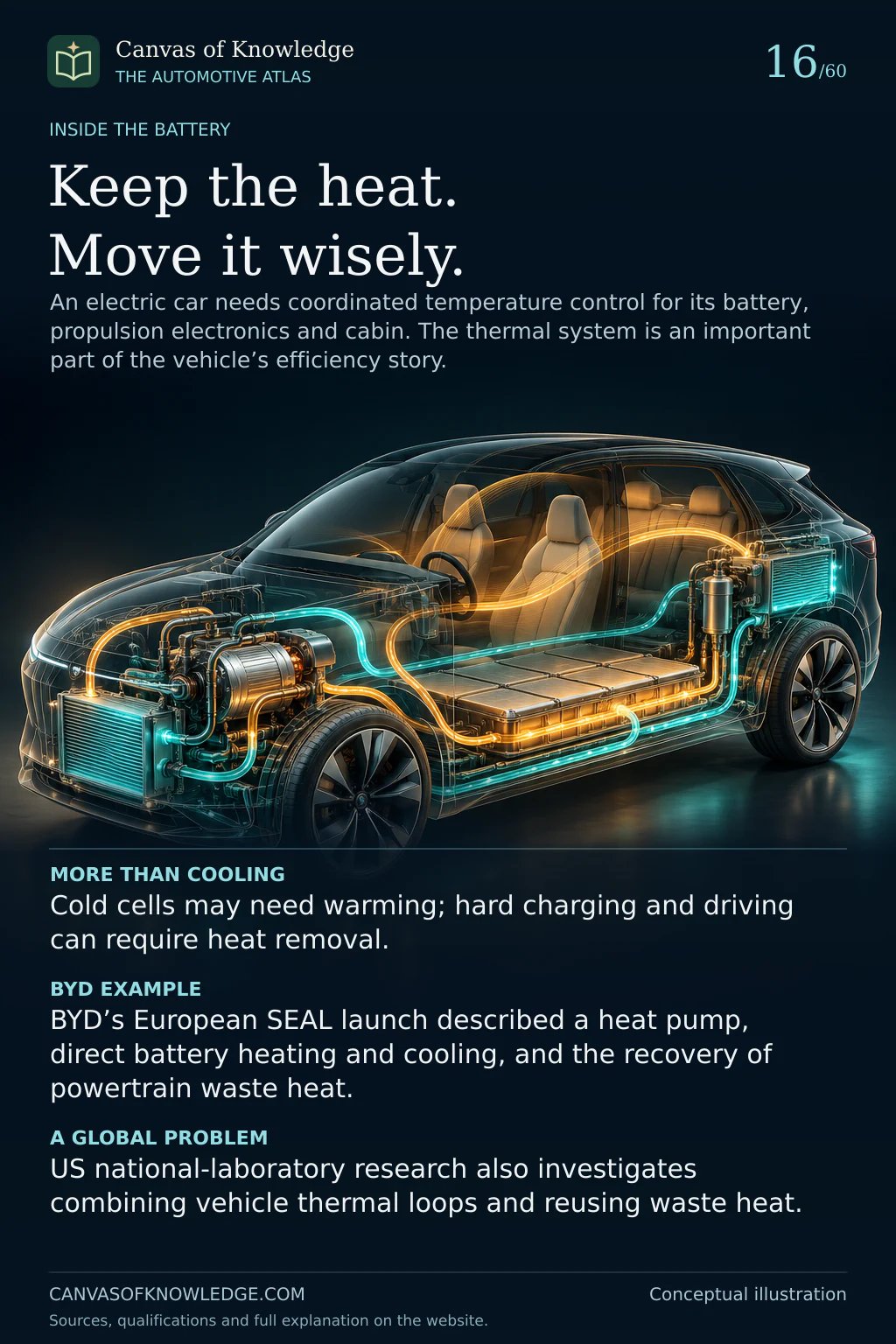 View full infographic +
An electric car needs coordinated temperature control for its battery, propulsion electronics and cabin. The thermal system is an important part of the vehicle’s efficiency story.
Explore the technology & sources →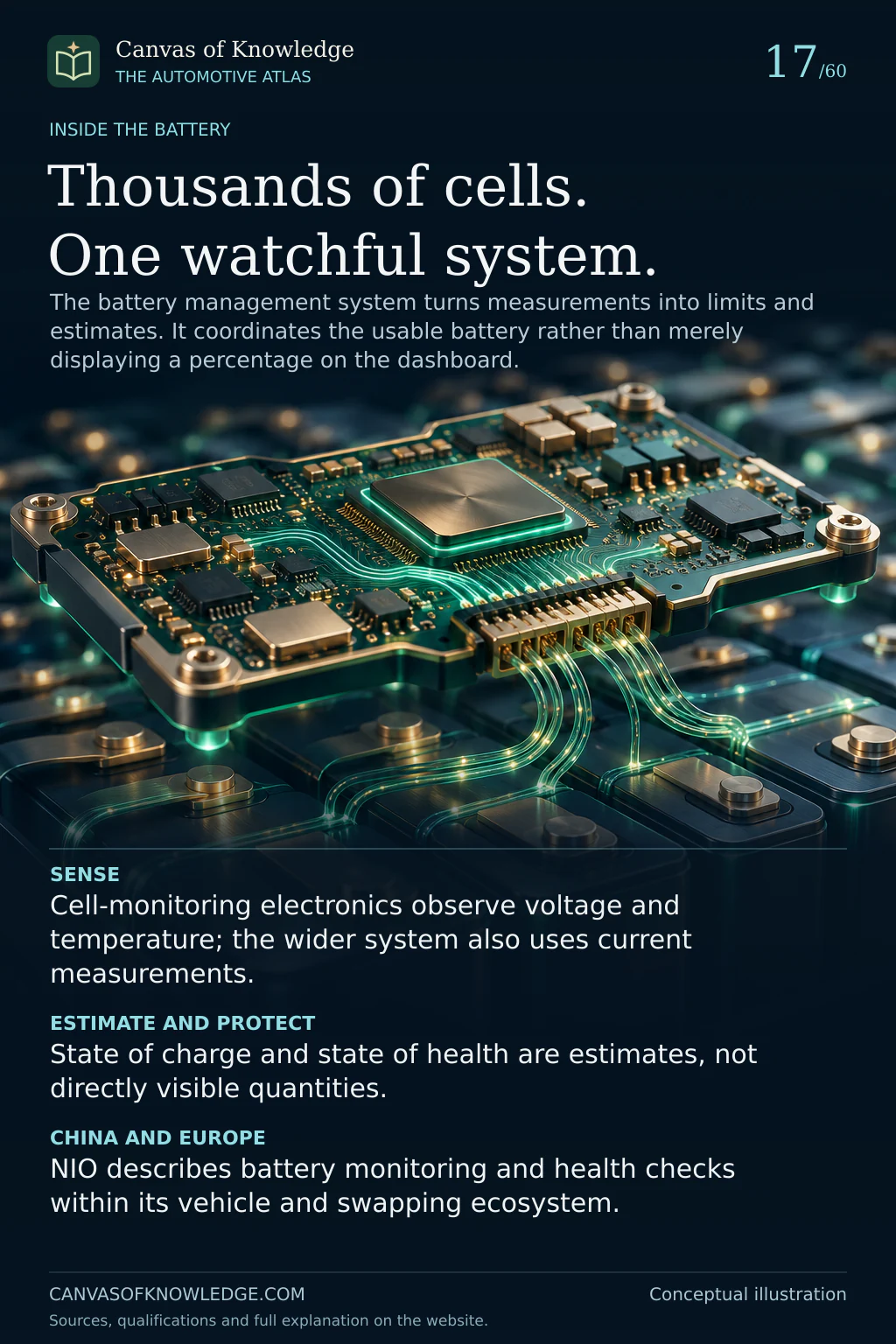 View full infographic +
The battery management system turns measurements into limits and estimates. It coordinates the usable battery rather than merely displaying a percentage on the dashboard.
Explore the technology & sources →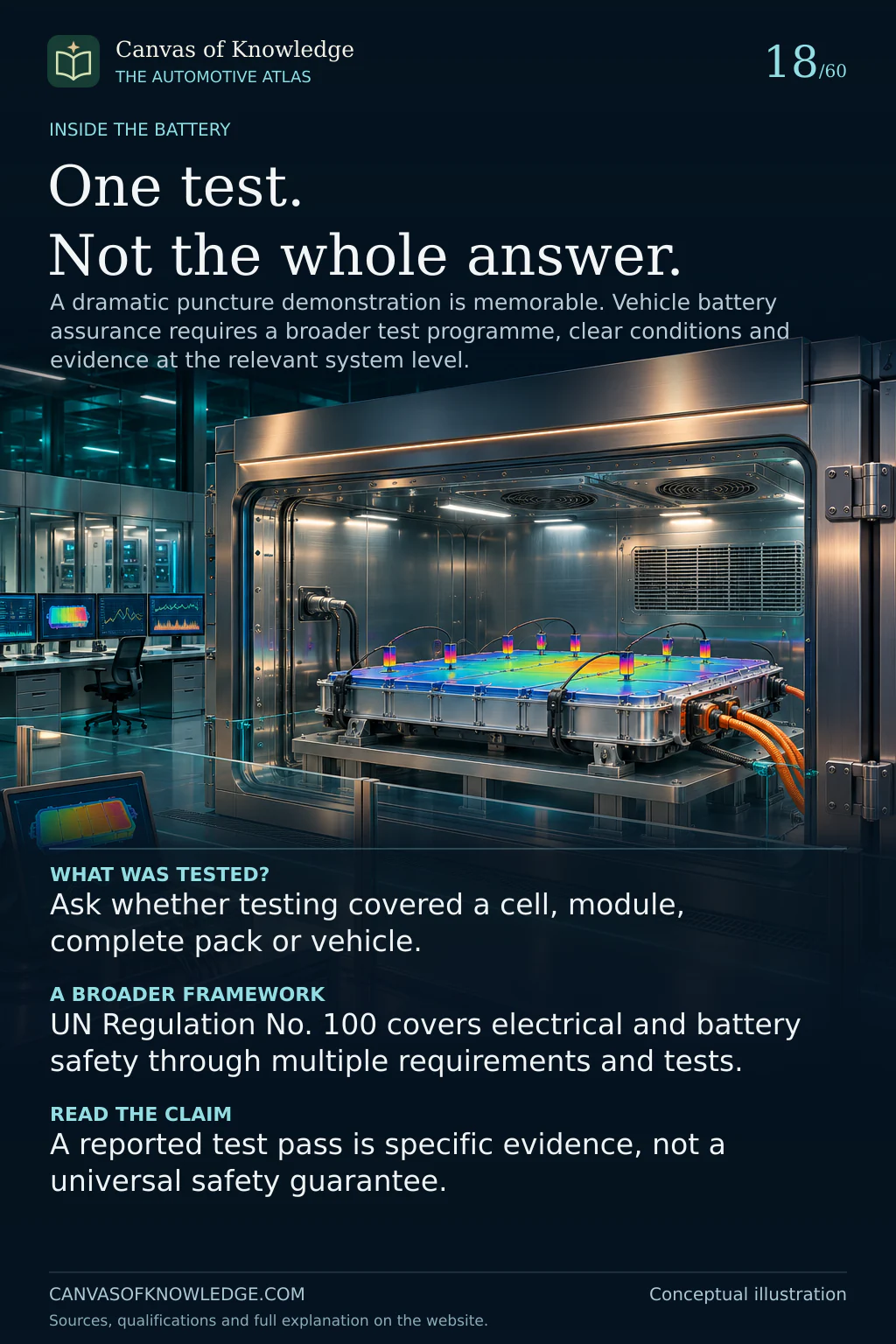 View full infographic +
A dramatic puncture demonstration is memorable. Vehicle battery assurance requires a broader test programme, clear conditions and evidence at the relevant system level.
Explore the technology & sources →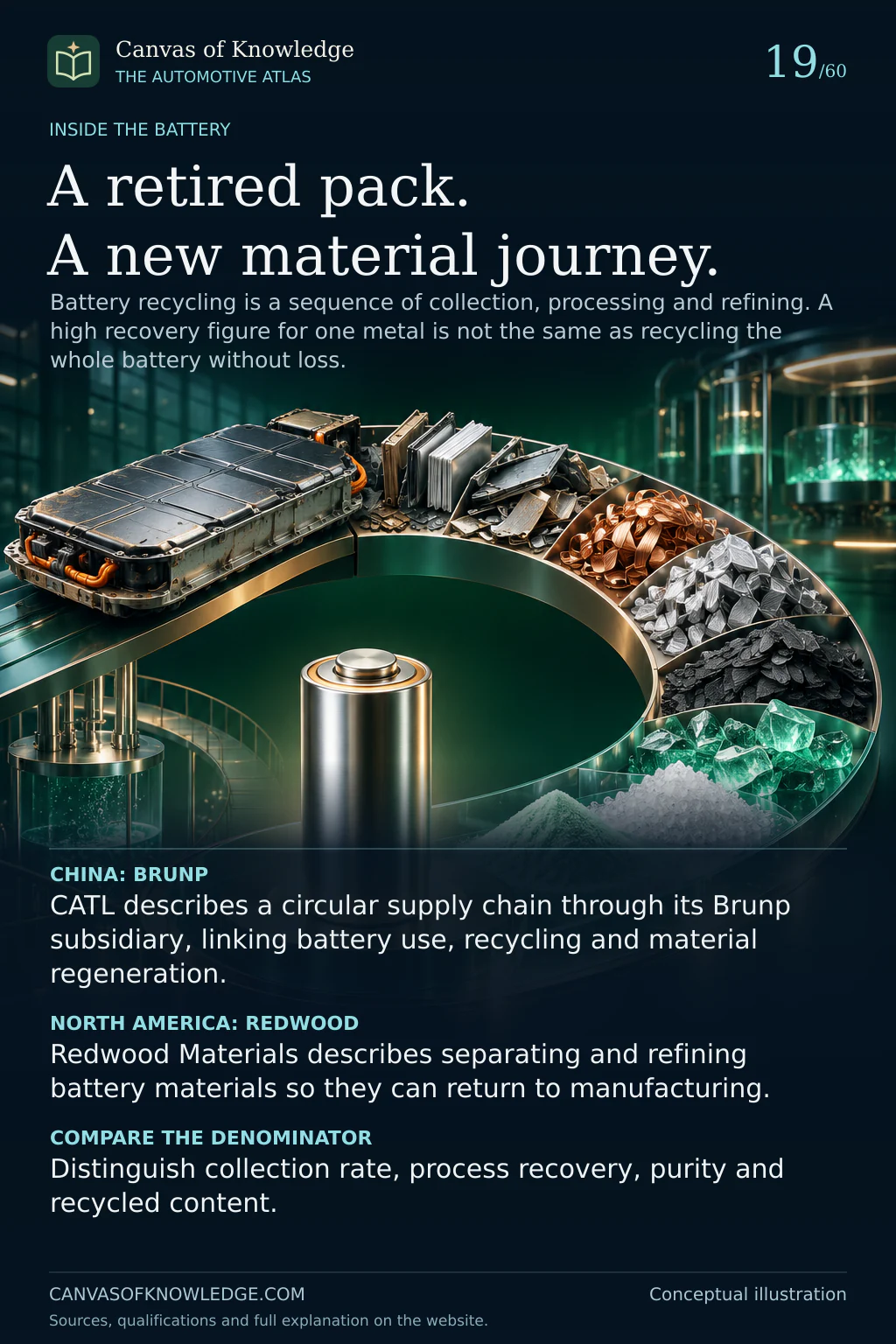 View full infographic +
Battery recycling is a sequence of collection, processing and refining. A high recovery figure for one metal is not the same as recycling the whole battery without loss.
Explore the technology & sources →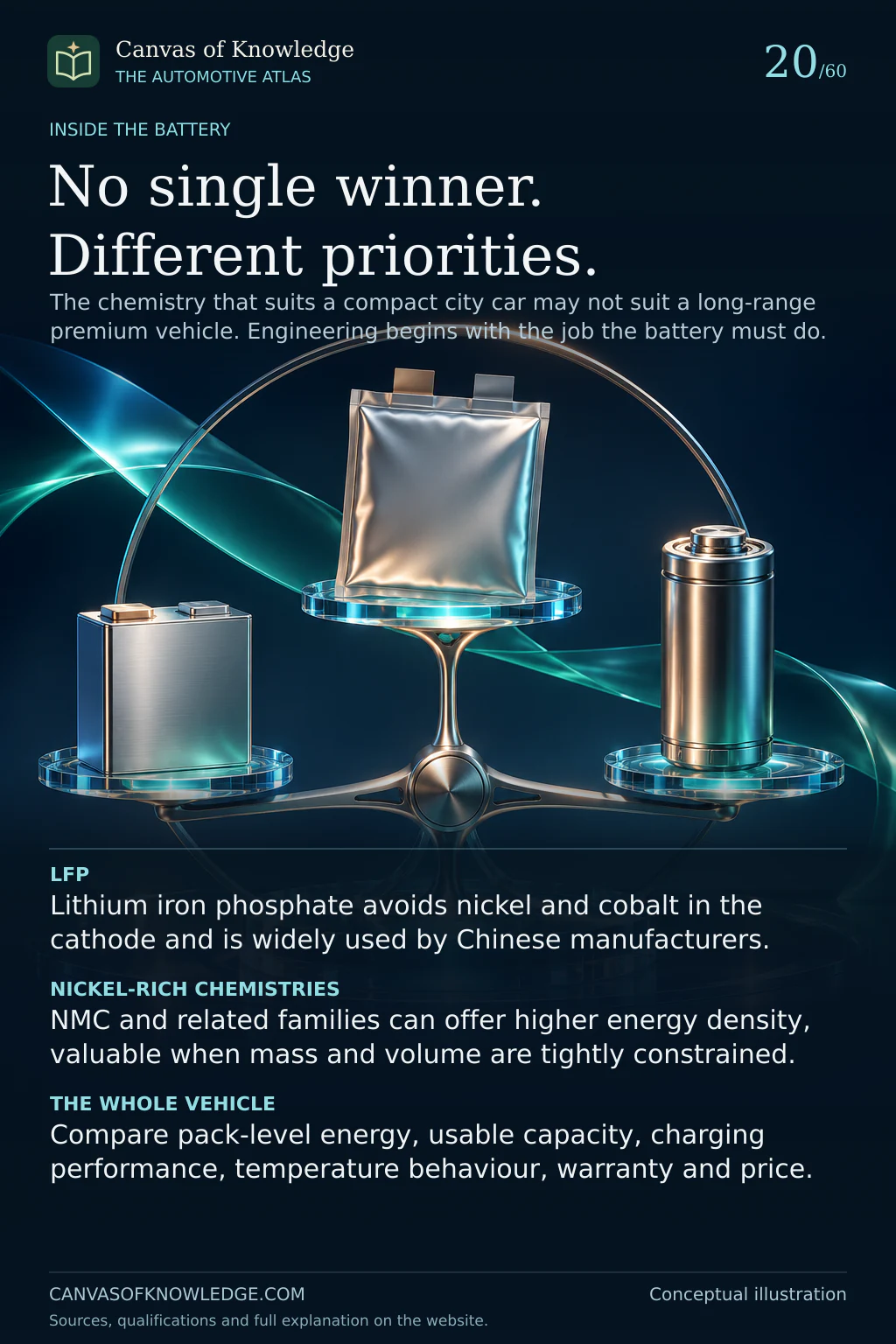 View full infographic +
The chemistry that suits a compact city car may not suit a long-range premium vehicle. Engineering begins with the job the battery must do.
Explore the technology & sources →Voltage, power, swapping and the conditions behind the headline.
 View full infographic +
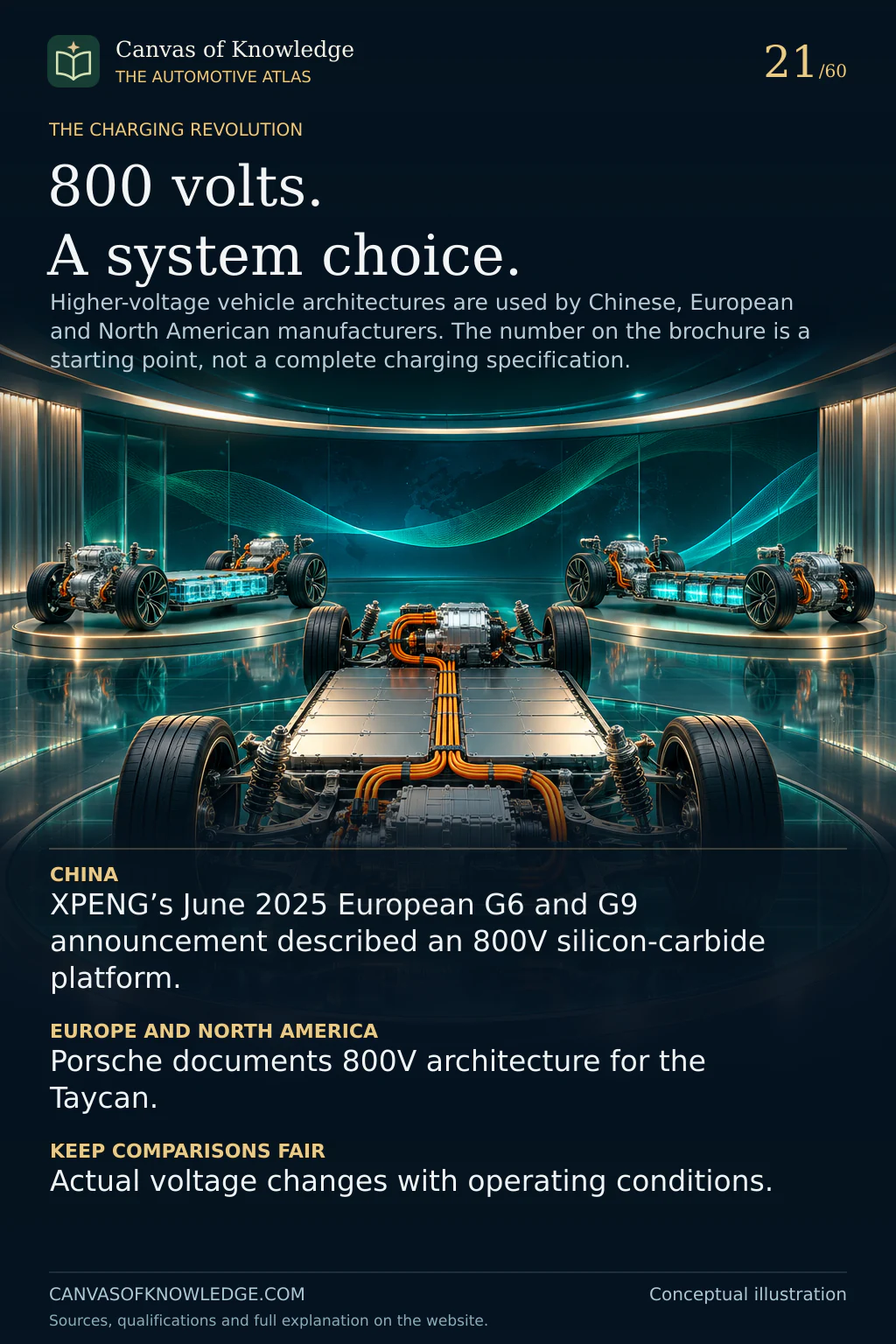
Higher-voltage vehicle architectures are used by Chinese, European and North American manufacturers. The number on the brochure is a starting point, not a complete charging specification.
Explore the technology & sources →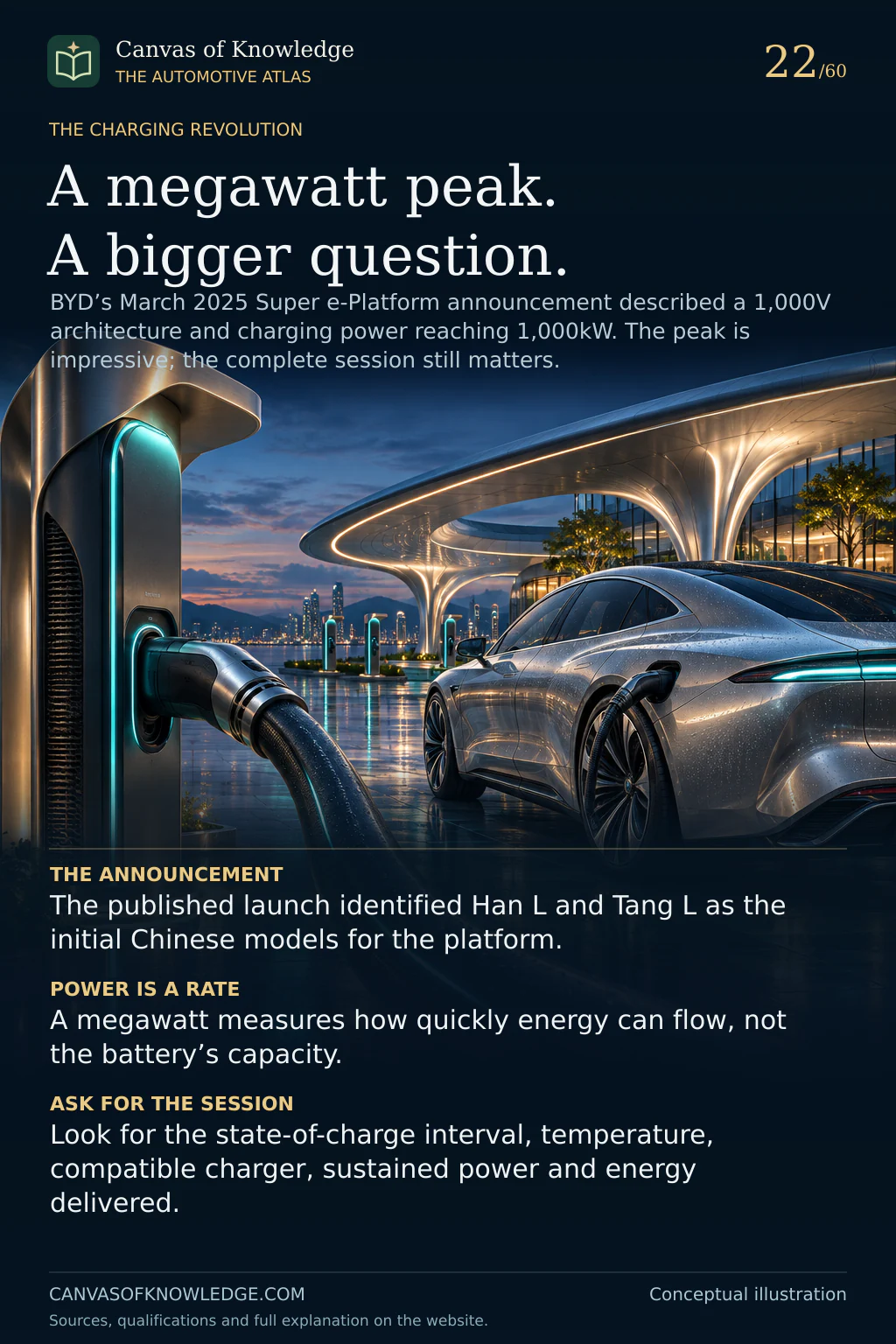 View full infographic +
BYD’s March 2025 Super e-Platform announcement described a 1,000V architecture and charging power reaching 1,000kW. The peak is impressive; the complete session still matters.
Explore the technology & sources →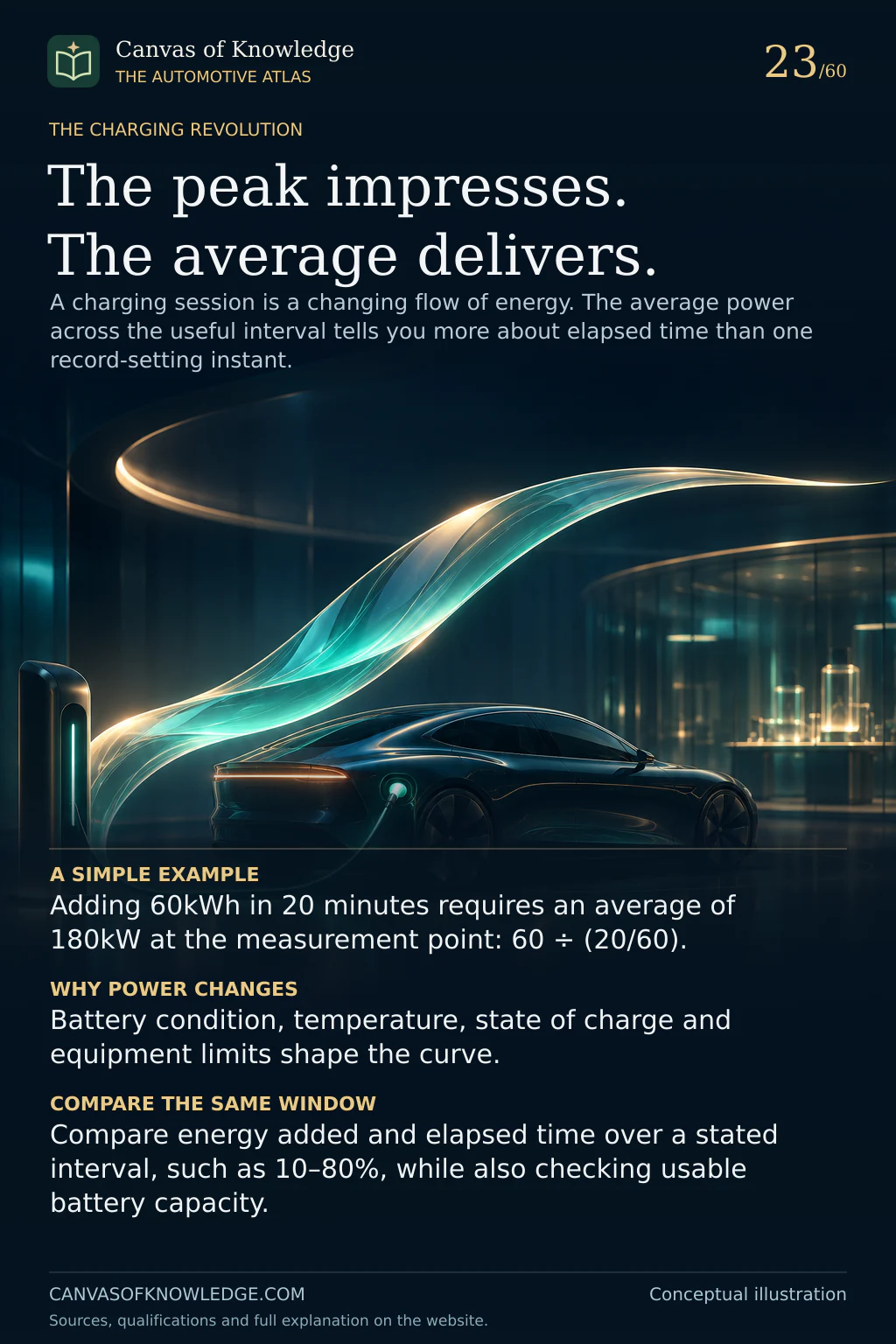 View full infographic +
A charging session is a changing flow of energy. The average power across the useful interval tells you more about elapsed time than one record-setting instant.
Explore the technology & sources →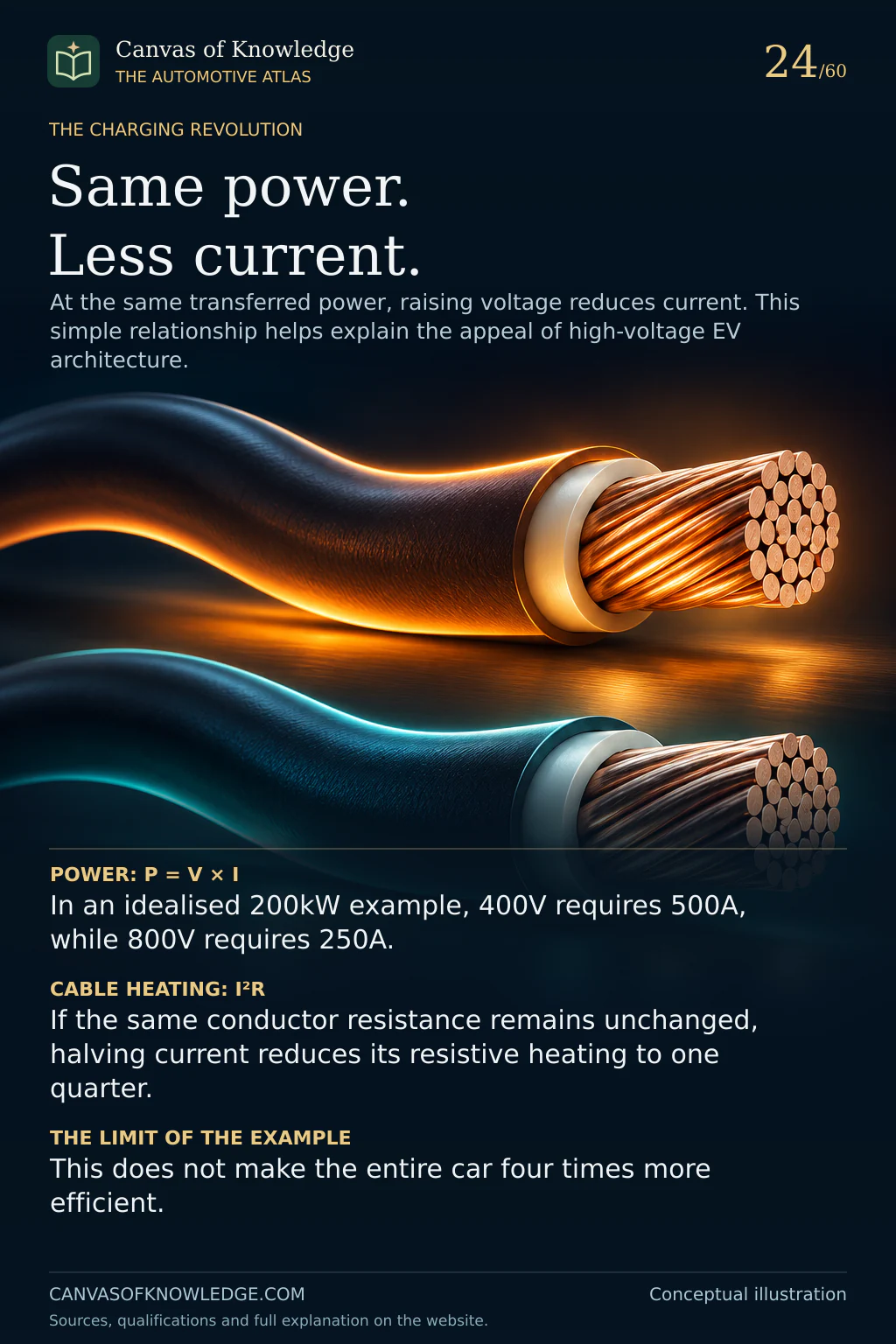 View full infographic +
At the same transferred power, raising voltage reduces current. This simple relationship helps explain the appeal of high-voltage EV architecture.
Explore the technology & sources →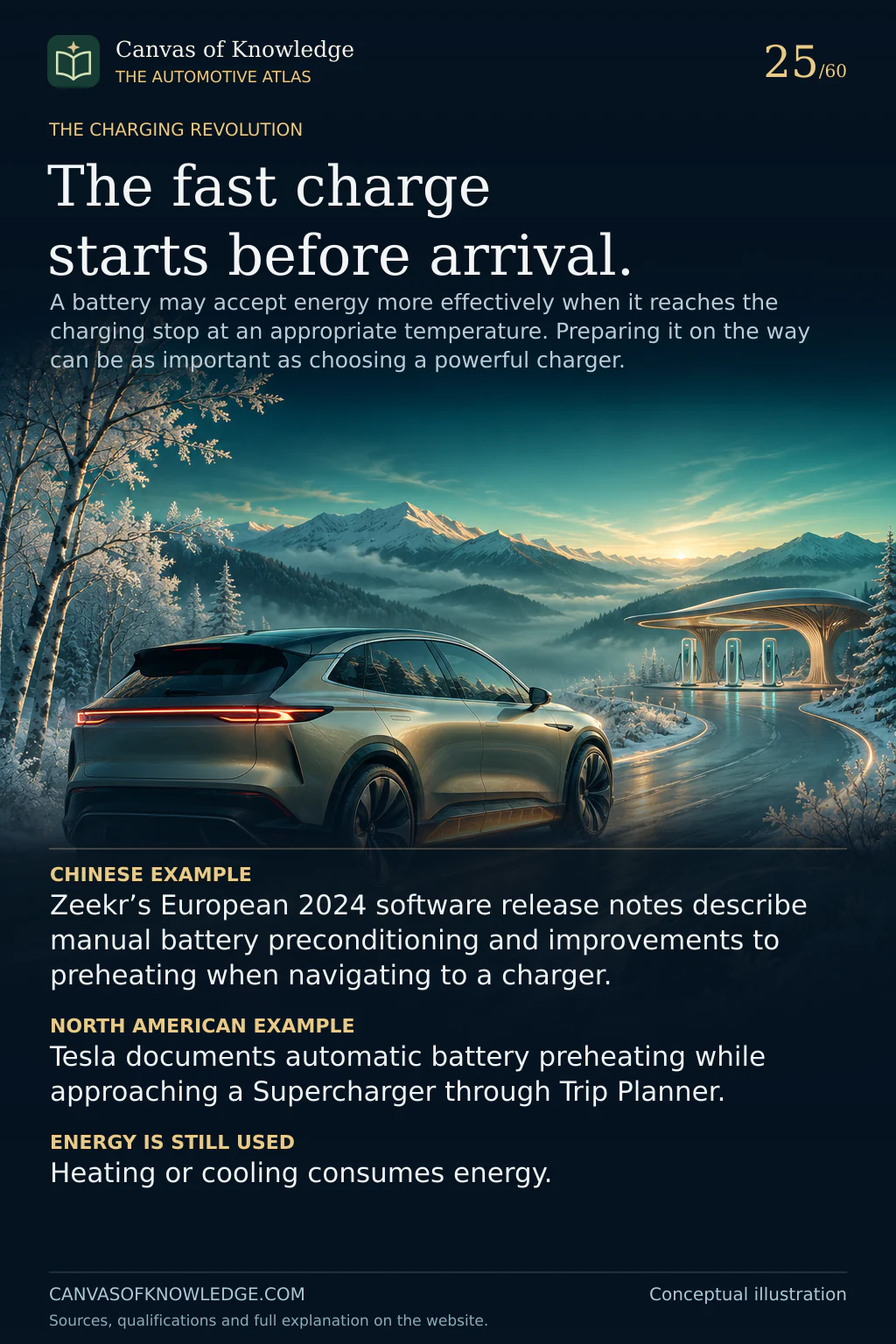 View full infographic +
A battery may accept energy more effectively when it reaches the charging stop at an appropriate temperature. Preparing it on the way can be as important as choosing a powerful charger.
Explore the technology & sources →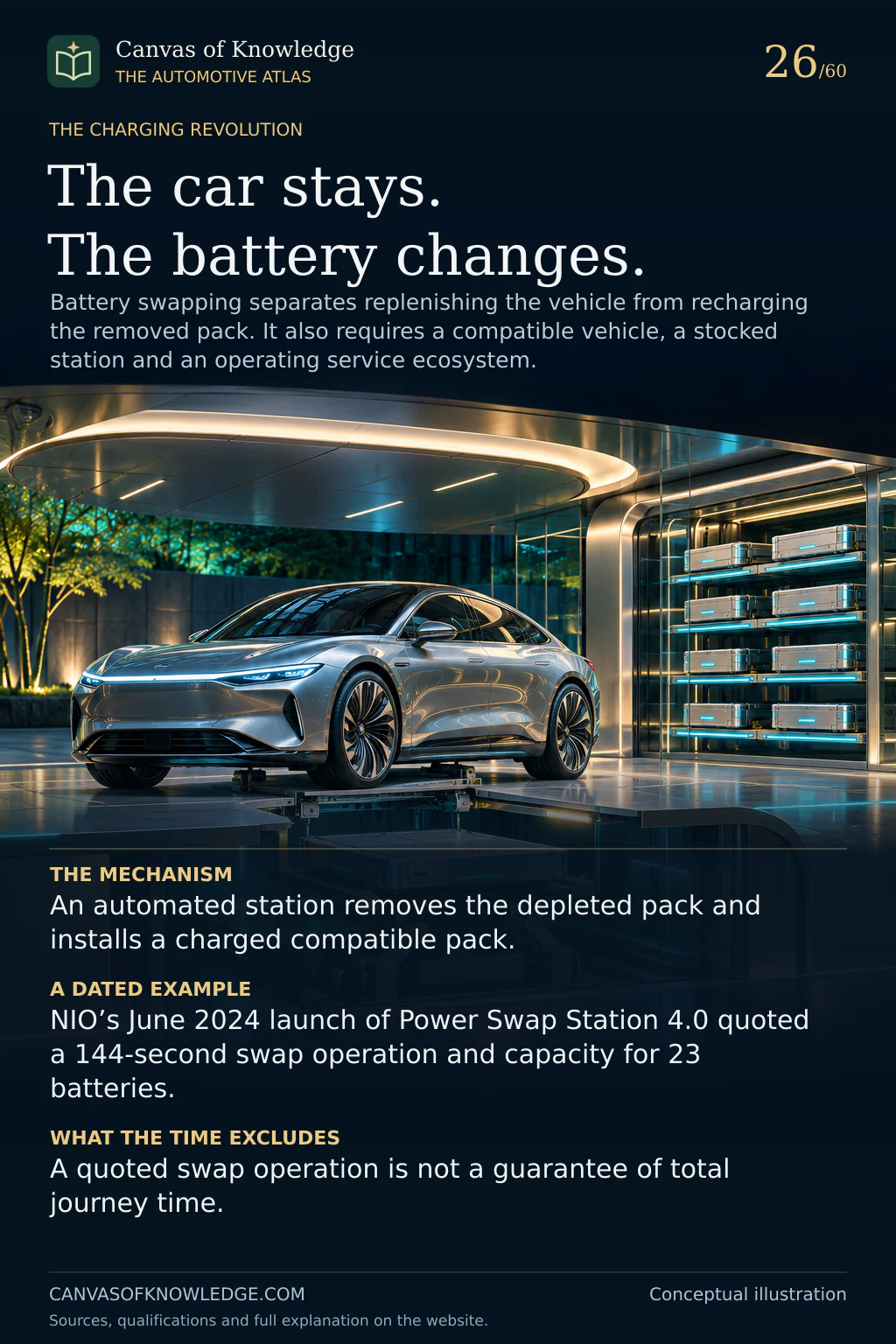 View full infographic +
Battery swapping separates replenishing the vehicle from recharging the removed pack. It also requires a compatible vehicle, a stocked station and an operating service ecosystem.
Explore the technology & sources →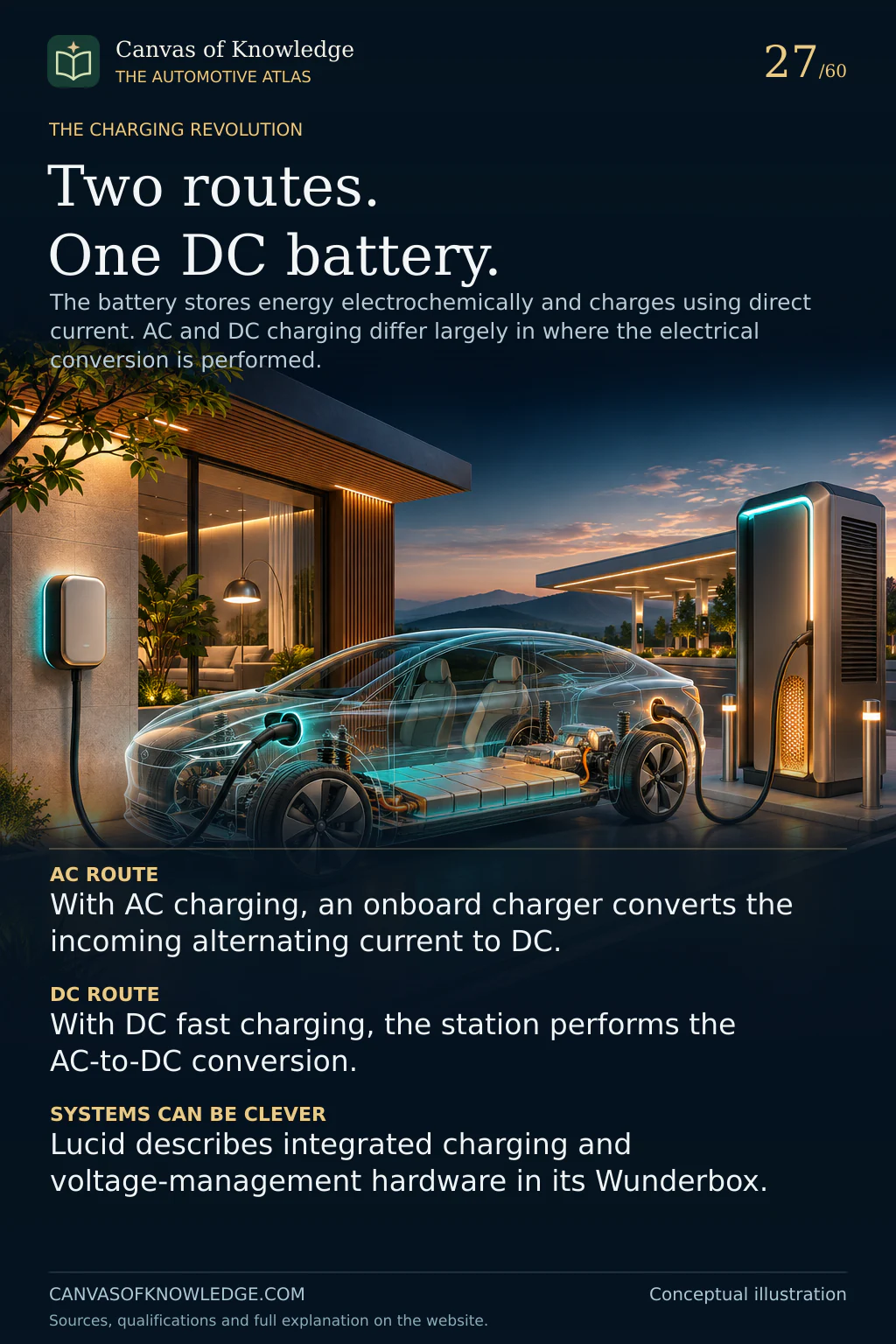 View full infographic +
The battery stores energy electrochemically and charges using direct current. AC and DC charging differ largely in where the electrical conversion is performed.
Explore the technology & sources →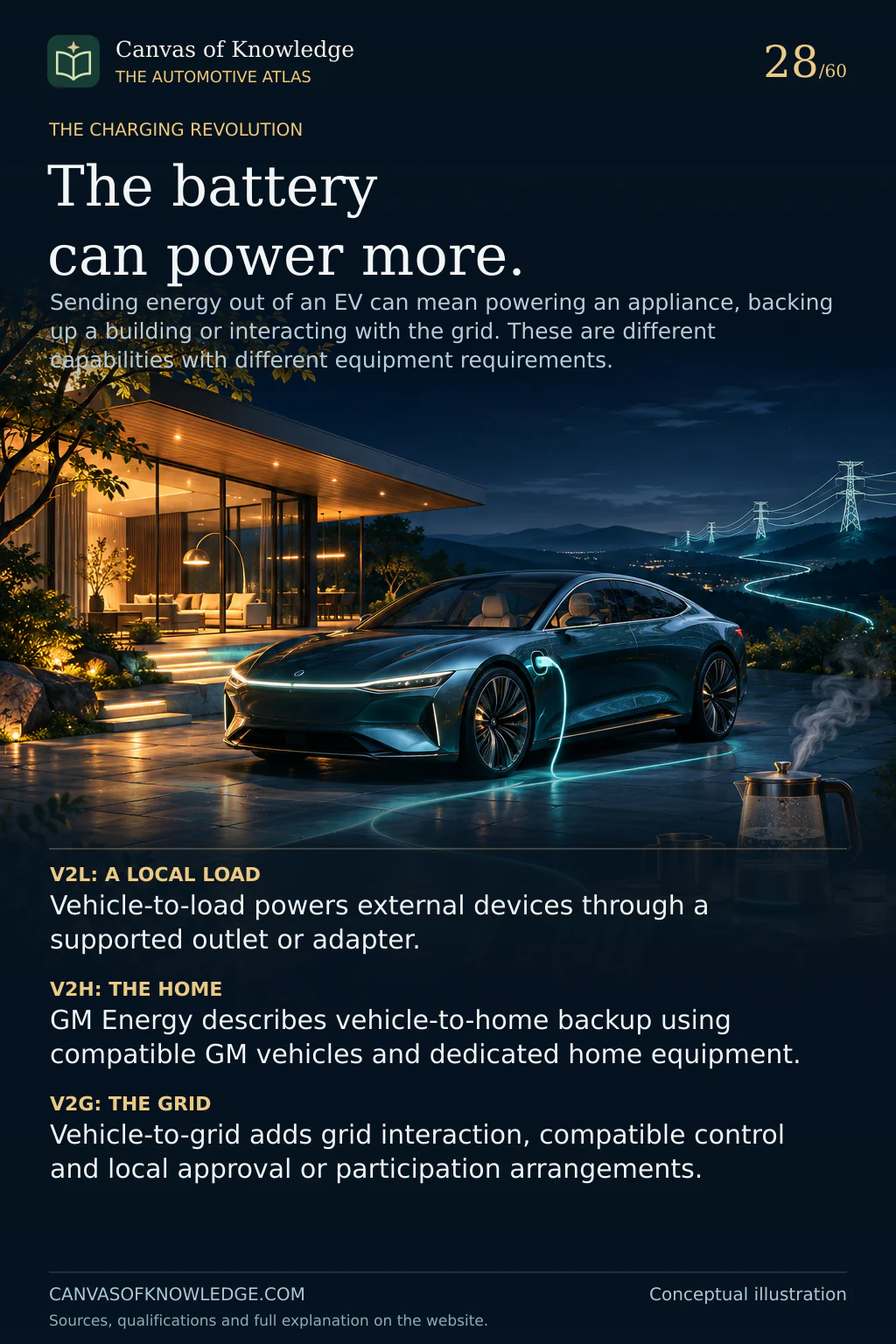 View full infographic +
Sending energy out of an EV can mean powering an appliance, backing up a building or interacting with the grid. These are different capabilities with different equipment requirements.
Explore the technology & sources →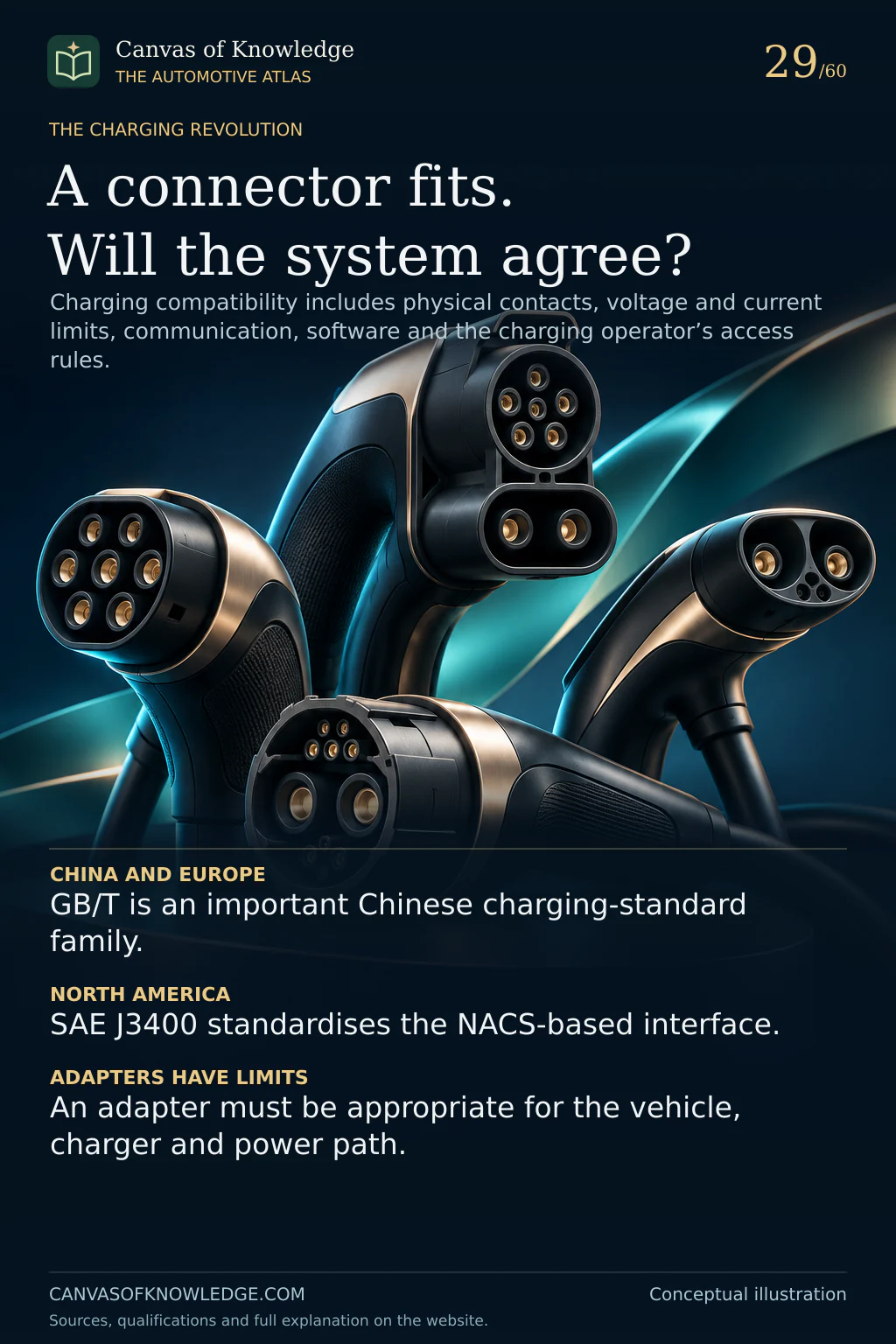 View full infographic +
Charging compatibility includes physical contacts, voltage and current limits, communication, software and the charging operator’s access rules.
Explore the technology & sources →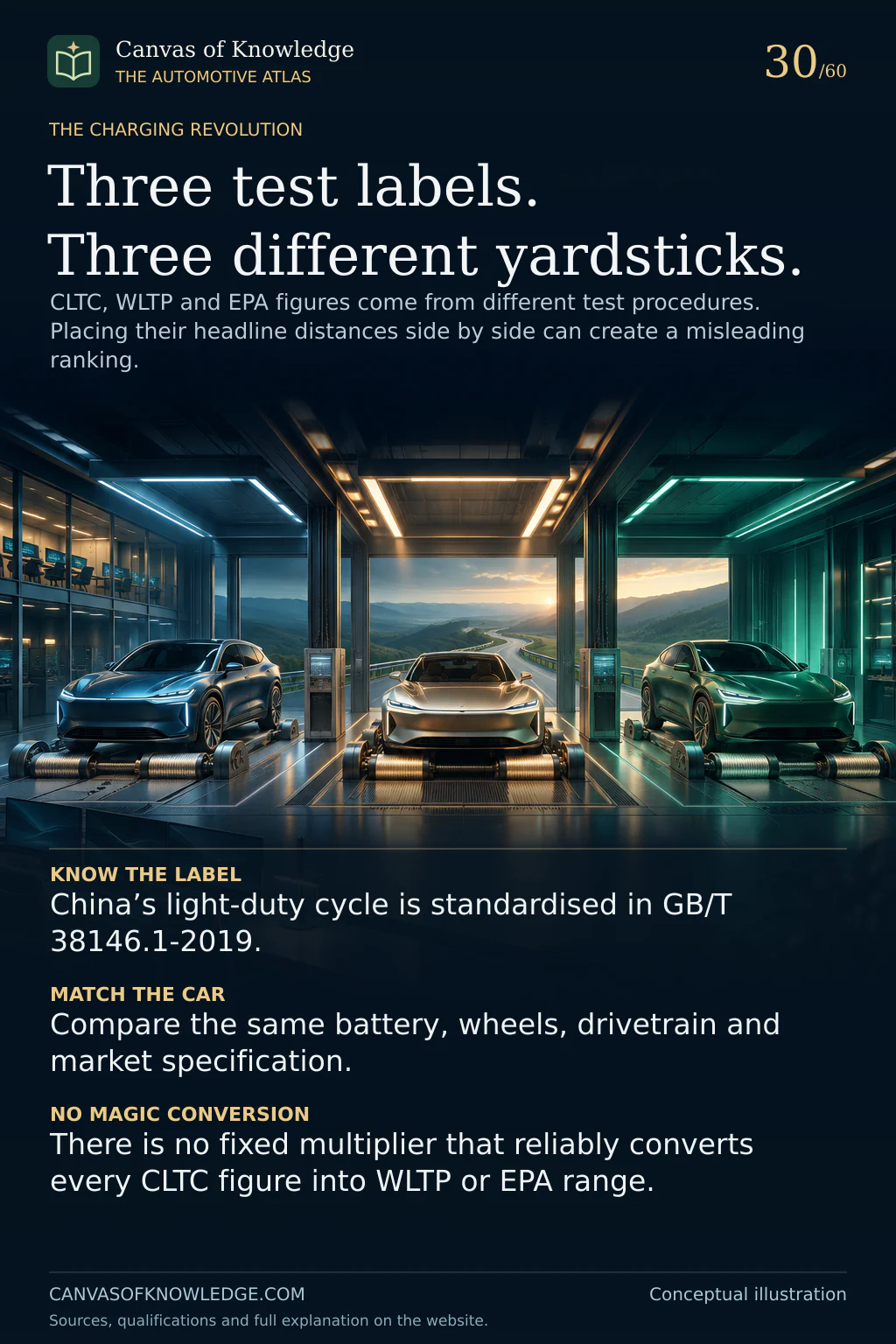 View full infographic +
CLTC, WLTP and EPA figures come from different test procedures. Placing their headline distances side by side can create a misleading ranking.
Explore the technology & sources →Motors, power electronics, chassis control and manufacturing.
 View full infographic +
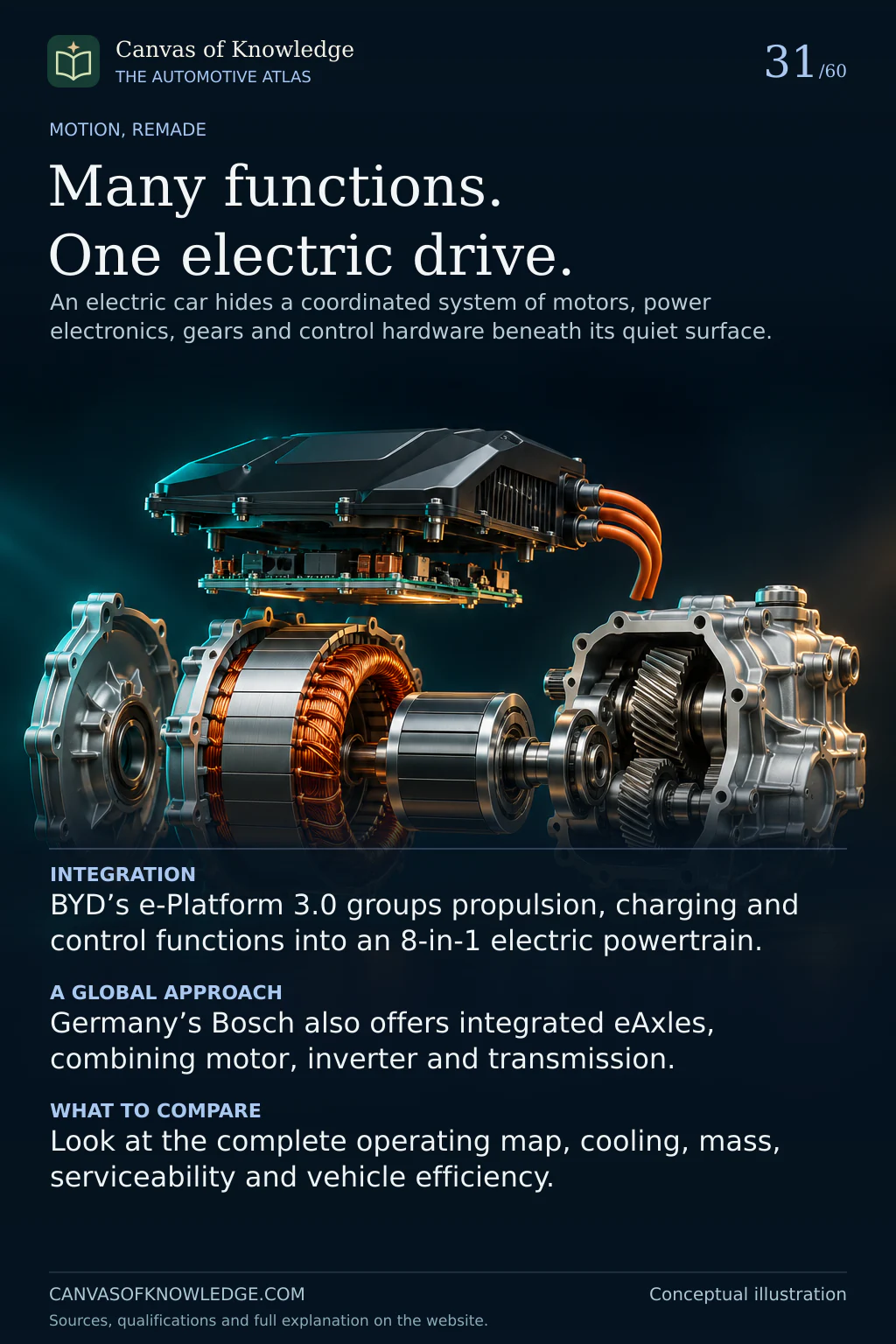
An electric car hides a coordinated system of motors, power electronics, gears and control hardware beneath its quiet surface.
Explore the technology & sources →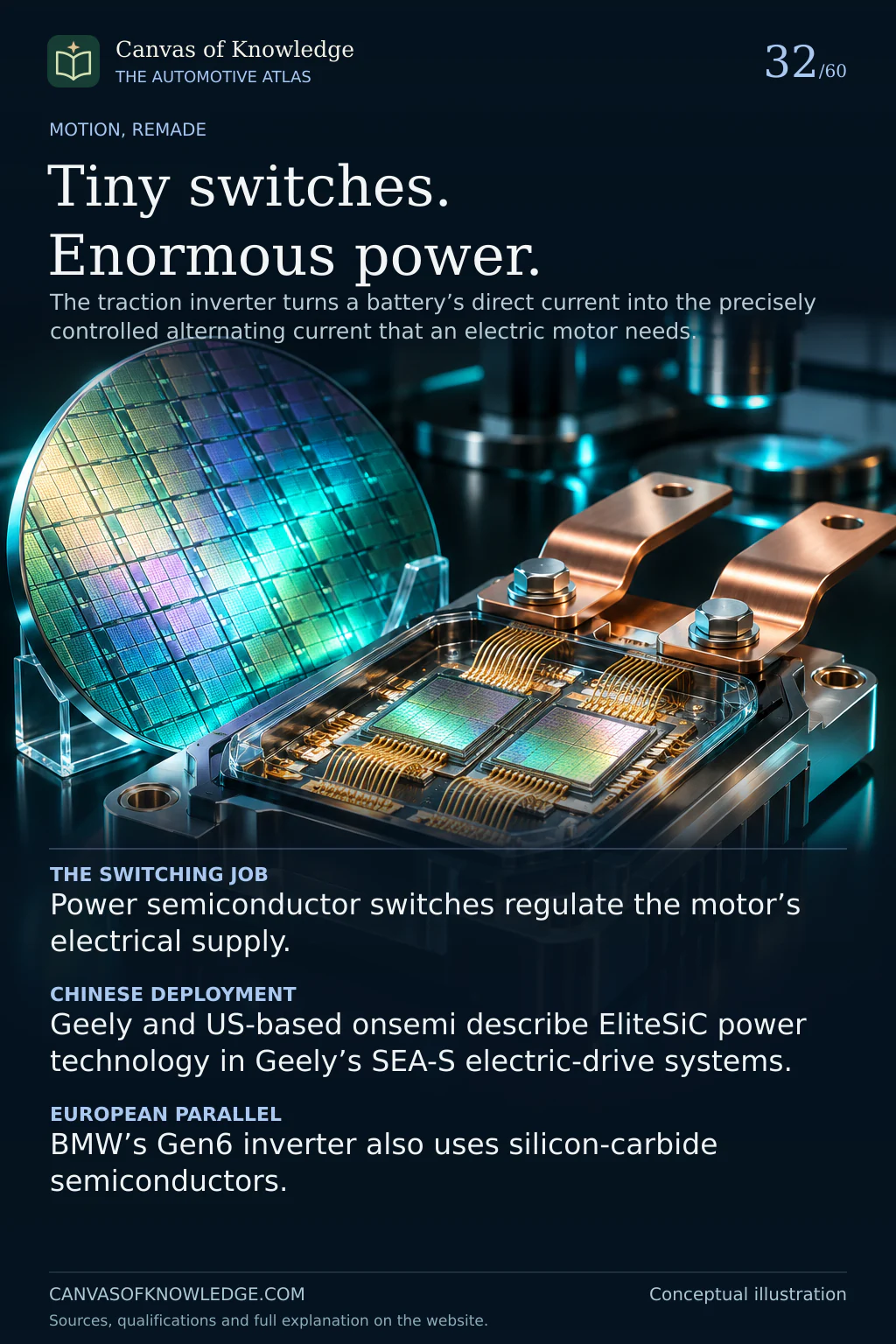 View full infographic +
The traction inverter turns a battery’s direct current into the precisely controlled alternating current that an electric motor needs.
Explore the technology & sources →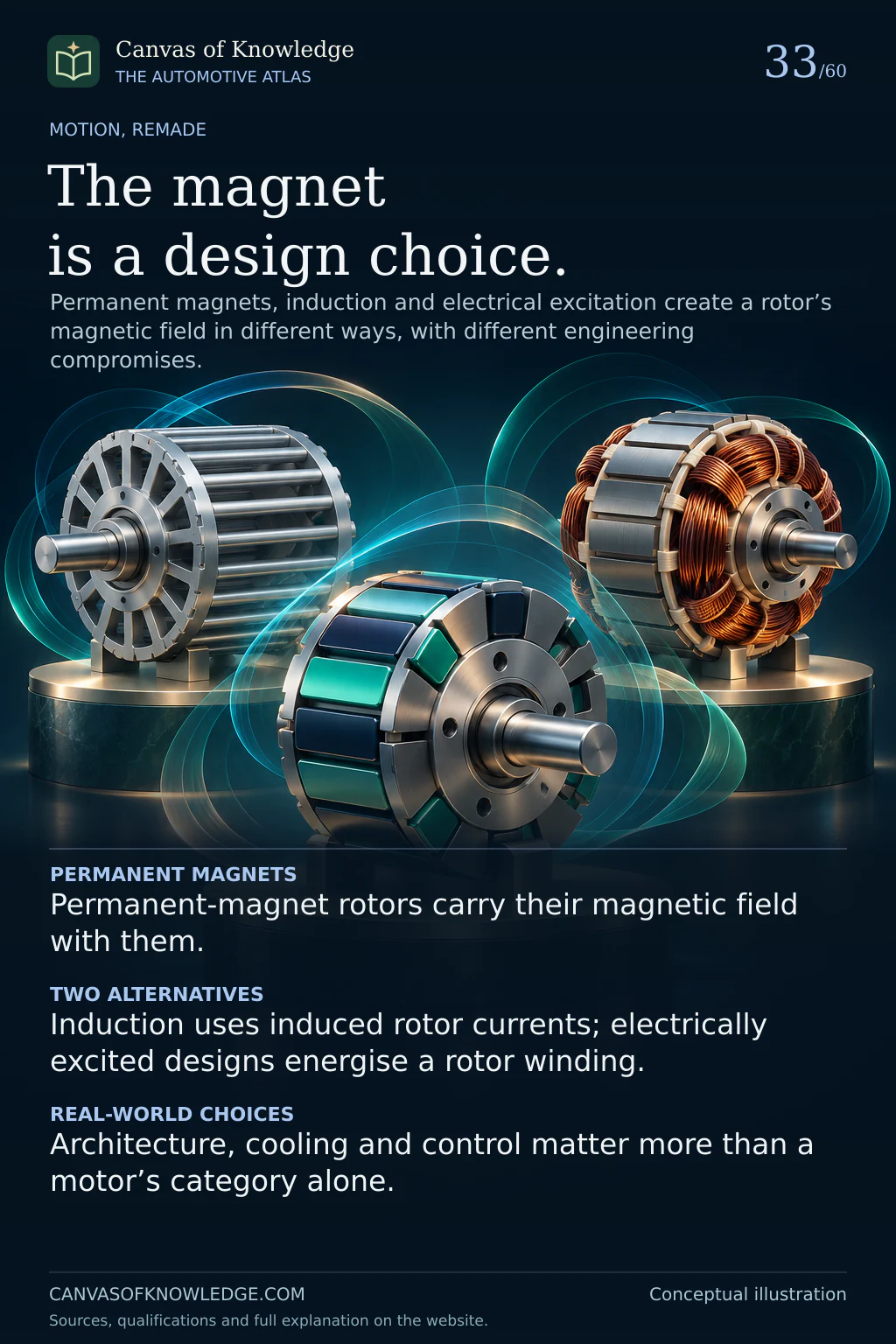 View full infographic +
Permanent magnets, induction and electrical excitation create a rotor’s magnetic field in different ways, with different engineering compromises.
Explore the technology & sources →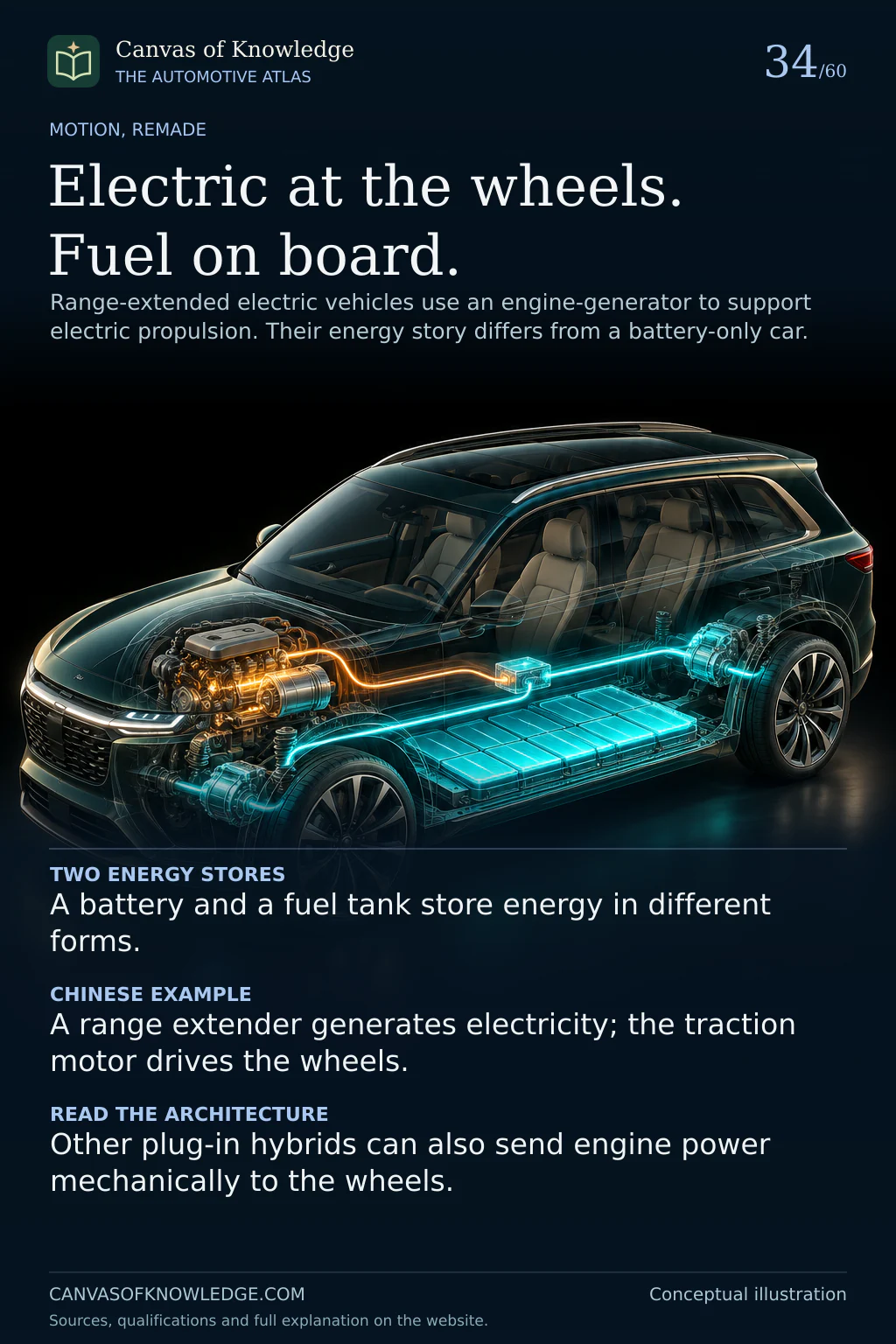 View full infographic +
Range-extended electric vehicles use an engine-generator to support electric propulsion. Their energy story differs from a battery-only car.
Explore the technology & sources →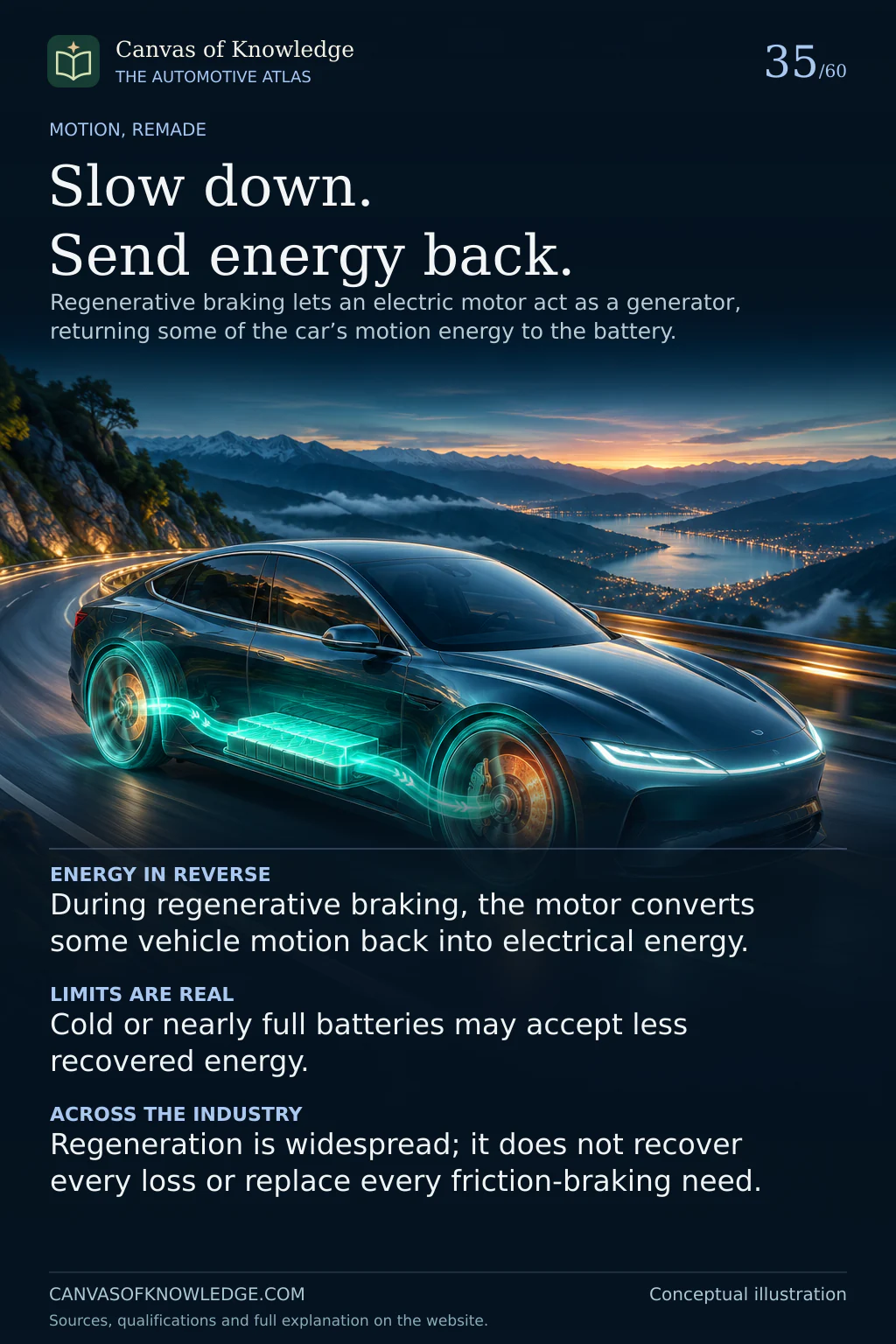 View full infographic +
Regenerative braking lets an electric motor act as a generator, returning some of the car’s motion energy to the battery.
Explore the technology & sources →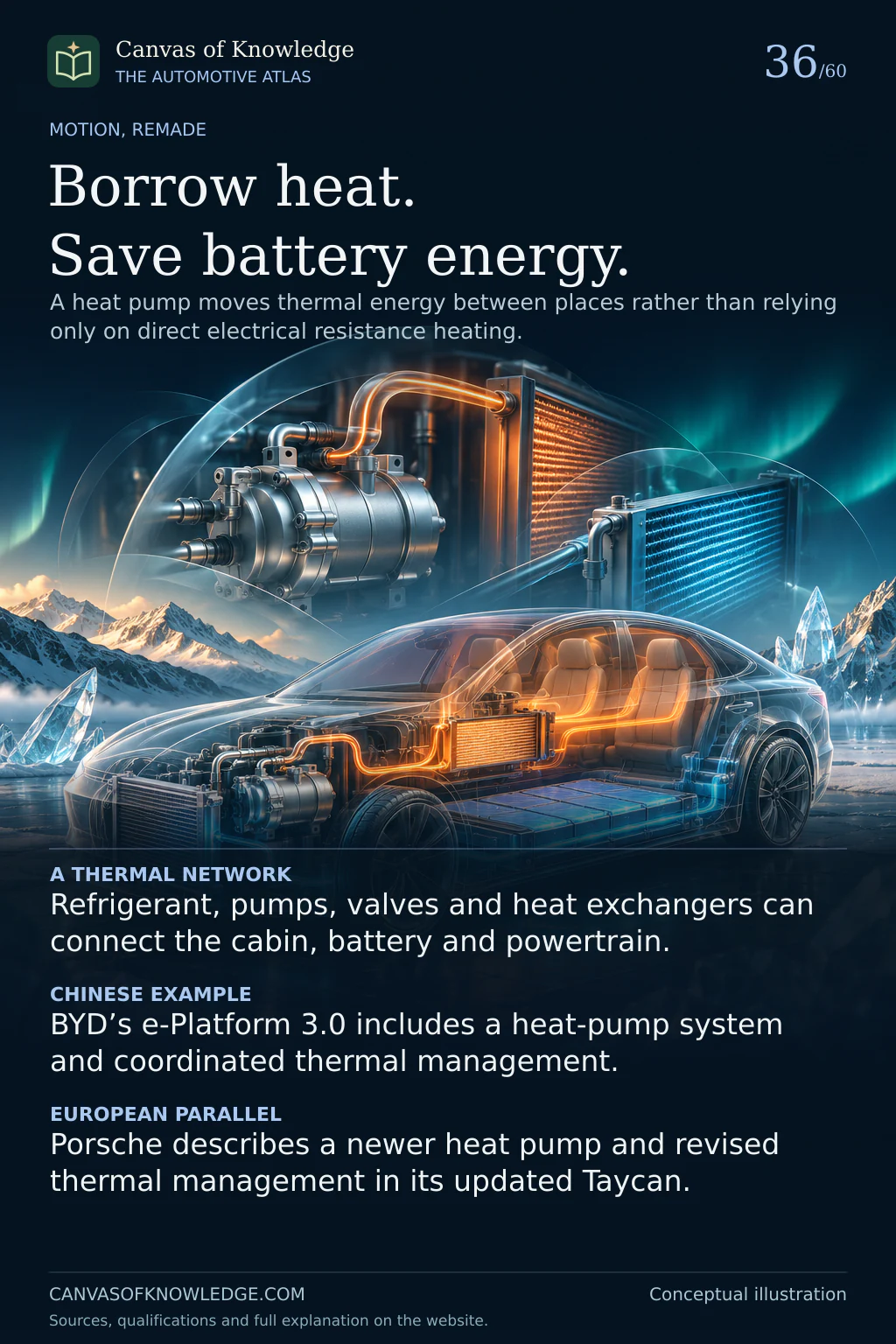 View full infographic +
A heat pump moves thermal energy between places rather than relying only on direct electrical resistance heating.
Explore the technology & sources →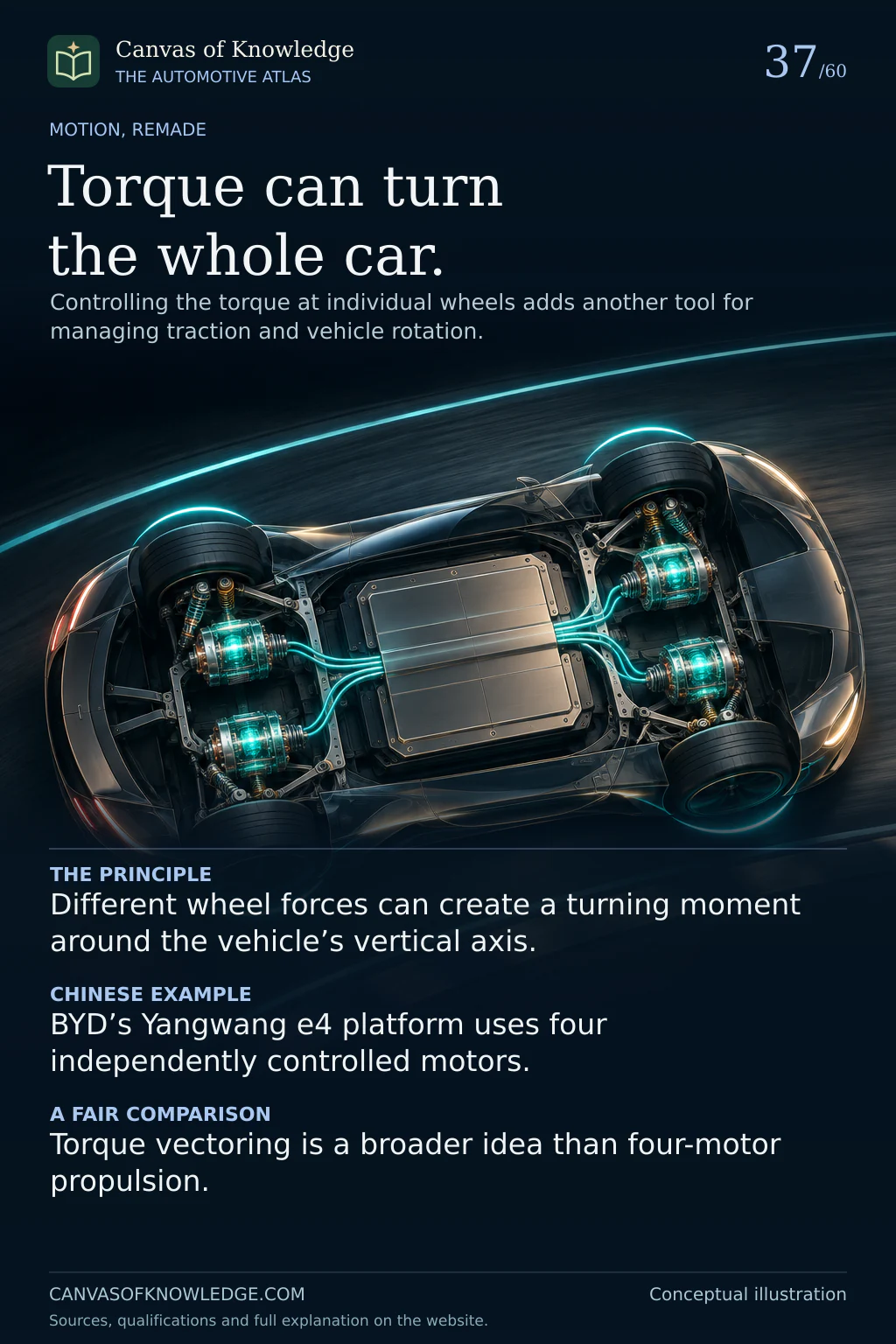 View full infographic +
Controlling the torque at individual wheels adds another tool for managing traction and vehicle rotation.
Explore the technology & sources →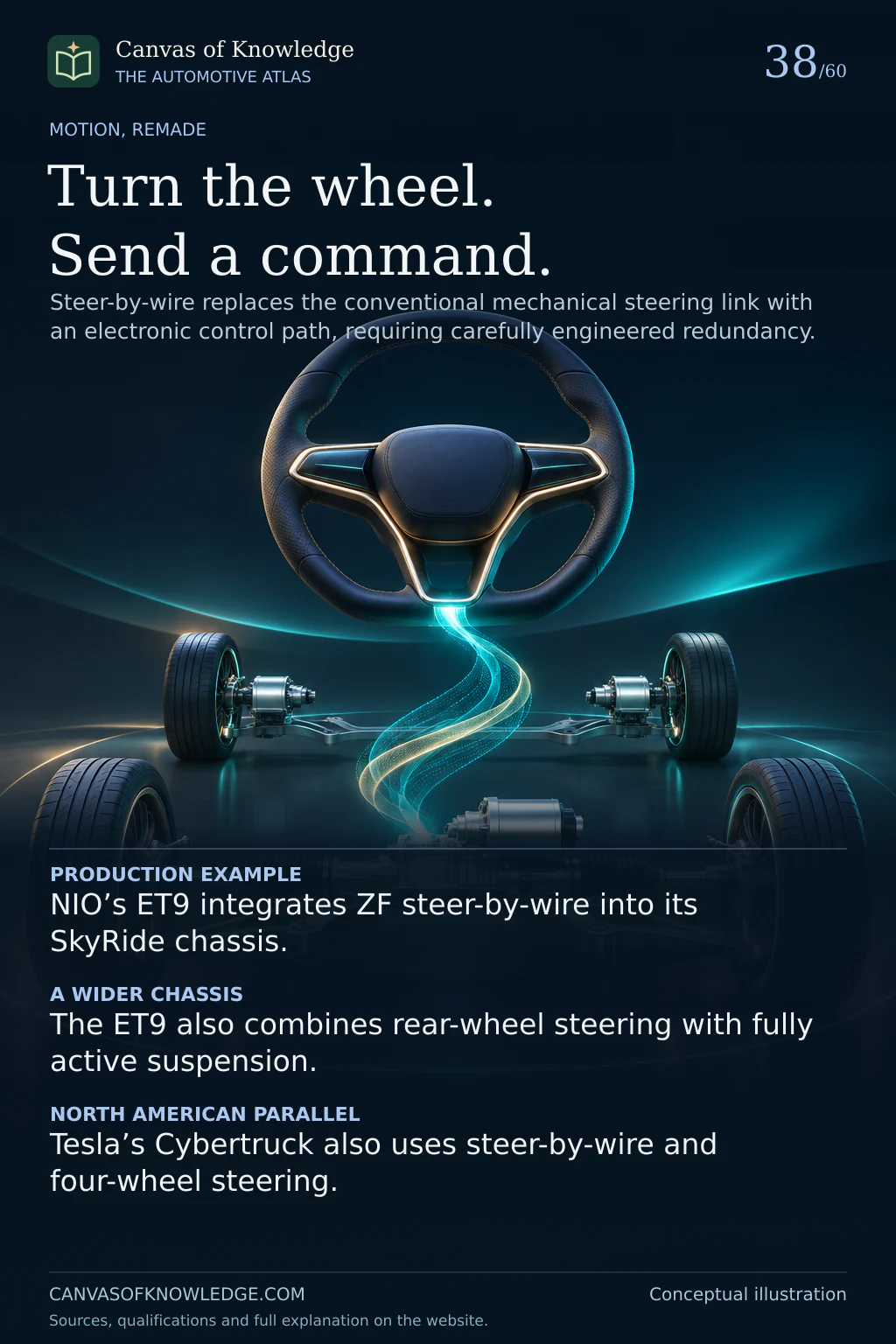 View full infographic +
Steer-by-wire replaces the conventional mechanical steering link with an electronic control path, requiring carefully engineered redundancy.
Explore the technology & sources →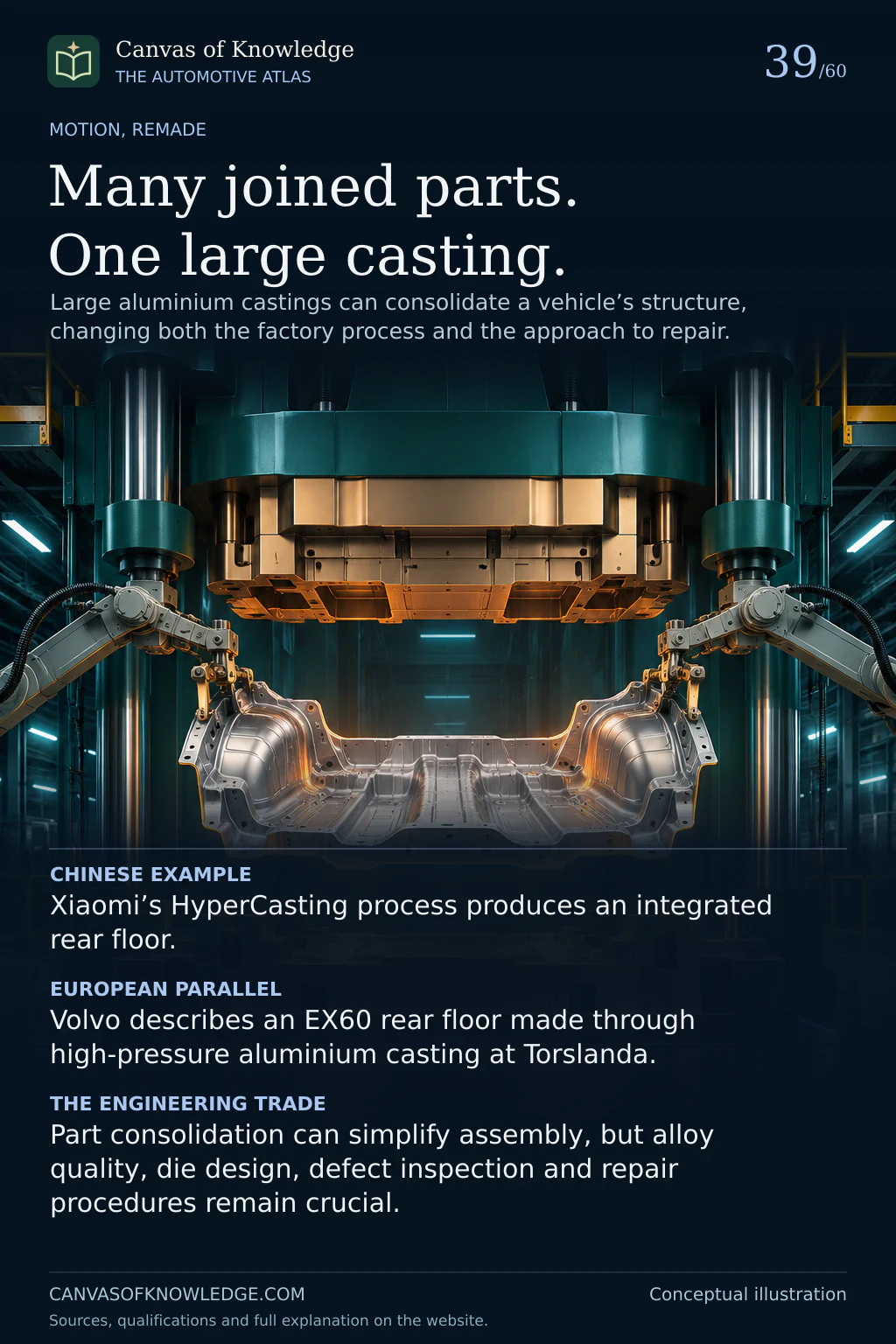 View full infographic +
Large aluminium castings can consolidate a vehicle’s structure, changing both the factory process and the approach to repair.
Explore the technology & sources →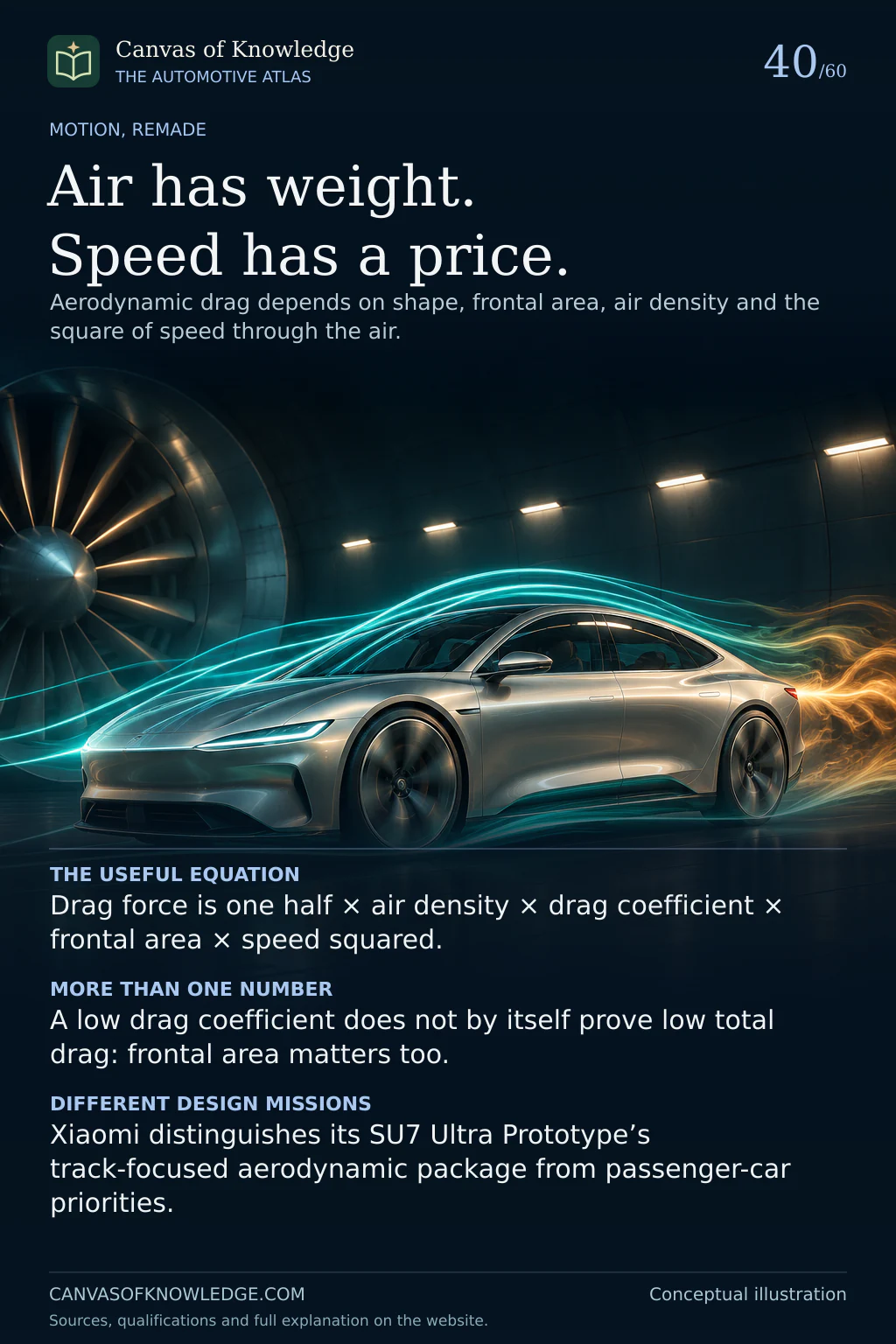 View full infographic +
Aerodynamic drag depends on shape, frontal area, air density and the square of speed through the air.
Explore the technology & sources →Perception, software, computing and human responsibility.
 View full infographic +
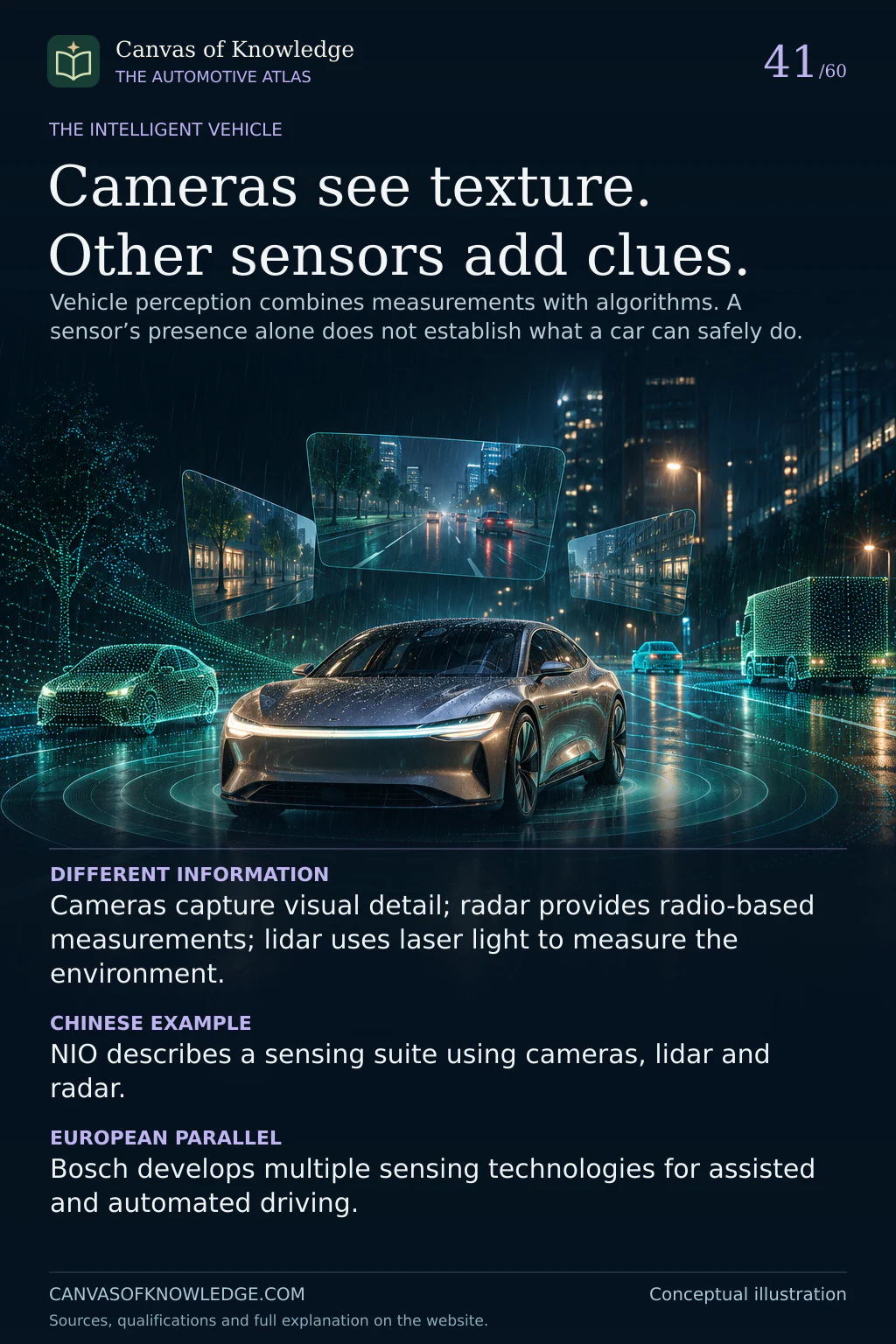
Vehicle perception combines measurements with algorithms. A sensor’s presence alone does not establish what a car can safely do.
Explore the technology & sources →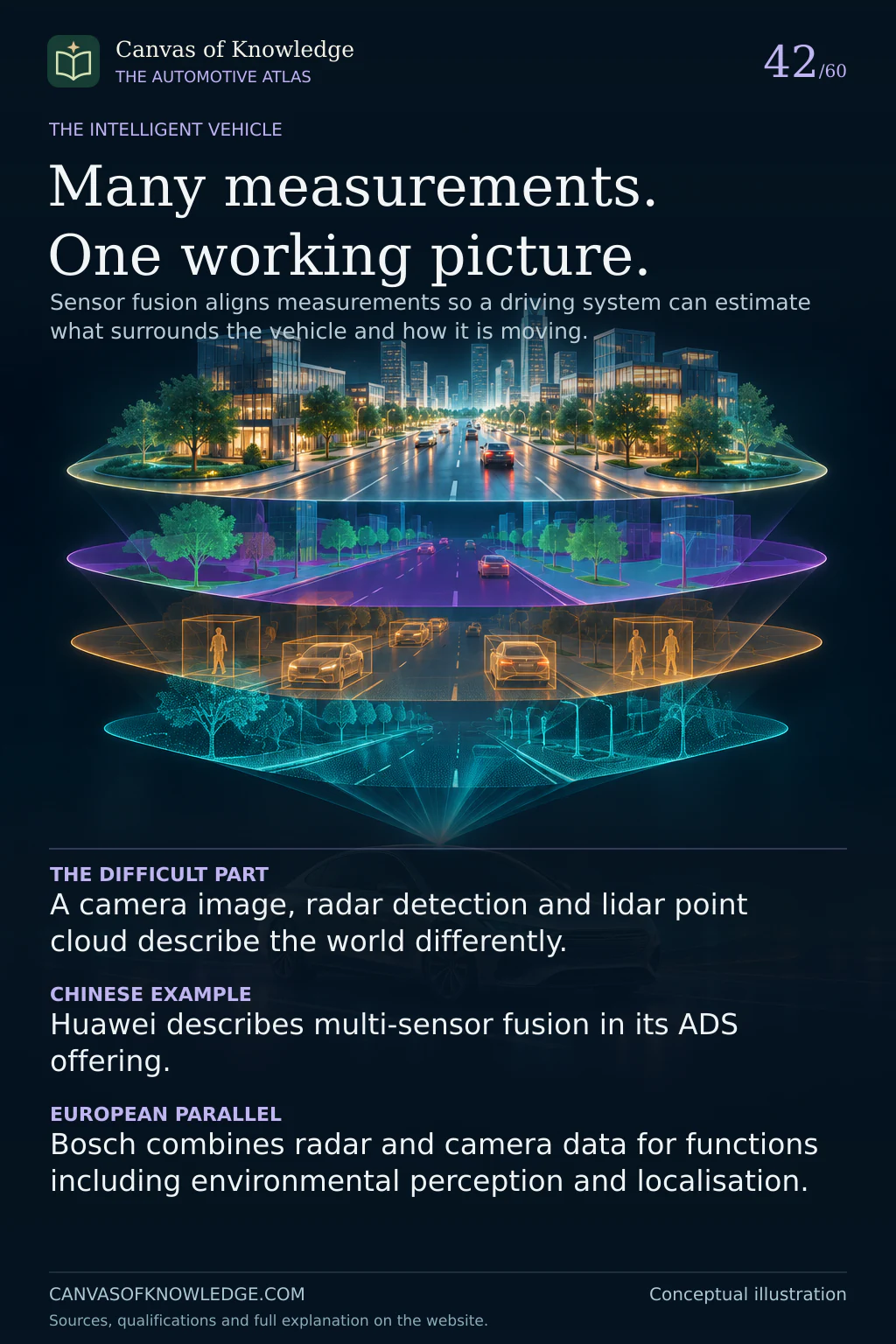 View full infographic +
Sensor fusion aligns measurements so a driving system can estimate what surrounds the vehicle and how it is moving.
Explore the technology & sources →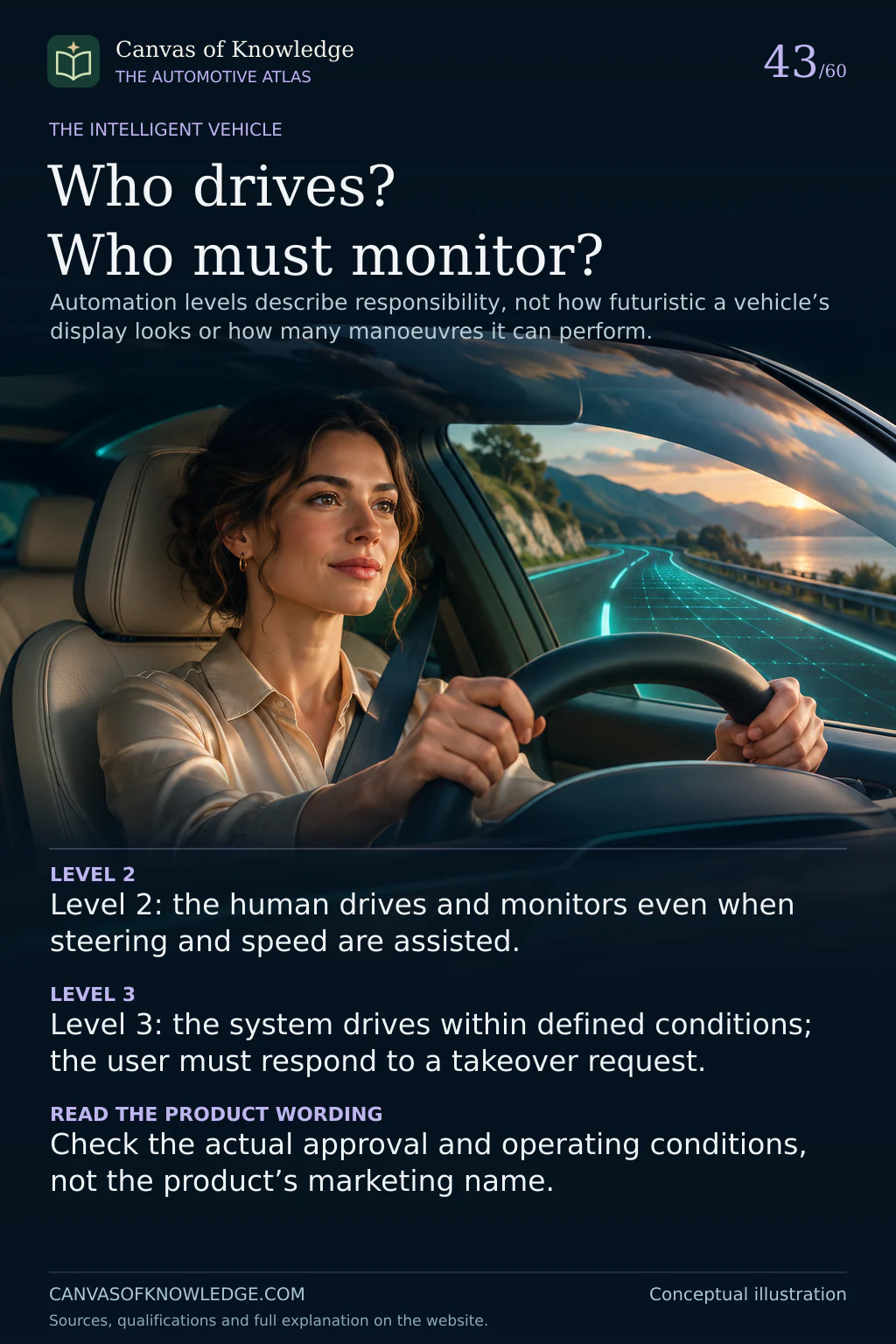 View full infographic +
Automation levels describe responsibility, not how futuristic a vehicle’s display looks or how many manoeuvres it can perform.
Explore the technology & sources →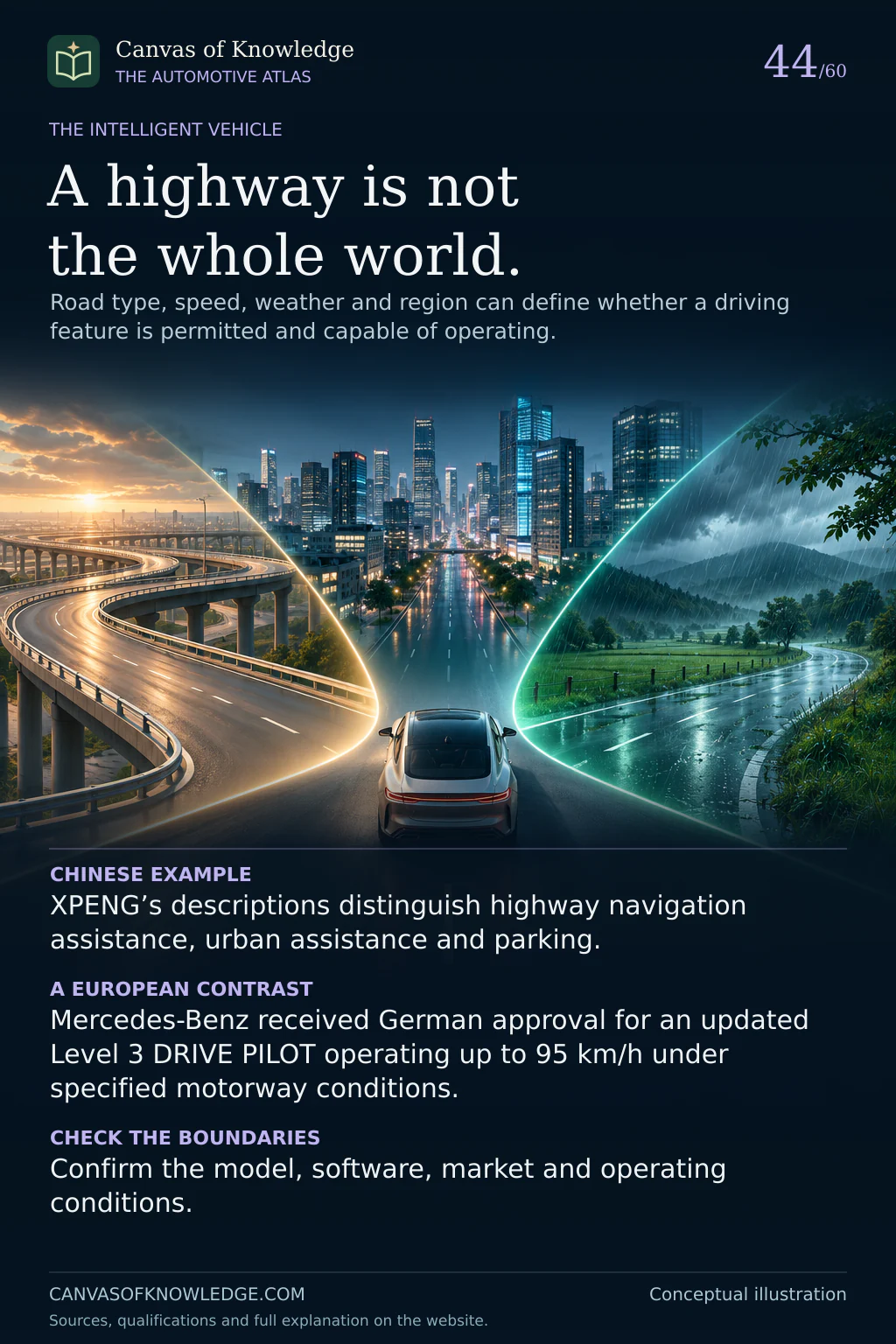 View full infographic +
Road type, speed, weather and region can define whether a driving feature is permitted and capable of operating.
Explore the technology & sources →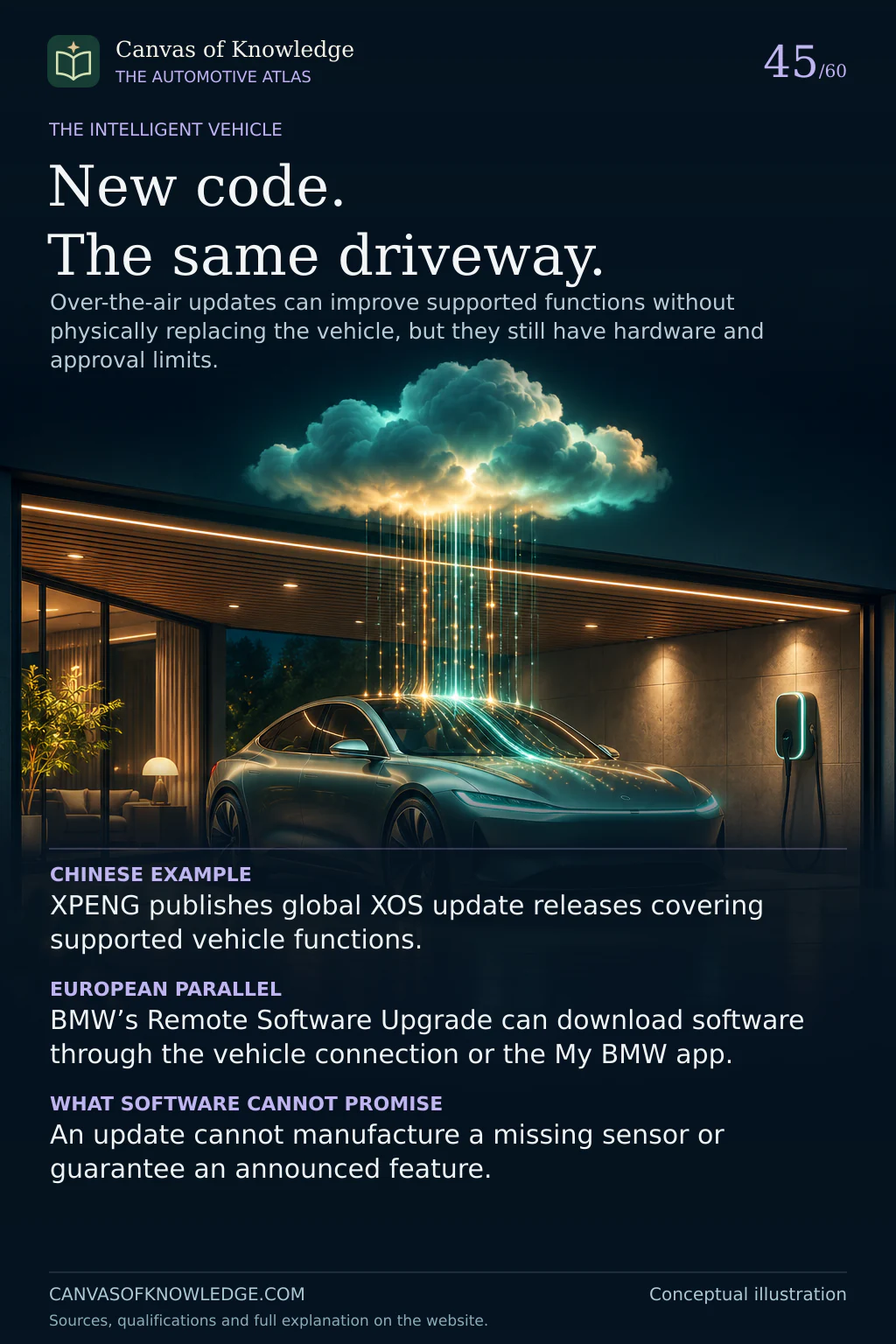 View full infographic +
Over-the-air updates can improve supported functions without physically replacing the vehicle, but they still have hardware and approval limits.
Explore the technology & sources →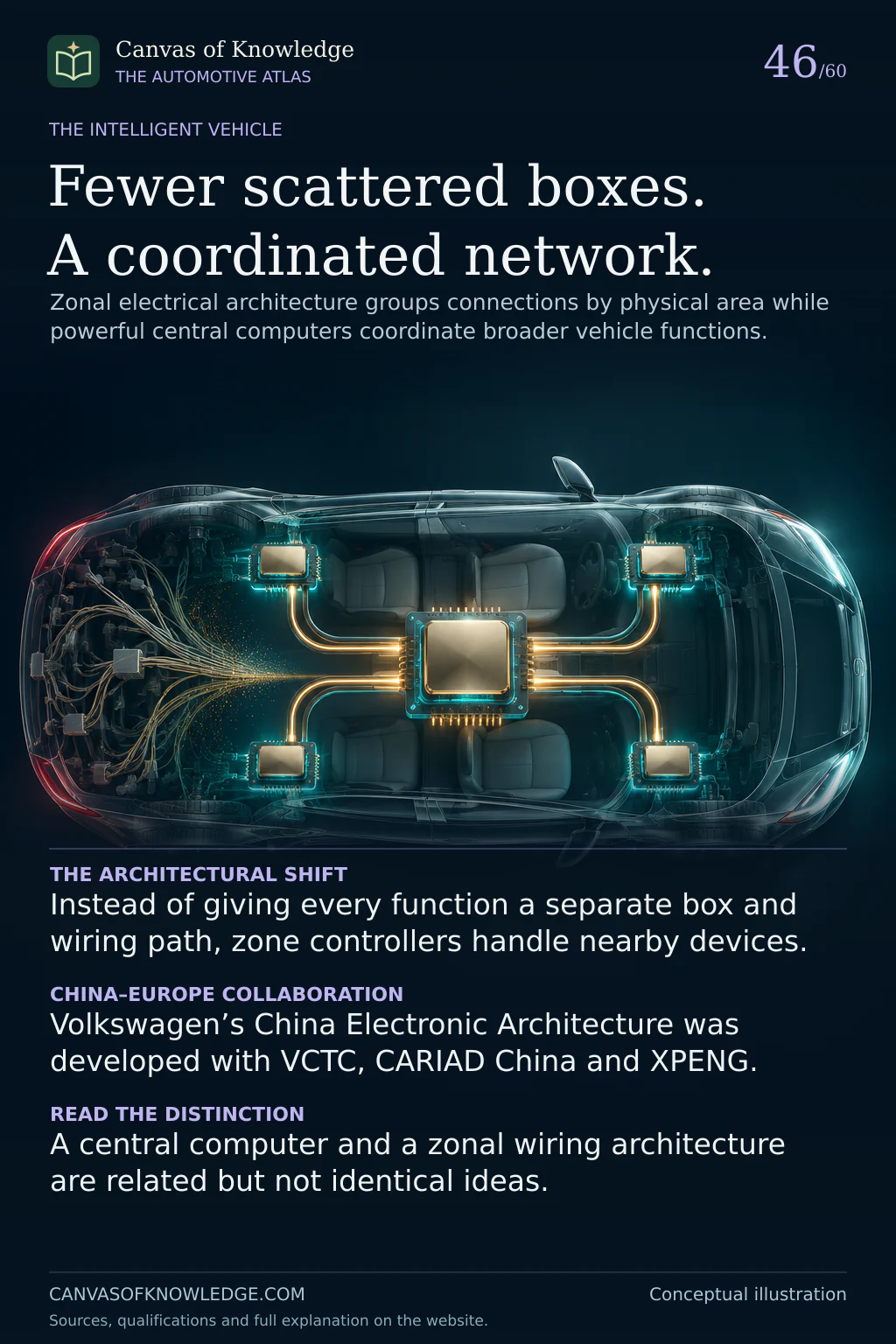 View full infographic +
Zonal electrical architecture groups connections by physical area while powerful central computers coordinate broader vehicle functions.
Explore the technology & sources →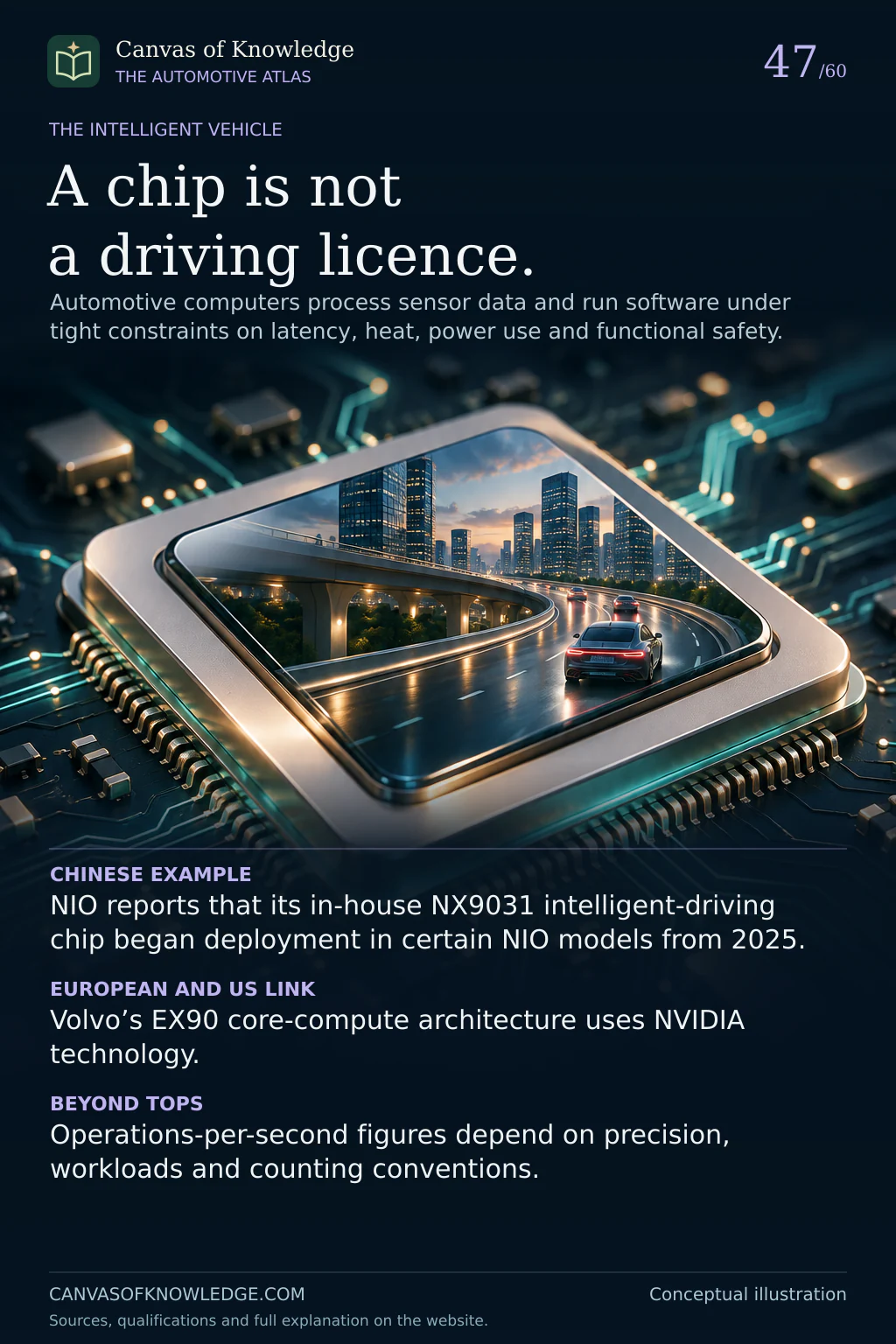 View full infographic +
Automotive computers process sensor data and run software under tight constraints on latency, heat, power use and functional safety.
Explore the technology & sources →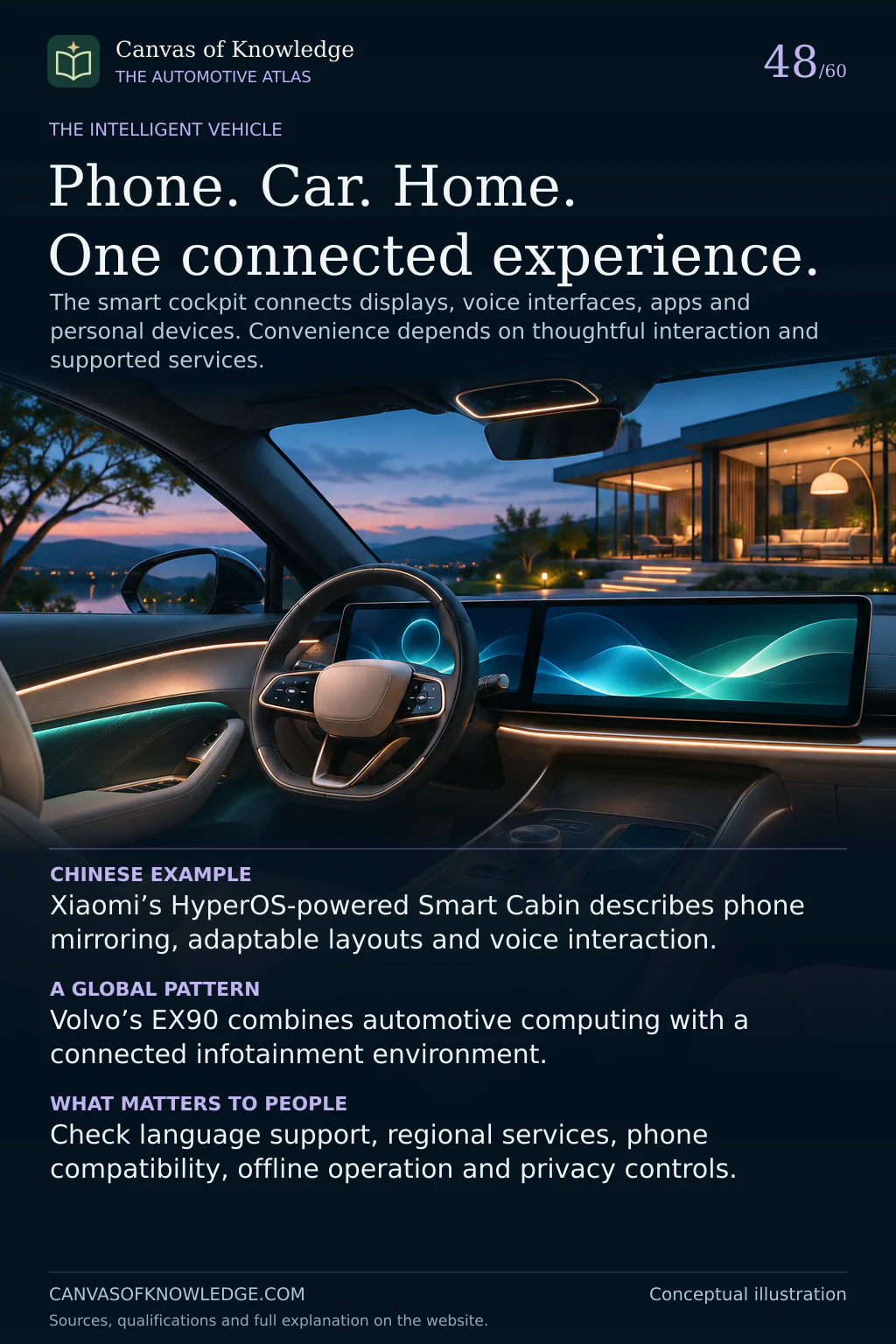 View full infographic +
The smart cockpit connects displays, voice interfaces, apps and personal devices. Convenience depends on thoughtful interaction and supported services.
Explore the technology & sources →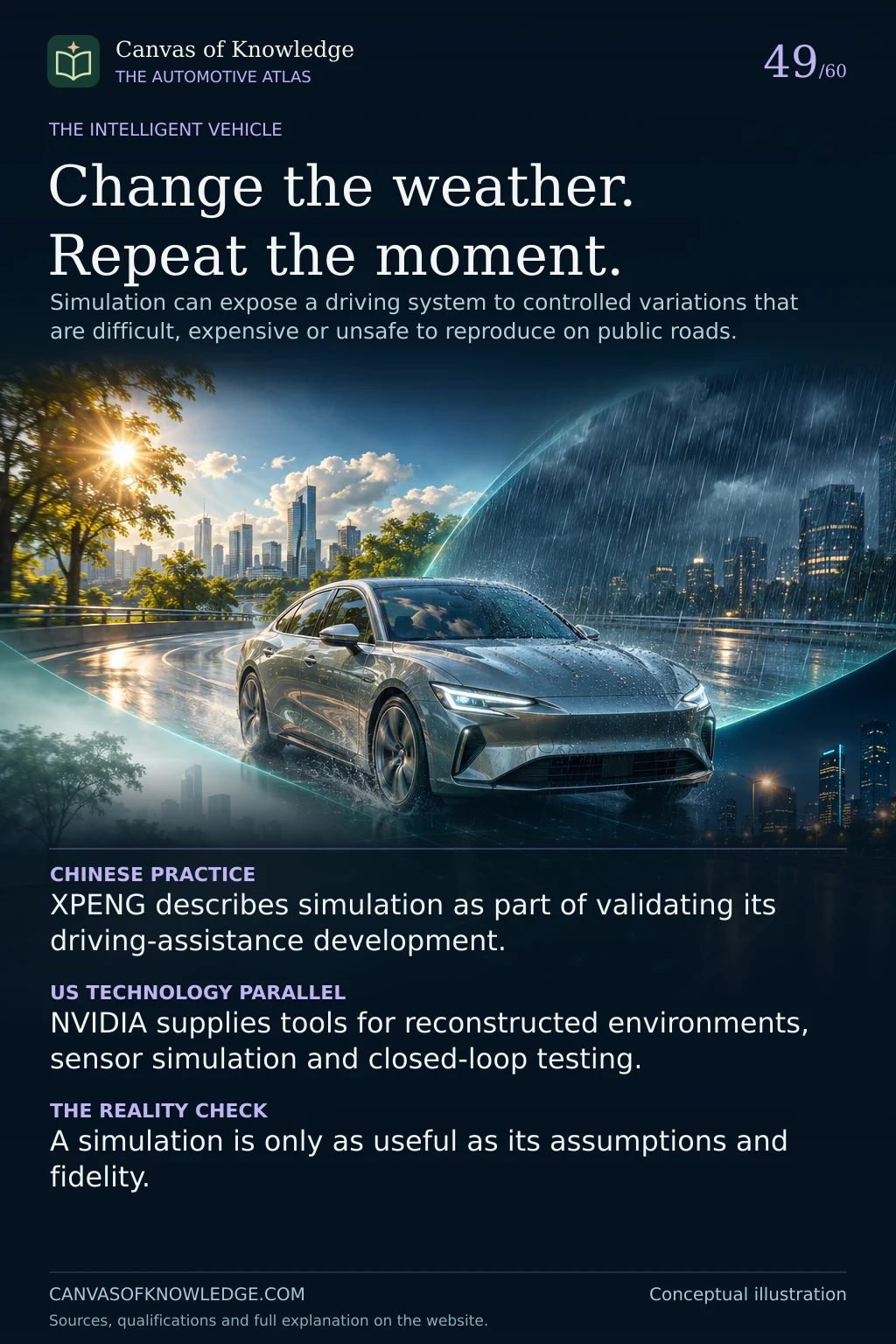 View full infographic +
Simulation can expose a driving system to controlled variations that are difficult, expensive or unsafe to reproduce on public roads.
Explore the technology & sources →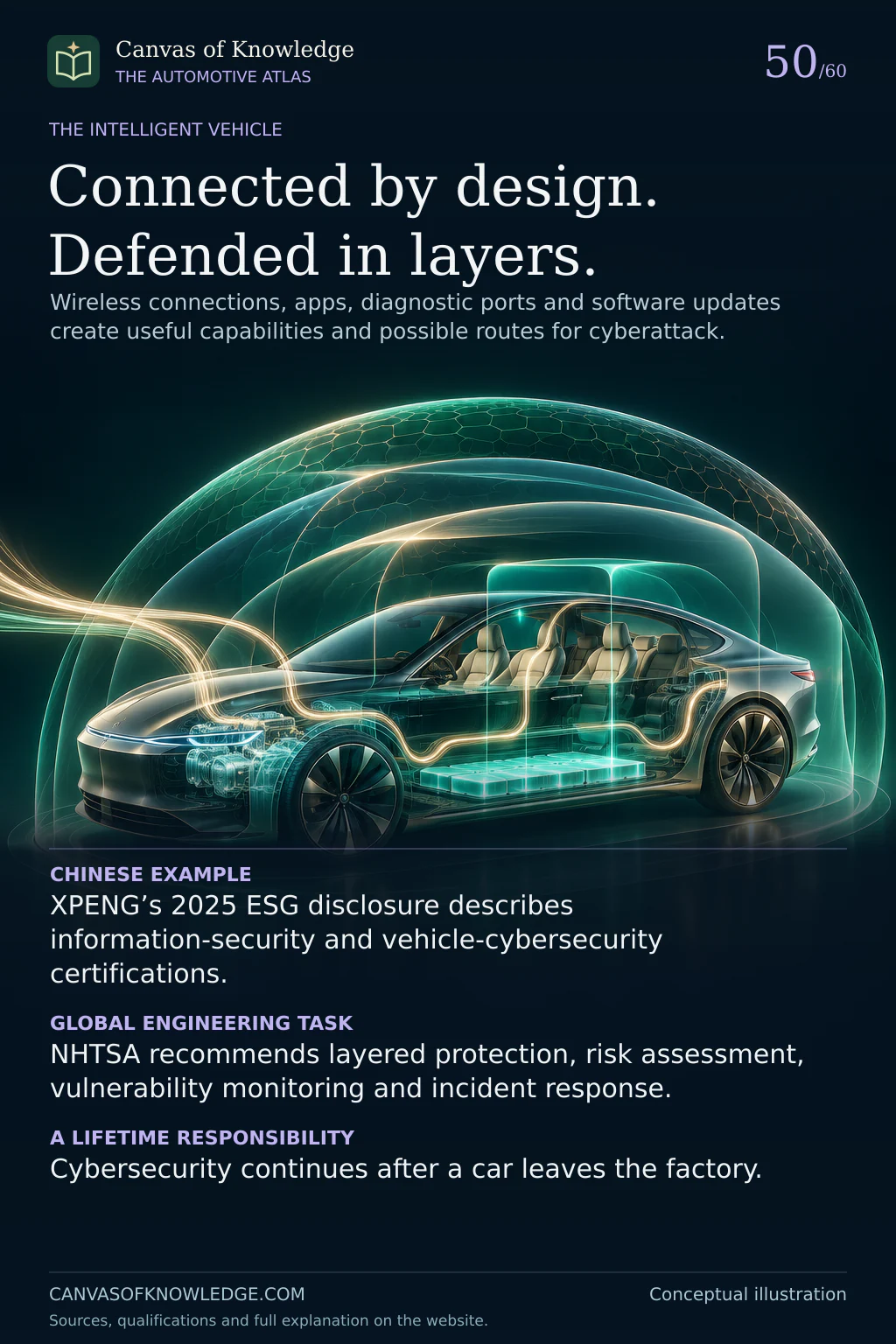 View full infographic +
Wireless connections, apps, diagnostic ports and software updates create useful capabilities and possible routes for cyberattack.
Explore the technology & sources →Six patent case studies—and how to read the evidence.
 View full infographic +
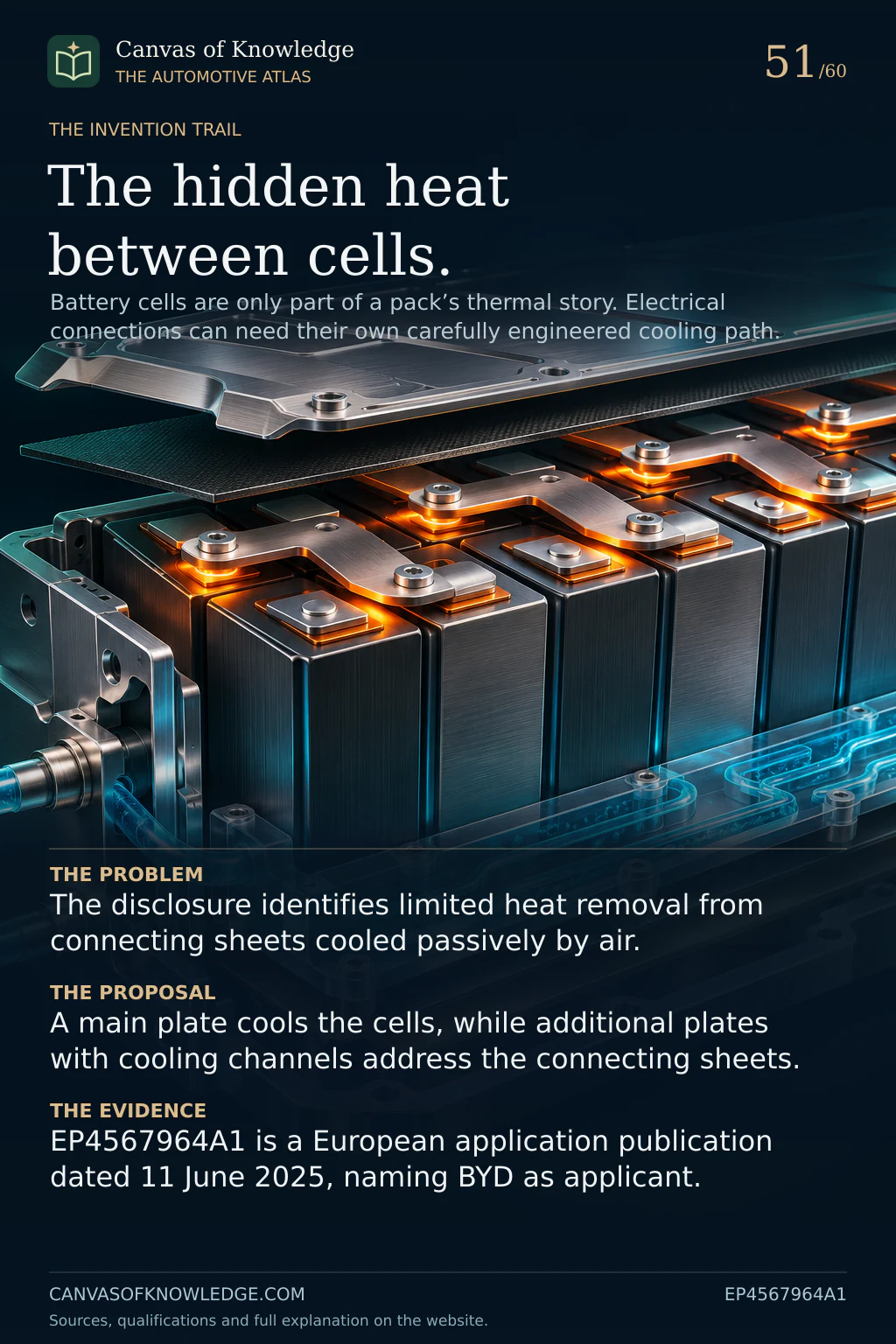
Battery cells are only part of a pack’s thermal story. Electrical connections can need their own carefully engineered cooling path.
Explore the technology & sources →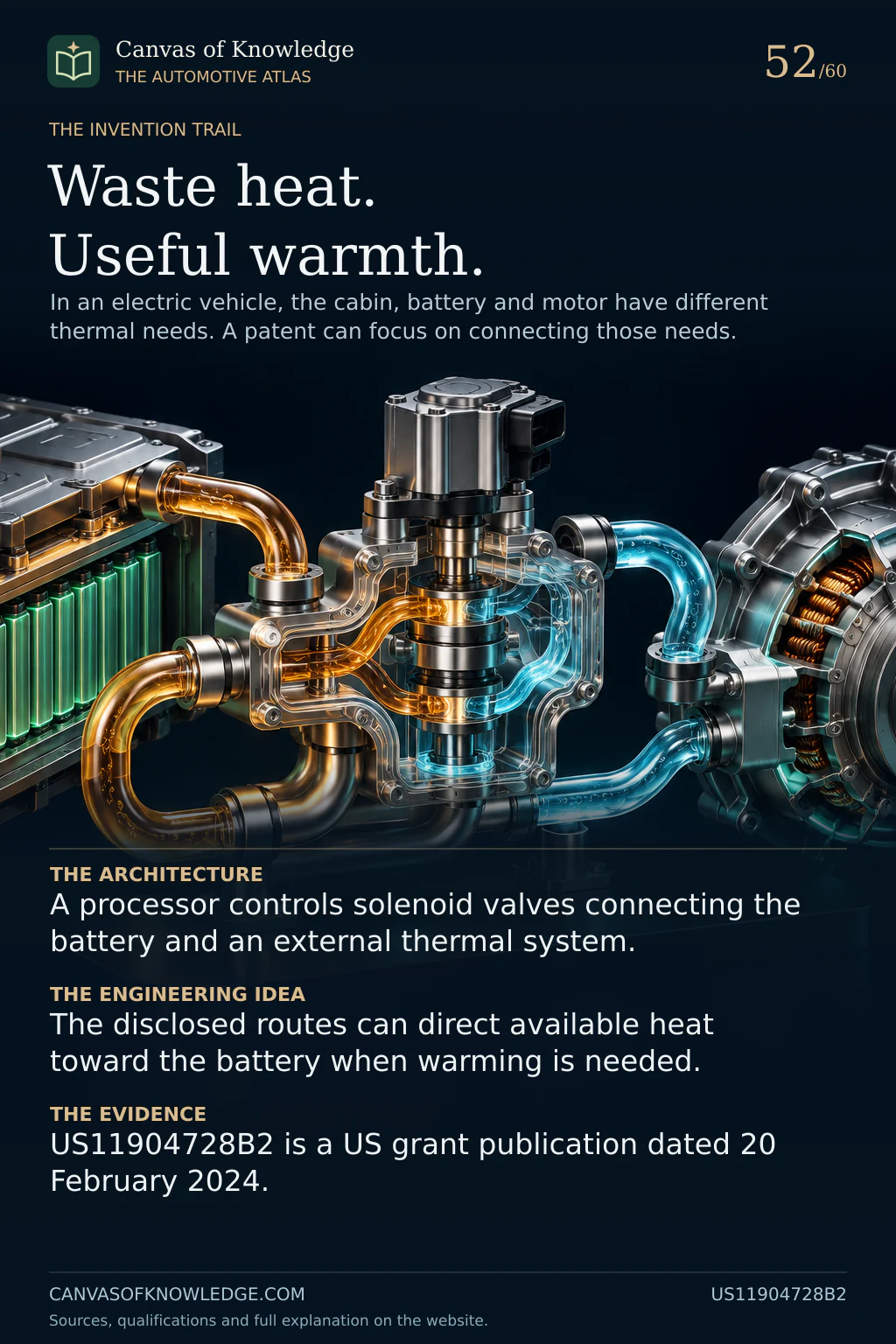 View full infographic +
In an electric vehicle, the cabin, battery and motor have different thermal needs. A patent can focus on connecting those needs.
Explore the technology & sources →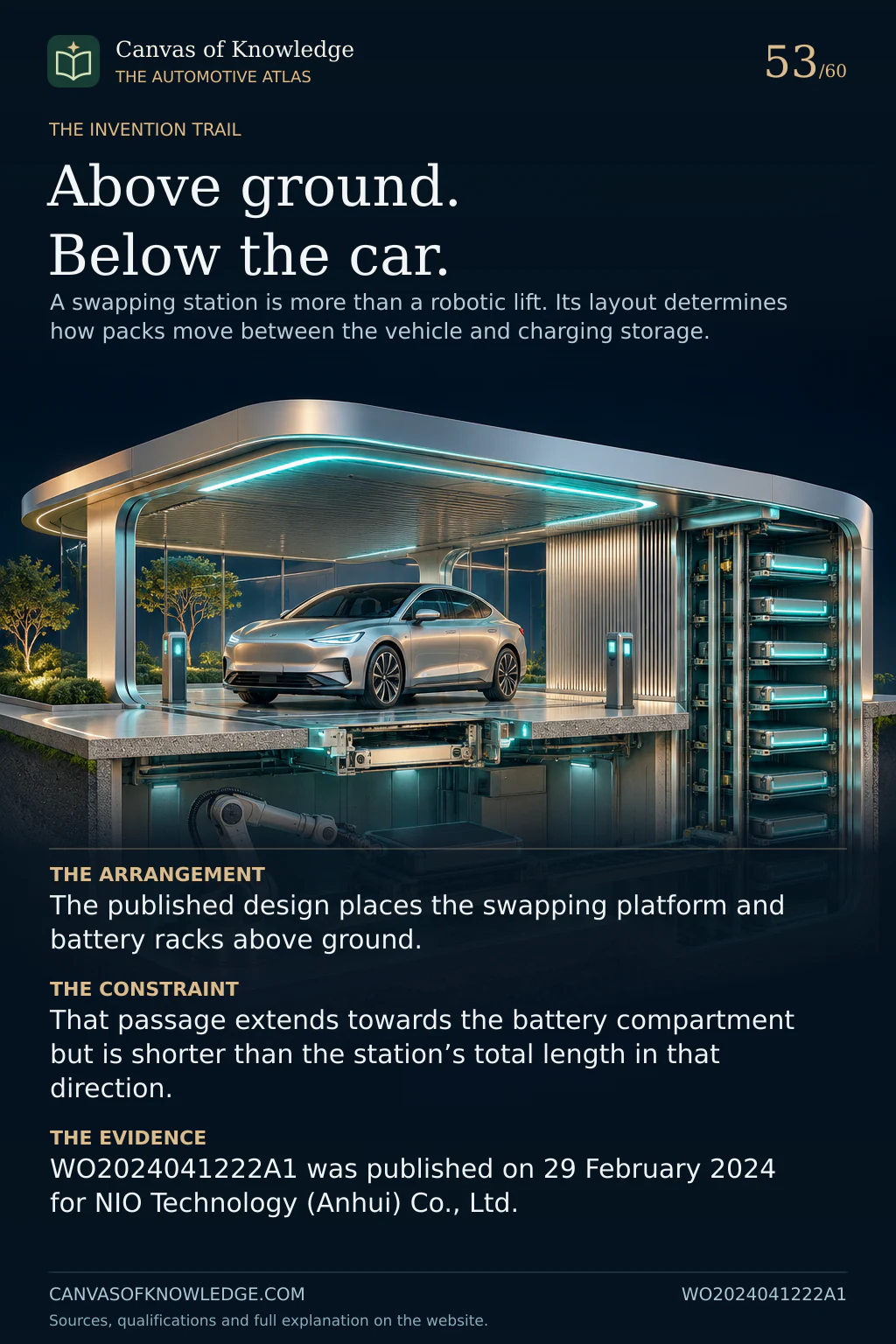 View full infographic +
A swapping station is more than a robotic lift. Its layout determines how packs move between the vehicle and charging storage.
Explore the technology & sources →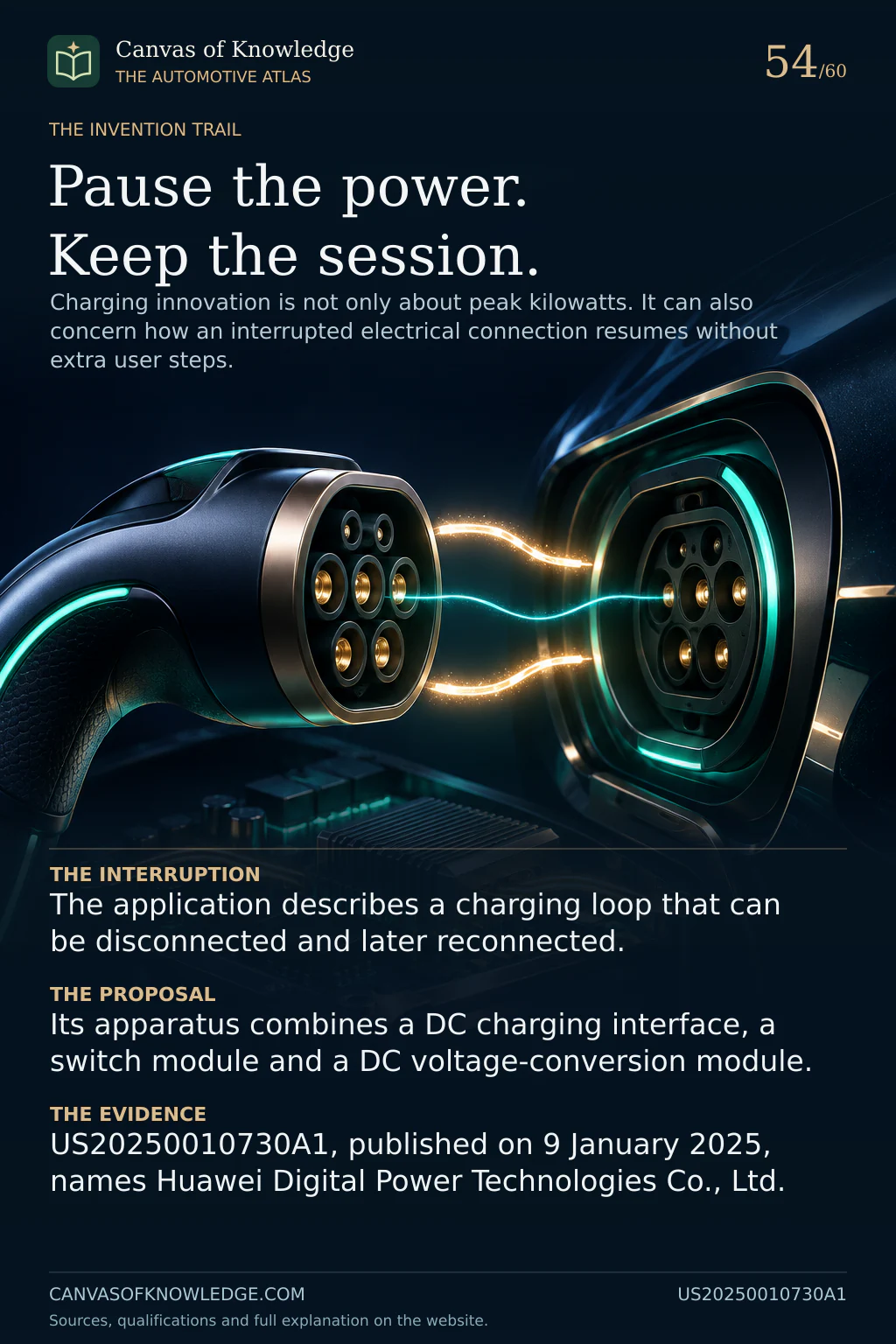 View full infographic +
Charging innovation is not only about peak kilowatts. It can also concern how an interrupted electrical connection resumes without extra user steps.
Explore the technology & sources →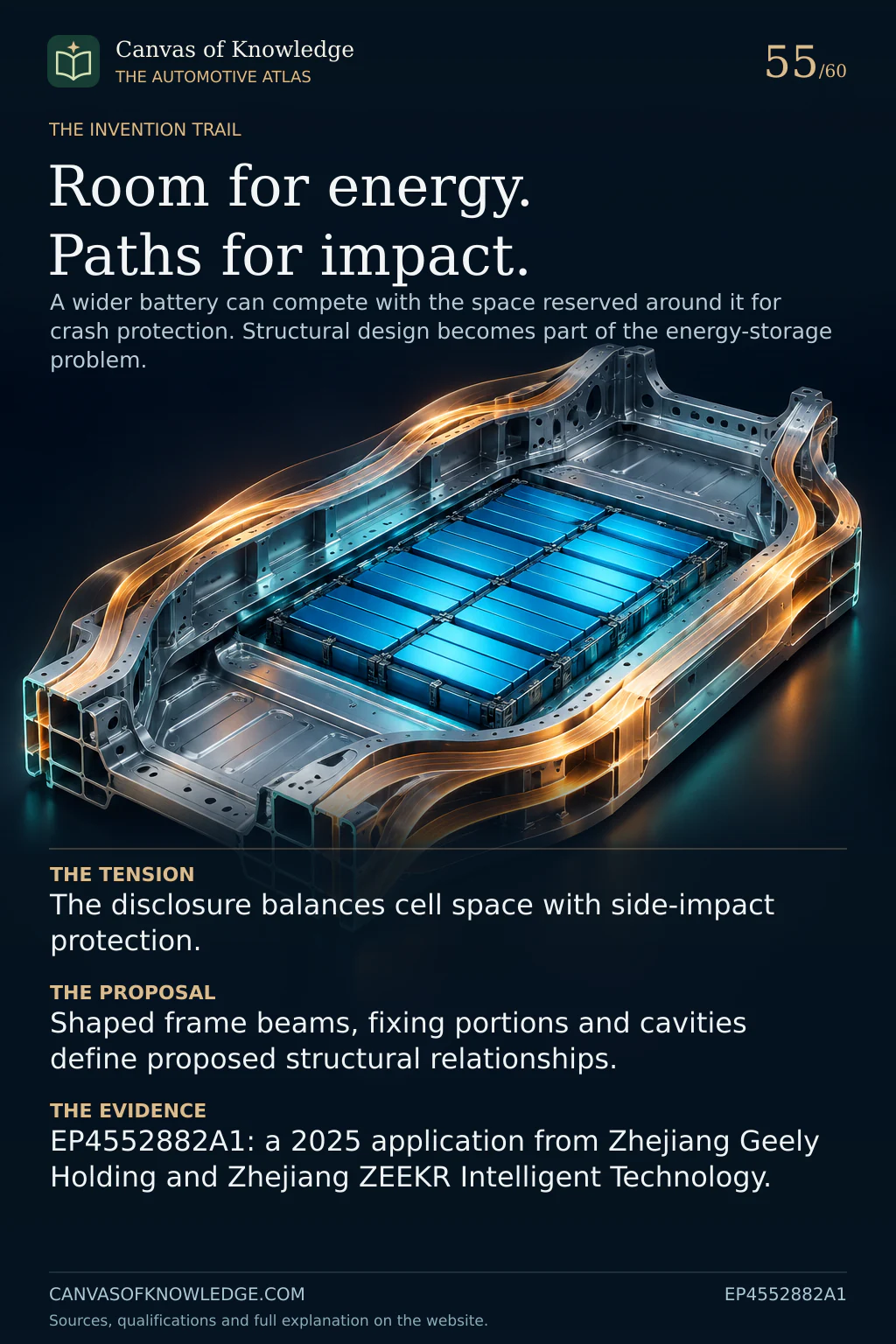 View full infographic +
A wider battery can compete with the space reserved around it for crash protection. Structural design becomes part of the energy-storage problem.
Explore the technology & sources →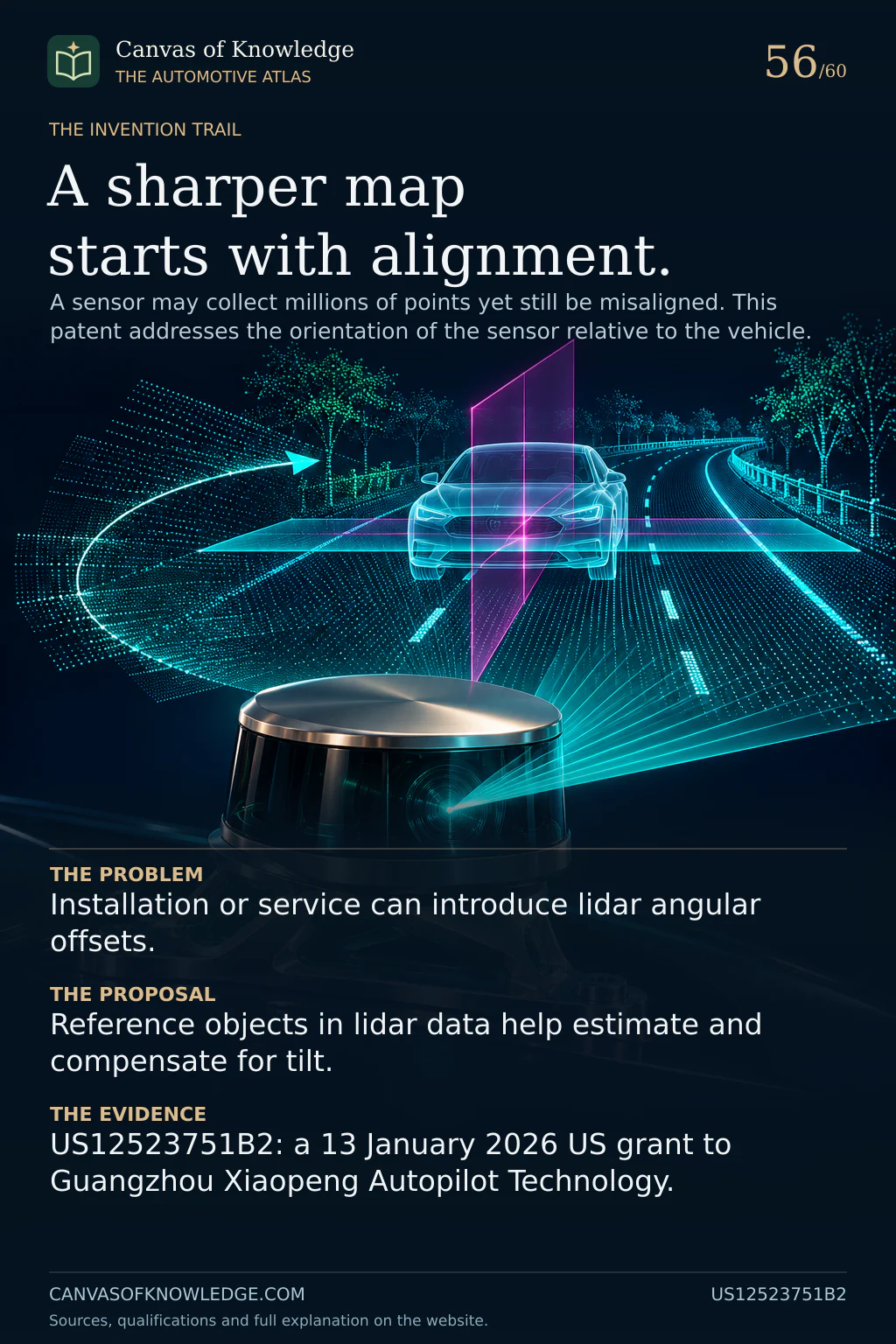 View full infographic +
A sensor may collect millions of points yet still be misaligned. This patent addresses the orientation of the sensor relative to the vehicle.
Explore the technology & sources →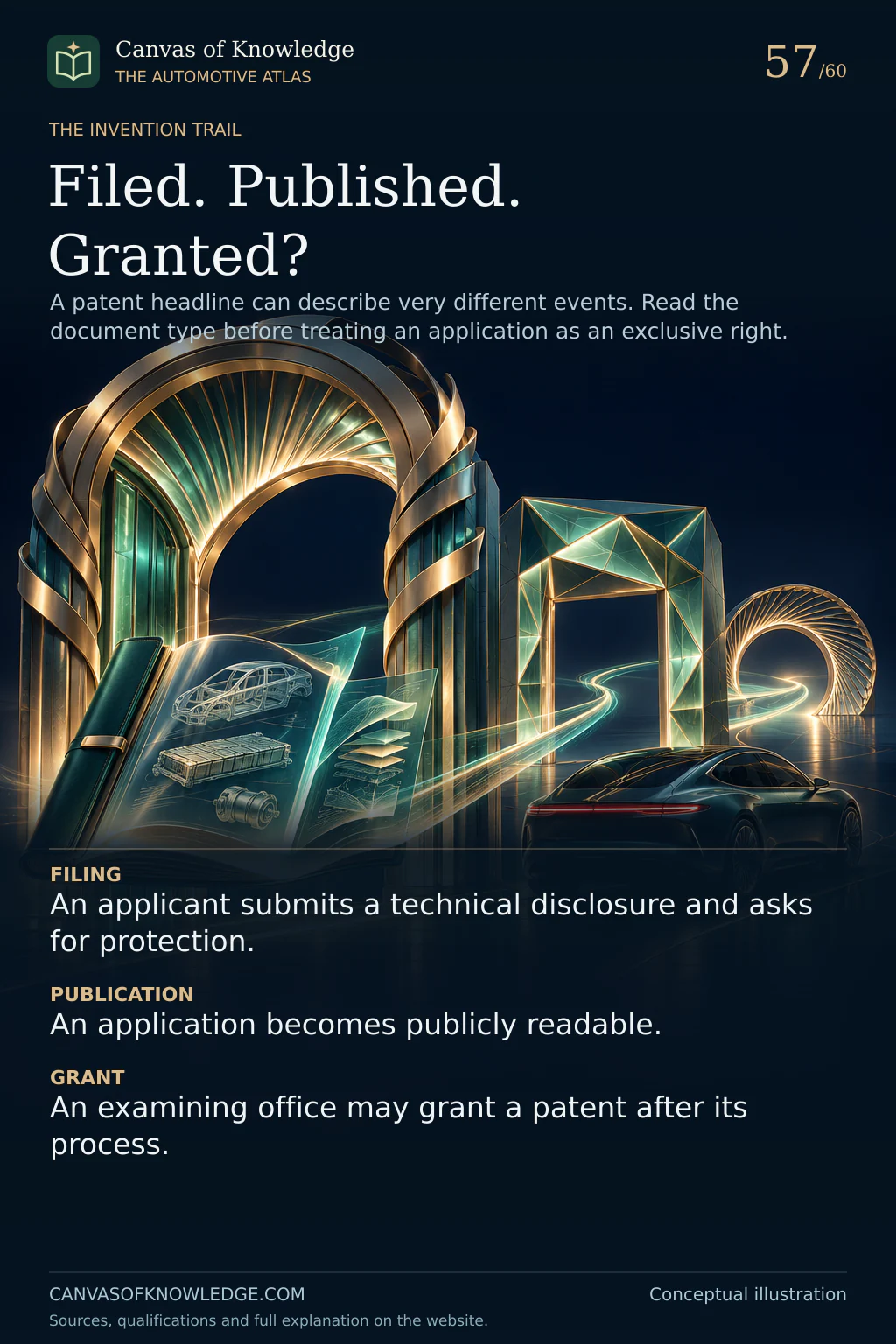 View full infographic +
A patent headline can describe very different events. Read the document type before treating an application as an exclusive right.
Explore the technology & sources →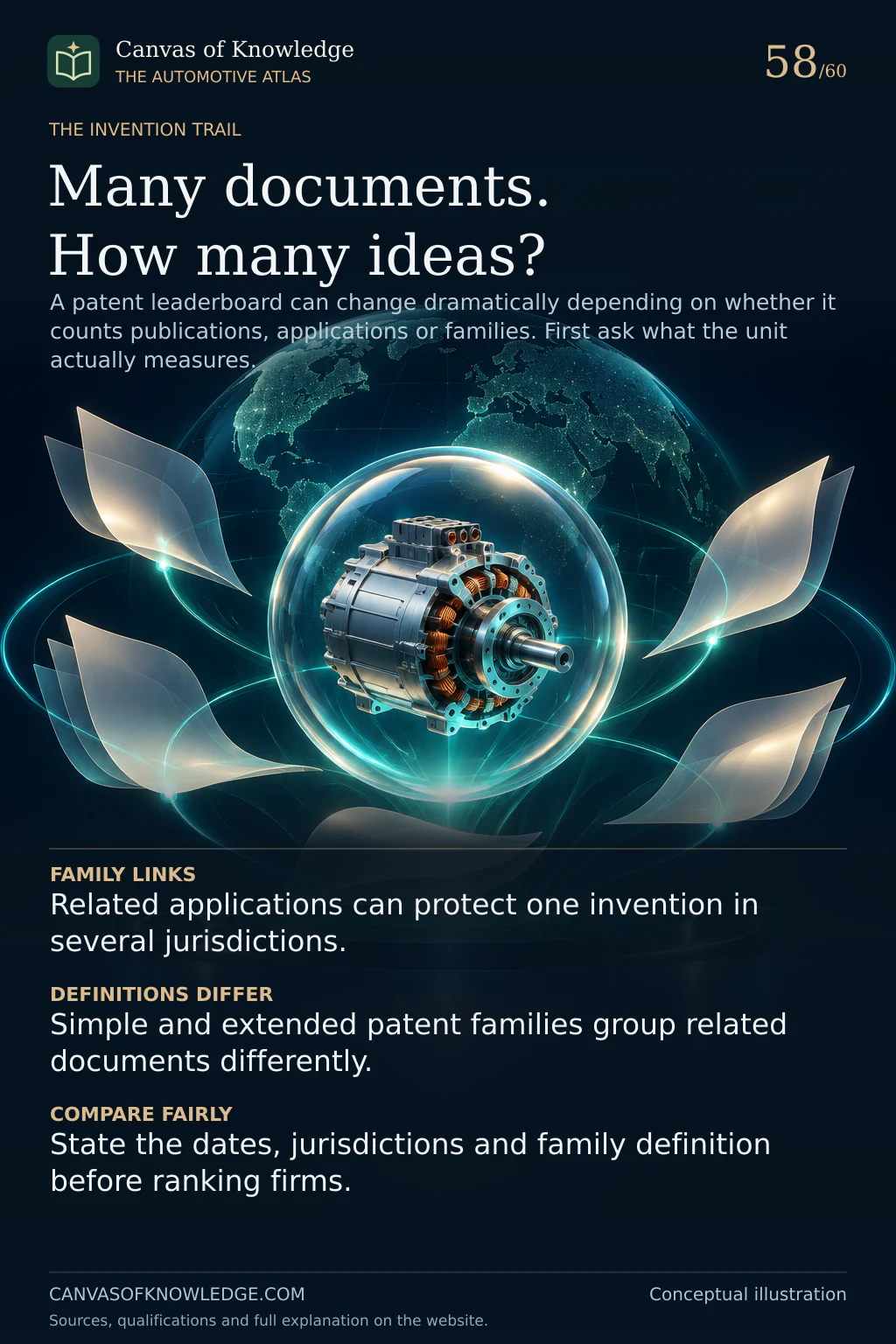 View full infographic +
A patent leaderboard can change dramatically depending on whether it counts publications, applications or families. First ask what the unit actually measures.
Explore the technology & sources →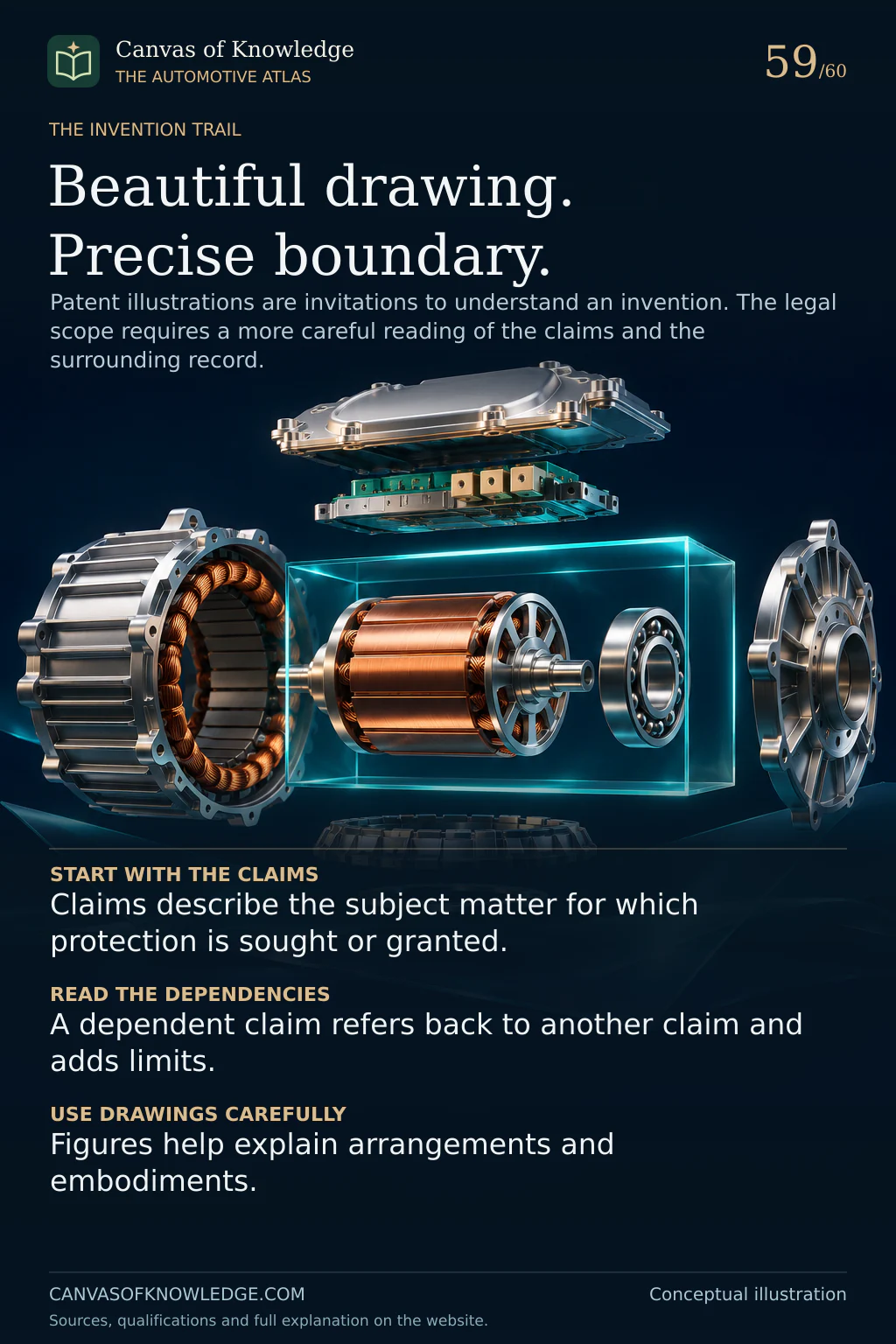 View full infographic +
Patent illustrations are invitations to understand an invention. The legal scope requires a more careful reading of the claims and the surrounding record.
Explore the technology & sources → View full infographic +
Chinese, European and North American firms can pursue similar engineering goals. Fair comparison separates the idea on paper from the technology delivered to drivers.
Explore the technology & sources →A curated guide to 45 Chinese automotive marques, groups and technology suppliers. It is a starting map, not an exhaustive census. Group relationships, joint ventures and partnerships are identified separately.
45 profiles

Vehicle marque · New-energy vehicle portfolio
Official background →
Vehicle marque · New-energy vehicle portfolio
Official background →
Vehicle marque · New-energy vehicle portfolio
Official background →
Vehicle marque · New-energy vehicle portfolio
Official background →
Vehicle marque · Vehicle platforms and electrification
Official background →
Vehicle marque · Vehicle platforms and electrification
Official background →
Vehicle marque · Vehicle platforms and electrification
Official background →
Vehicle marque · Passenger and commercial vehicle engineering
Official background →
Vehicle marque · Passenger and commercial vehicle engineering
Official background →
Vehicle marque · Passenger and commercial vehicle engineering
Official background →
Vehicle marque · Passenger and commercial vehicle engineering
Official background →
Joint-venture vehicle marque · Small-vehicle and electrification programmes
Official background →
Joint-venture vehicle marque · Small-vehicle and electrification programmes
Official background →
Vehicle marque · Multiple combustion and electrified powertrains
Official background →
Vehicle marque · Multiple combustion and electrified powertrains
Official background →
Vehicle marque · Multiple combustion and electrified powertrains
Official background →
Vehicle marque · Multiple combustion and electrified powertrains
Official background →
Vehicle marque · Multiple combustion and electrified powertrains
Official background →
Overseas product line / marque · Hybrid and battery-electric product ranges
Official background →
Overseas product line / marque · Hybrid and battery-electric product ranges
Official background →
Vehicle marque · SUVs, electrification and off-road systems
Official background →
Vehicle marque · SUVs, electrification and off-road systems
Official background →
Vehicle marque · SUVs, electrification and off-road systems
Official background →
Vehicle marque · SUVs, electrification and off-road systems
Official background →
Vehicle marque · Electrified and connected vehicle programmes
Official background →
Vehicle marque · Electrified and connected vehicle programmes
Official background →
Vehicle marque · Electrified and connected vehicle programmes
Official background →
Vehicle marque · Electrified and connected vehicle programmes
Official background →
Vehicle marque · Smart electrified passenger vehicles
Official background →
Vehicle marque · Electrified off-road engineering
Official background →
Vehicle marque / product series · New-energy vehicle programmes
Official background →
Vehicle marque / product series · New-energy vehicle programmes
Official background →
Vehicle marque · Premium vehicle engineering
Official background →
Vehicle marque · Passenger-car and electric model portfolio
Official background →
Vehicle marque · Distinct vehicle and customer propositions
Official background →
Vehicle marque · Distinct vehicle and customer propositions
Official background →
Vehicle marque · Distinct vehicle and customer propositions
Official background →
Vehicle manufacturer · Software, charging and driver assistance
Official background →
Vehicle manufacturer · Range-extended and battery-electric vehicles
Official background →
Vehicle manufacturer · Smart EV and device-ecosystem integration
Official background →
Vehicle manufacturer · Vehicle software and electrified vehicles
Official background →
Vehicle manufacturer · Intelligent electrified vehicles
Official background →
Collaborative vehicle marque · Automotive manufacturing with connected-vehicle technology
Official background →
Battery supplier · Cells, battery systems and energy solutions
Official background →
Technology and systems supplier · Driver assistance, vehicle control and smart cockpit
Official background →No matching profiles. Try another name or clear the filters.
Logos are reproduced from the linked official sources for identification. They remain the property of their respective owners; inclusion does not imply endorsement. Directory reviewed 14 November 2026.
Six published records anchor chapter six. An application, a granted patent and a production feature are three different kinds of evidence.
| Publication | Applicant at filing | Document type | Published |
|---|---|---|---|
| EP4567964A1 | BYD Company Limited | European patent application publication | 2025-06-11 |
| US11904728B2 | Contemporary Amperex Technology Co., Limited | US granted patent publication | 2024-02-20 |
| WO2024041222A1 | NIO Technology (Anhui) Co., Ltd. | International PCT application publication | 2024-02-29 |
| US20250010730A1 | Huawei Digital Power Technologies Co., Ltd. | US patent application publication | 2025-01-09 |
| EP4552882A1 | Zhejiang Geely Holding Group Co., Ltd., Zhejiang ZEEKR Intelligent Technology Co., Ltd. | European patent application publication | 2025-05-14 |
| US12523751B2 | Guangzhou Xiaopeng Autopilot Technology Co., Ltd. | US granted patent publication | 2026-01-13 |