Multiply the price by the shares
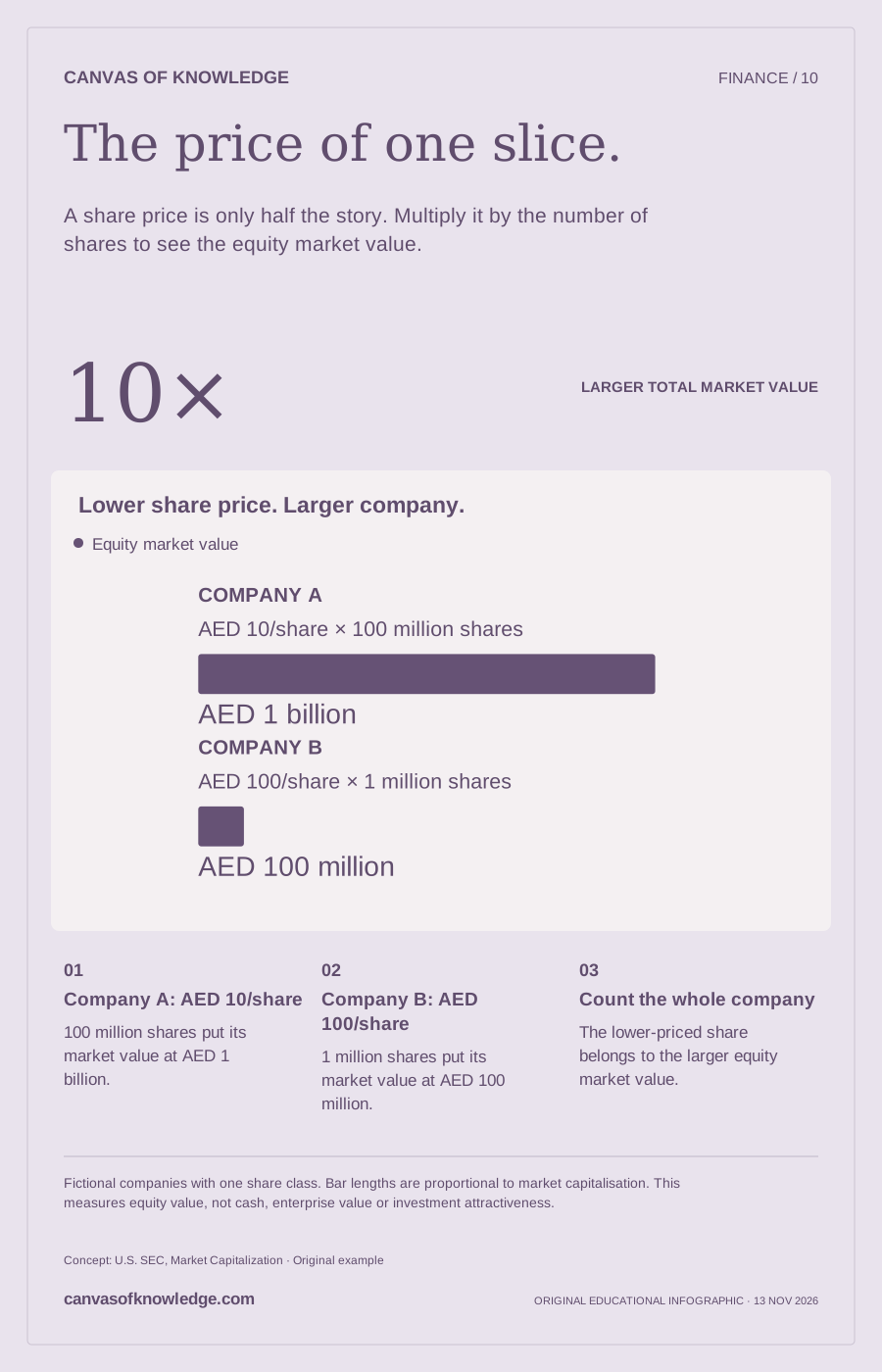
Market capitalisation equals the current share price multiplied by the number of outstanding shares. It measures the stock market’s value of a company’s equity. A per-share price is only one part of that calculation.
Two imaginary companies
Company A trades at AED 10 with 100 million shares outstanding: a market capitalisation of AED 1 billion. Company B trades at AED 100 with 1 million shares outstanding: a market capitalisation of AED 100 million. A’s share price is one-tenth of B’s, yet its total equity market value is ten times larger.
The slice can change
In a hypothetical two-for-one split with nothing else changing, A would have 200 million shares at a mechanically adjusted AED 5 each. The product stays AED 1 billion. An investor holding 10 shares before the split would hold 20 afterward; the split alone creates no extra value. Actual trading prices can move for other reasons.
Size is not cheapness
Market capitalisation is neither cash held by the company nor a measure of whether its shares are attractively valued. It does not include debt as equity value. Assessing valuation requires context about earnings, cash flows, growth and risk. The companies and prices in this lesson are fictional, with one share class each.
Sources & further reading
Sources checked 13 November 2026. These organisations provide reference material and do not endorse this website.