Cost & scale advantagesNetwork effectsIntangible assets
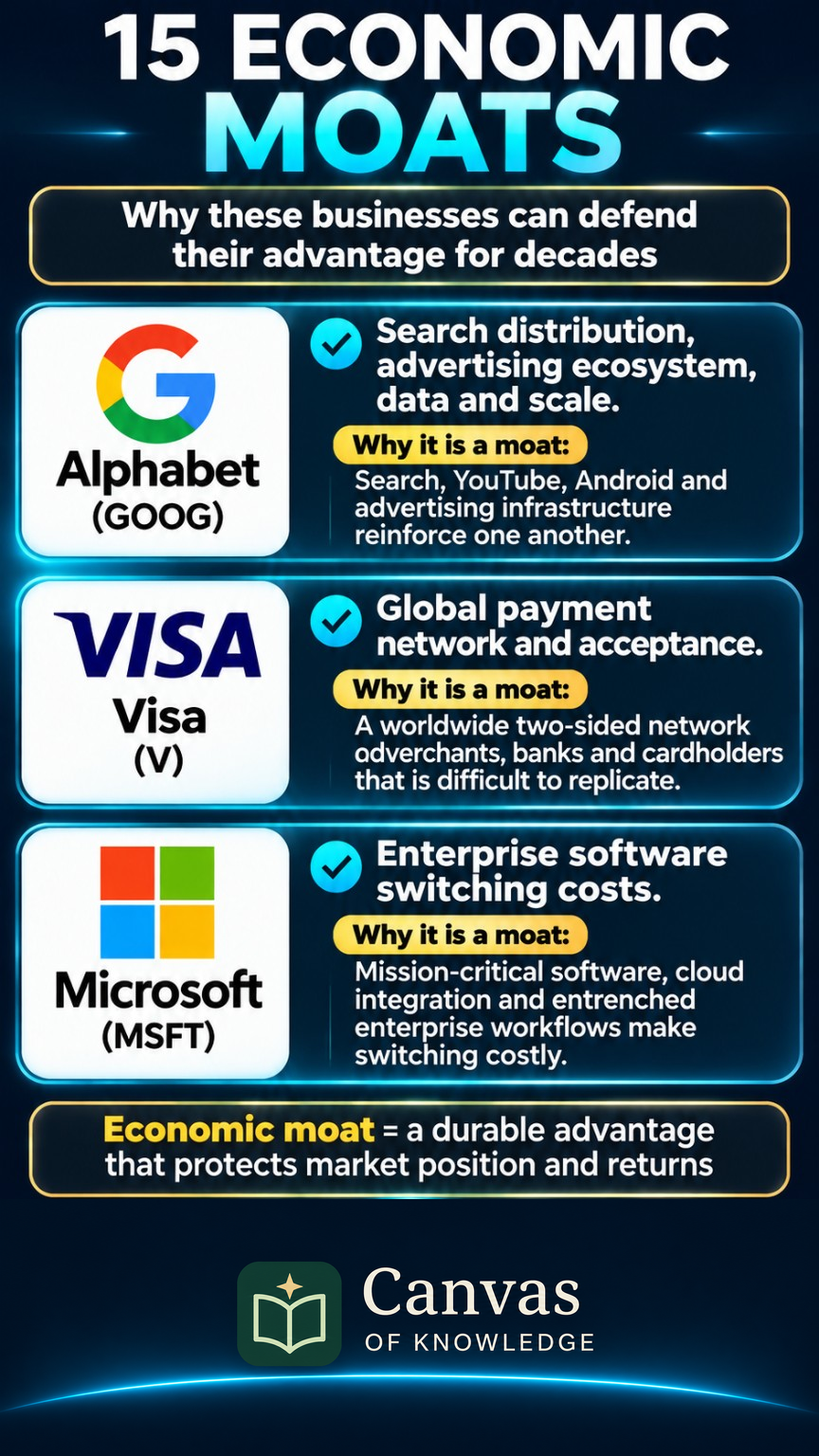
Distribution meets a deep advertising ecosystem.
Alphabet connects search, YouTube, advertising tools and distribution partners. Its annual report describes both advertiser demand and payments to partners that provide search access points. The moat hypothesis is that reach, technical infrastructure and established advertiser relationships reinforce one another: a rival needs more than a good search box to reproduce the surrounding system. This is an interpretation of the business model, rather than proof of permanent protection. Distribution also carries a recurring cost.
Look beneath the advantage +
What could weaken it
AI tools and specialist search services can change how people find information. Competition remedies, privacy rules and more expensive distribution agreements can weaken existing advantages. Scale helps fund innovation, but it does not ensure that users will stay.
The question to ask
Are users and advertisers staying while traffic acquisition costs and infrastructure spending remain economically sustainable?
Read the primary evidence
Network effectsCost & scale advantagesIntangible assets
Acceptance makes a network more useful.
Visa operates payment infrastructure connecting financial institutions, merchants and account holders. It does not issue cards or lend to cardholders. The moat hypothesis is a reinforcing acceptance network: widespread merchant acceptance helps issuers offer useful payment products, while a broad account-holder base makes acceptance valuable to merchants. Technical reliability, common standards and established relationships add to the challenge of building an alternative. Network reach is an advantage to examine, not an assurance that every transaction must use Visa.
Look beneath the advantage +
What could weaken it
Account-to-account payments, domestic networks and other payment methods compete for transactions. Regulation, merchant pressure on acceptance costs, incentives paid to clients and operational failures can change the economics even if overall electronic payments continue growing.
The question to ask
Does growing payment activity translate into durable economics after client incentives, competition and regulatory costs?
Read the primary evidence
Switching costsCost & scale advantagesIntangible assets
The workflow is bigger than the software.
Microsoft's enterprise portfolio spans productivity applications, identity, security, business software and cloud infrastructure. Its annual report describes how these products work across connected organisational needs. The moat hypothesis is that replacing a deeply embedded system can involve migrating data, rebuilding integrations and retraining people, not simply buying a competing licence. Familiar tools and a broad partner ecosystem can support retention. Yet customers can use several providers, and each product must continue earning its place in their workflows.
Look beneath the advantage +
What could weaken it
Security failures, poor service, aggressive pricing or better competing tools can overcome switching friction. Open-source alternatives, competing clouds and new AI interfaces can shift workloads. Large infrastructure commitments also create costs before demand and returns are certain.
The question to ask
Are customers expanding useful workloads because of product value, rather than merely tolerating the cost of switching?
Read the primary evidence
Cost & scale advantagesSwitching costsNetwork effects
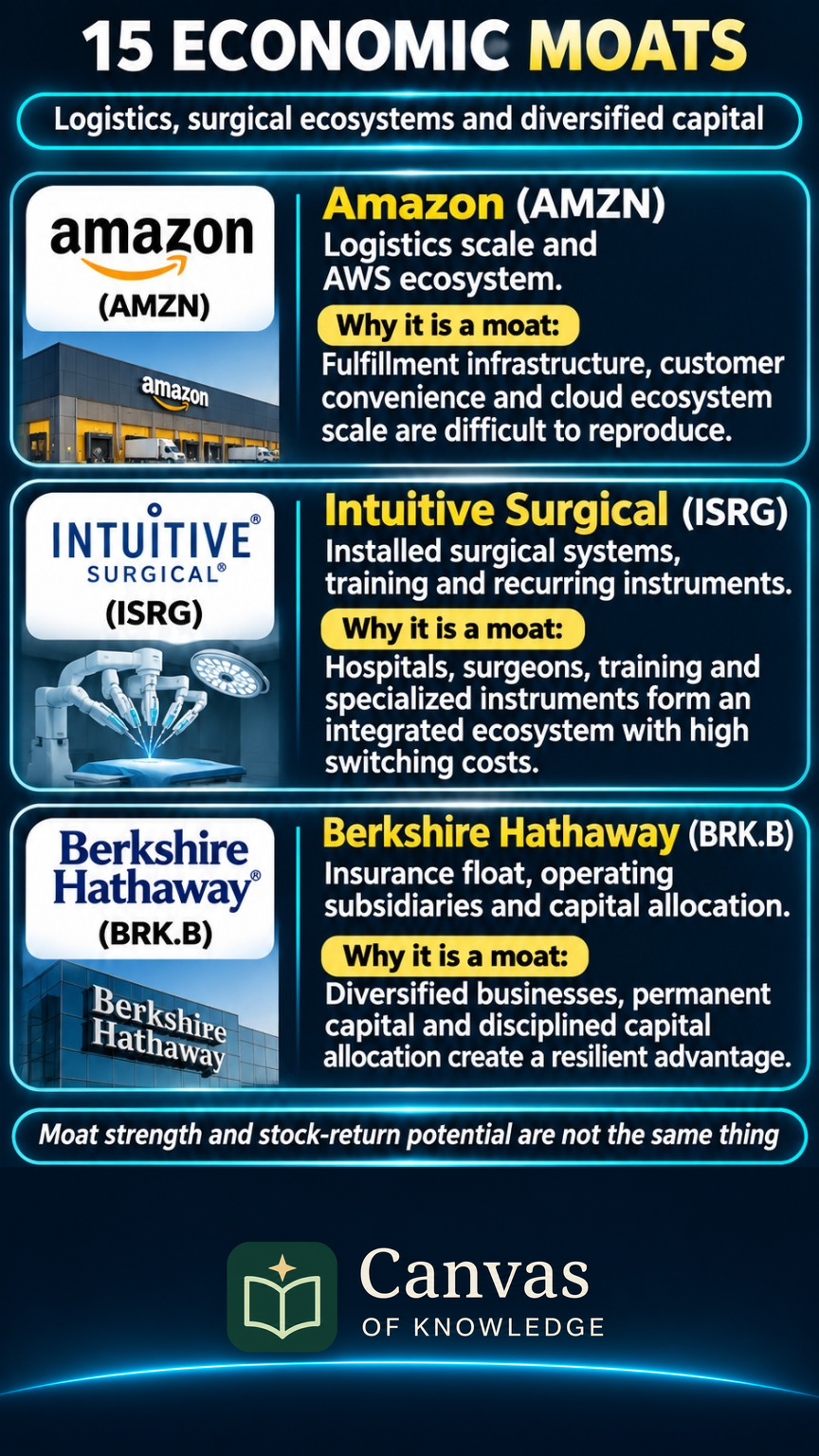
Convenience built on infrastructure.
Amazon combines stores, a third-party marketplace, fulfilment services and Prime. AWS separately supplies computing, storage, databases and other technology services. The moat hypothesis has two parts: delivery infrastructure and marketplace participation can reinforce retail convenience, while applications built around cloud services can make migration demanding. These are related advantages within one group, but they should be tested separately. Infrastructure creates an advantage only when its customer benefits justify the capital and operating costs.
Look beneath the advantage +
What could weaken it
Retailers, marketplaces and cloud providers compete intensely on price, selection and service. New shopping interfaces, weaker seller economics or infrastructure spending that outpaces profitable demand can erode the advantage. Customers can also use several providers.
The question to ask
Do delivery improvements, seller participation and AWS customer demand translate into stronger economics after reinvestment?
Read the primary evidence
Switching costsSpecialist barriersIntangible assets
The system is more than the machine.
Intuitive sells robotic-assisted surgical systems together with instruments, accessories, service and training. Its learning pathways support surgeons and operating-room teams, while instruments are designed to work with particular platforms. The moat hypothesis is that accumulated technical familiarity, installed equipment and established workflows make a change of platform consequential. Recurring instrument and service use connects the installed base to continuing revenue. That commercial mechanism does not, by itself, establish superior clinical outcomes for every procedure.
Look beneath the advantage +
What could weaken it
Competing surgical platforms, alternative treatments, reimbursement changes and hospital budget pressures can alter adoption. Safety, reliability and regulatory approval remain essential; an installed base cannot substitute for evidence of value to patients and care teams.
The question to ask
Are procedure use and customer retention growing alongside credible clinical and economic value?
Read the primary evidence
Cost & scale advantagesSpecialist barriers
Capital that can take the long view.
Berkshire combines insurance operations, investments and numerous operating businesses. Insurance float is money held against policyholder obligations that can be invested before claims are paid; its cost depends on underwriting results. The advantage hypothesis centres on financial capacity, disciplined insurance pricing and allocating capital across opportunities. It is not a single moat shared equally by every subsidiary. Each business still needs its own competitive case, and diversified ownership alone does not create superior returns.
Look beneath the advantage +
What could weaken it
Large claims, inadequate reserves or poor underwriting can make float costly. Misjudged acquisitions and investments can destroy value, while the group's scale can narrow the pool of opportunities large enough to affect its results.
The question to ask
What is the cost of float across the cycle, and how effectively is retained capital being reinvested?
Read the primary evidence
Network effectsCost & scale advantagesSpecialist barriers
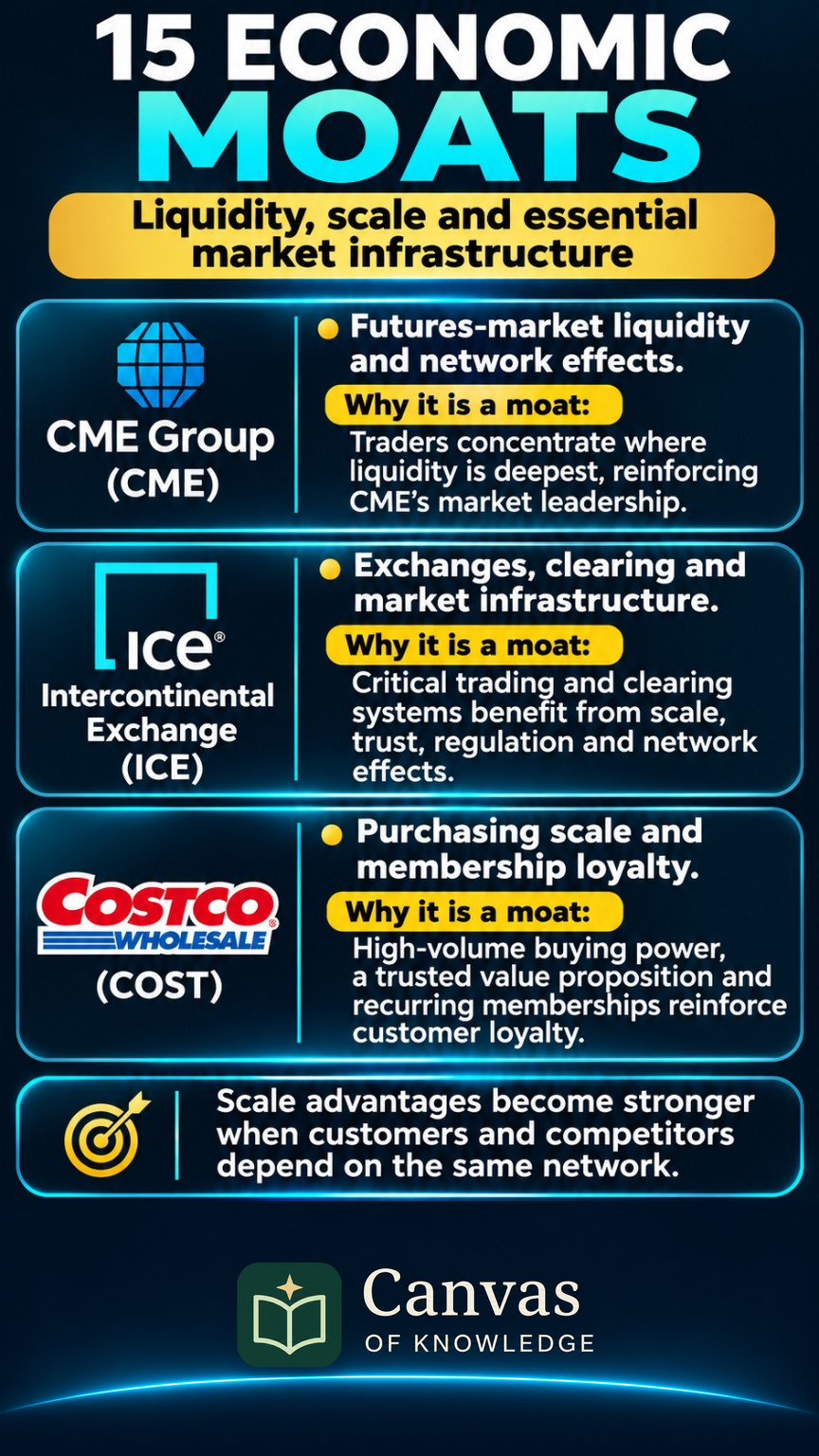
Liquidity attracts liquidity.
CME operates derivatives markets and clearing services. Its annual report identifies market depth, transaction costs, dependable clearing and capital efficiencies as competitive factors. The moat hypothesis is a reinforcing loop: traders seek active markets because finding a counterparty can be easier; their participation can then improve those markets for others. Clearing connections and related contracts can add further convenience. That is a network advantage to investigate, rather than proof that every CME product is equally defensible.
Look beneath the advantage +
What could weaken it
Rival exchanges can compete on fees, contract design and clearing efficiencies. Regulatory changes or alternative instruments can redirect activity. An operational failure could damage the trust on which a trading venue depends, even when its existing network is substantial.
The question to ask
Are liquidity, market share and trading costs holding up in the specific contracts that matter?
Read the primary evidence
ICEICE
Intercontinental Exchange
Network effectsSwitching costsSpecialist barriers
Infrastructure woven into the working day.
ICE combines exchanges and clearing with data services and mortgage technology. Its products support trading, pricing, connectivity and financial workflows. The potential advantage comes from several mechanisms working together: a venue's participants create liquidity, while established data feeds and software integrations can make replacement operationally demanding. The strength of that argument varies by business. A derivatives benchmark, a stock-trading venue and a mortgage platform should each be assessed on their own competitive economics.
Look beneath the advantage +
What could weaken it
ICE describes intense competition across its businesses. Customers may route trades elsewhere or replace data and software suppliers. Technology failures, regulatory changes and weaker mortgage activity can affect different parts of the company in different ways.
The question to ask
Which revenues reflect enduring customer reliance, and which rise mainly with trading or mortgage activity?
Read the primary evidence
Cost & scale advantagesIntangible assets
Pass the scale advantage to the member.
Costco describes a model built around a limited product selection, volume purchasing, efficient distribution and rapid stock turnover. Membership fees support a recurring commercial relationship; the company identifies renewal and member trust as central to profitability. The moat hypothesis is a reinforcing loop: operating efficiency supports attractive prices, attractive prices encourage shopping and renewal, and volume supports efficiency. This is a cost-and-trust proposition rather than a technological barrier preventing members from shopping elsewhere.
Look beneath the advantage +
What could weaken it
If members find better value elsewhere, renewal and shopping frequency can weaken. Product-quality problems, damage to the Kirkland Signature brand, supply disruption or rising costs can undermine a model that depends on delivering consistent value.
The question to ask
Are membership renewals, shopping demand and the price proposition holding up as costs change?
Read the primary evidence
Network effectsCost & scale advantagesIntangible assets
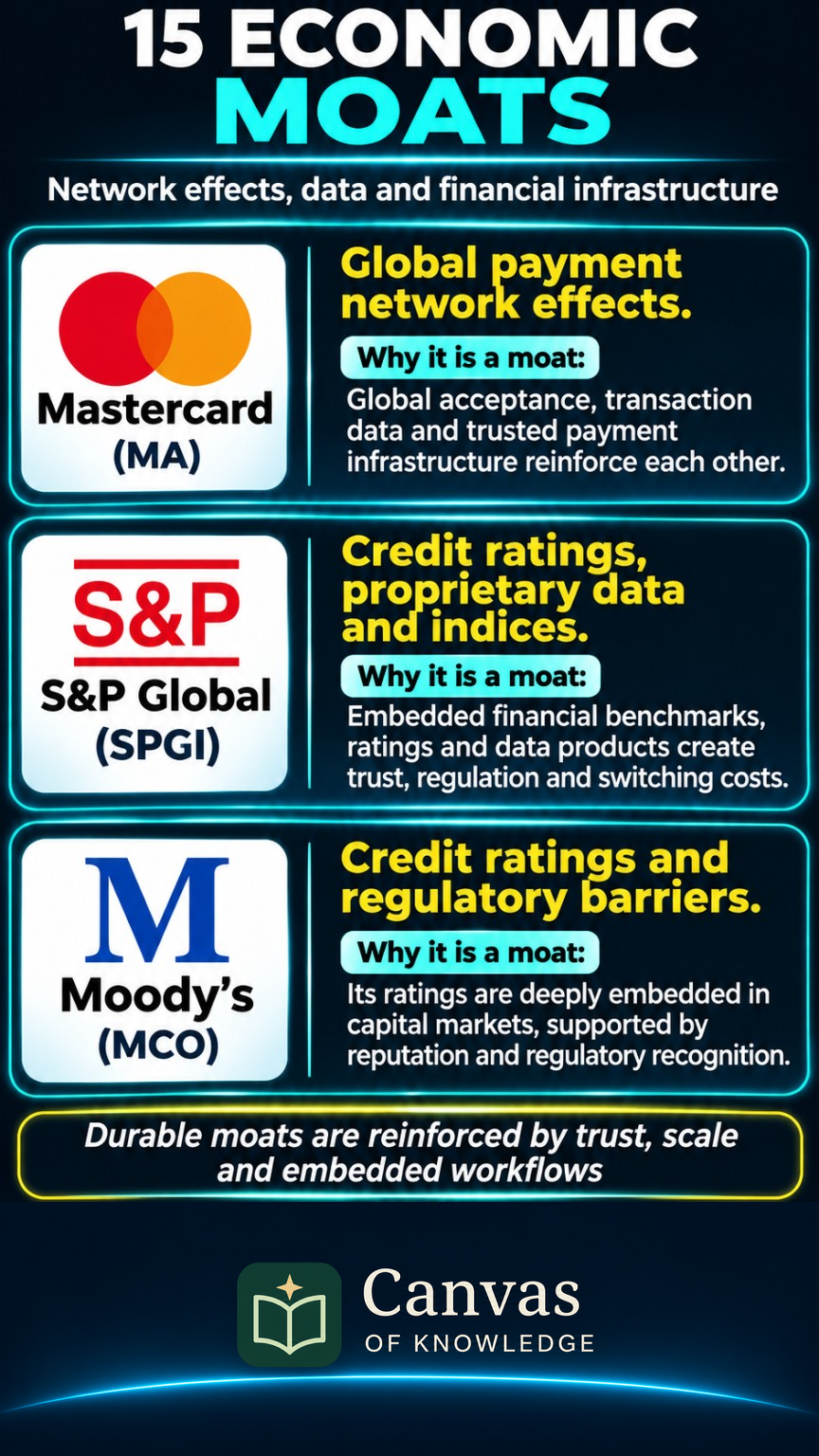
A shared standard connects both sides.
Mastercard links issuers and acquirers through payment infrastructure and common operating standards. It does not issue cards or extend credit to account holders. Its report describes network reach, brand, data services and interoperability as competitive capabilities. The moat hypothesis is that merchants, institutions and account holders benefit from a system others already use, while security and related services deepen those relationships. Reproducing that combination is harder than launching a payment app, although customers and merchants retain alternatives.
Look beneath the advantage +
What could weaken it
Domestic payment systems, instant account-to-account transfers and regulatory changes can redirect transactions. Large customers and merchants can press for better terms. Cybersecurity incidents or settlement failures could damage the trust on which network participation depends.
The question to ask
Are network use and services demand strengthening without requiring disproportionately higher customer incentives?
Read the primary evidence
Intangible assetsSwitching costsCost & scale advantages
When a benchmark becomes a shared language.
S&P Global supplies credit ratings, indices, market data and workflow tools. Its index business licenses benchmark intellectual property, while data products help customers analyse markets and run recurring tasks. The moat hypothesis rests on recognised benchmarks, accumulated information and integration into customer processes. Replacing a familiar reference or rebuilding a workflow can carry costs beyond the subscription fee. Reputation must still be earned: a recognised name is only valuable while customers trust the underlying work.
Look beneath the advantage +
What could weaken it
Competing benchmarks, lower-cost data and new analytical tools can challenge pricing. Errors or credibility failures can weaken trust. Ratings activity also depends on debt issuance, so cyclical revenue growth alone does not demonstrate a stronger moat.
The question to ask
Do customers renew and expand usage because the information remains useful, differentiated and difficult to replace?
Read the primary evidence
Intangible assetsSwitching costsSpecialist barriers
A reputation that has to be re-earned.
Moody’s provides credit ratings and risk analytics. Its ratings business is registered with the SEC as a nationally recognised statistical rating organisation, and its disclosures identify reputation and credibility as competitive strengths. The moat hypothesis combines familiarity among market participants, specialist analytical capabilities and tools embedded in customer workflows. Regulatory registration is relevant context, not a guarantee of quality or an exclusive franchise. An established ratings brand remains valuable only while users find its judgements credible.
Look beneath the advantage +
What could weaken it
Perceived conflicts of interest, ratings failures or weak data quality can erode confidence. Competitors and customers' own models can pressure prices. Debt-issuance cycles affect ratings demand, while regulatory reforms may encourage additional competition rather than protect incumbents.
The question to ask
Is customer trust supported by analytical quality and retention, rather than merely a busy issuance market?
Read the primary evidence
Network effectsCost & scale advantagesIntangible assets
Attention attracts advertisers. Connections retain attention.
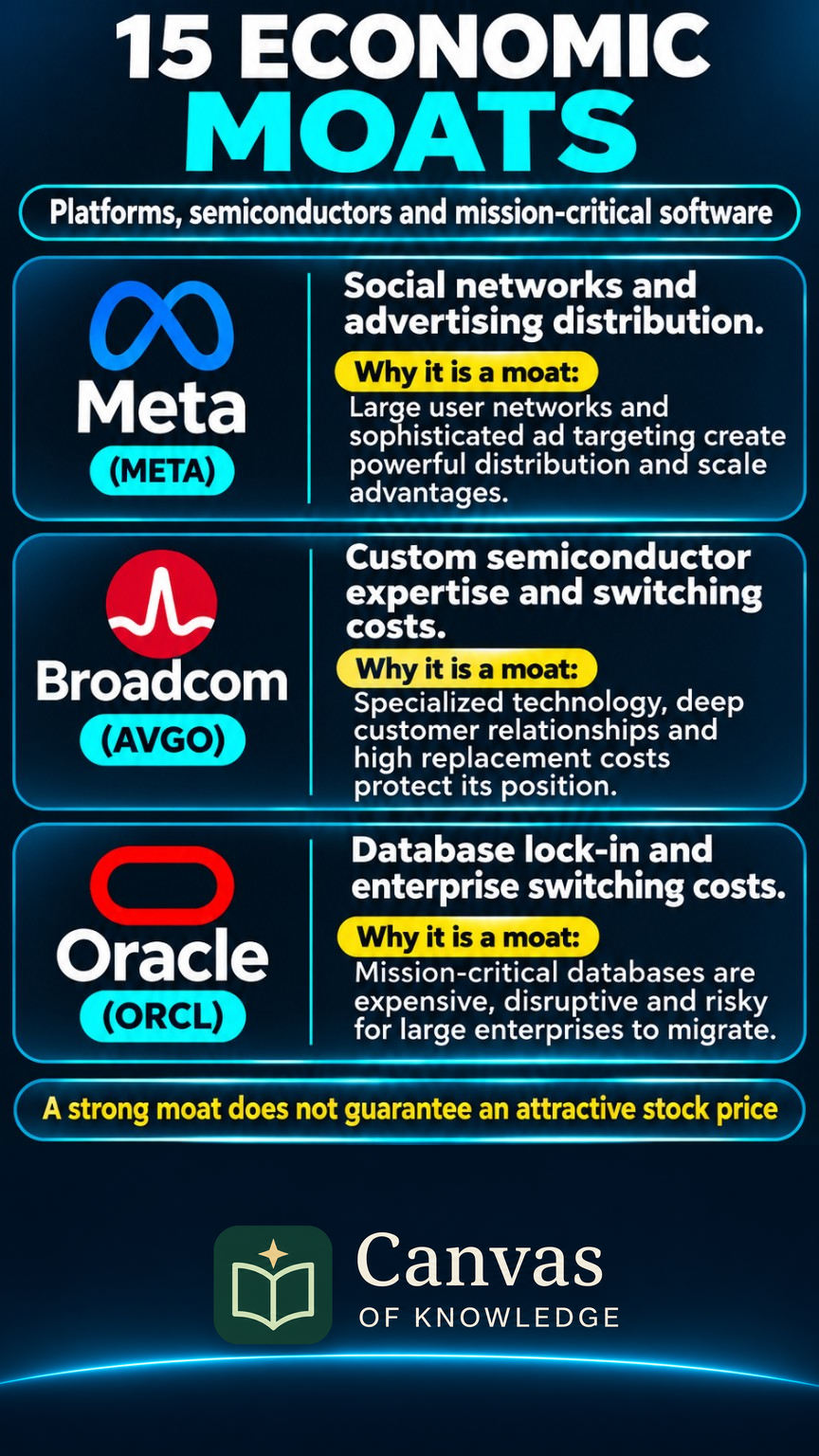
Meta's Family of Apps brings together social connection, communication, content discovery and advertising. Its annual report links advertising demand to audience engagement and the effectiveness of targeting and measurement tools. The moat hypothesis combines social-network effects with advertising infrastructure: people find value in the communities and creators already present, while advertisers seek useful access to that attention. This is not an automatic flywheel. Users can spend time across several platforms, and relevance has to be renewed continually.
Look beneath the advantage +
What could weaken it
Audience preferences can move quickly, especially towards competing formats and platforms. Privacy restrictions, changes imposed by mobile operating systems and regulatory interventions can reduce advertising effectiveness. Heavy investment does not guarantee that new products will win sustained engagement.
The question to ask
Is engagement strengthening alongside demonstrable advertiser value, rather than only more advertisements per user?
Read the primary evidence
Switching costsSpecialist barriersIntangible assets
Designed into systems that matter.
Broadcom operates semiconductor and infrastructure-software businesses, including VMware. Semiconductor design wins can involve lengthy development, customer-specific engineering and products integrated into a wider system. The moat hypothesis is that expertise and integration make replacement more demanding than exchanging a generic component. In software, entrenched infrastructure can also create migration work. These mechanisms differ across products: a design win is not a guaranteed order, and the breadth of the group should not disguise that distinction.
Look beneath the advantage +
What could weaken it
A small group of customers accounts for substantial demand. Customers may reduce orders, design their own solutions or choose competing technology. Software dissatisfaction can encourage migration, and successful engineering today does not guarantee the next design win.
The question to ask
Do repeat design wins and software renewals reflect continuing customer value rather than temporary dependence?
Read the primary evidence
Switching costsIntangible assets
The cost of rewiring a business.
Oracle supplies databases, enterprise applications, cloud infrastructure and support services used in customers' business operations. Its annual report describes an installed software base and recurring support relationships. The switching-cost hypothesis follows from those connections: changing a core database can mean adapting applications, transferring data, testing reliability and retraining teams. These are practical transition burdens, not an inability to leave. The case is strongest where Oracle technology is deeply integrated and continues to deliver value relative to alternatives.
Look beneath the advantage +
What could weaken it
Competing cloud platforms, alternative databases and migration tools can lower switching barriers. Uncompetitive pricing or poor service can justify the effort of moving. Oracle itself warns that multicloud arrangements may help customers shift spending towards competitors.
The question to ask
Are customers renewing and extending workloads by choice, and are alternatives becoming easier to adopt?
Read the primary evidence
The business descriptions draw on linked company filings and official materials. The advantages, risks and questions are Canvas of Knowledge’s analysis. No company, source provider or exchange endorses this collection. Reviewed 14 November 2026.