A library frozen in time
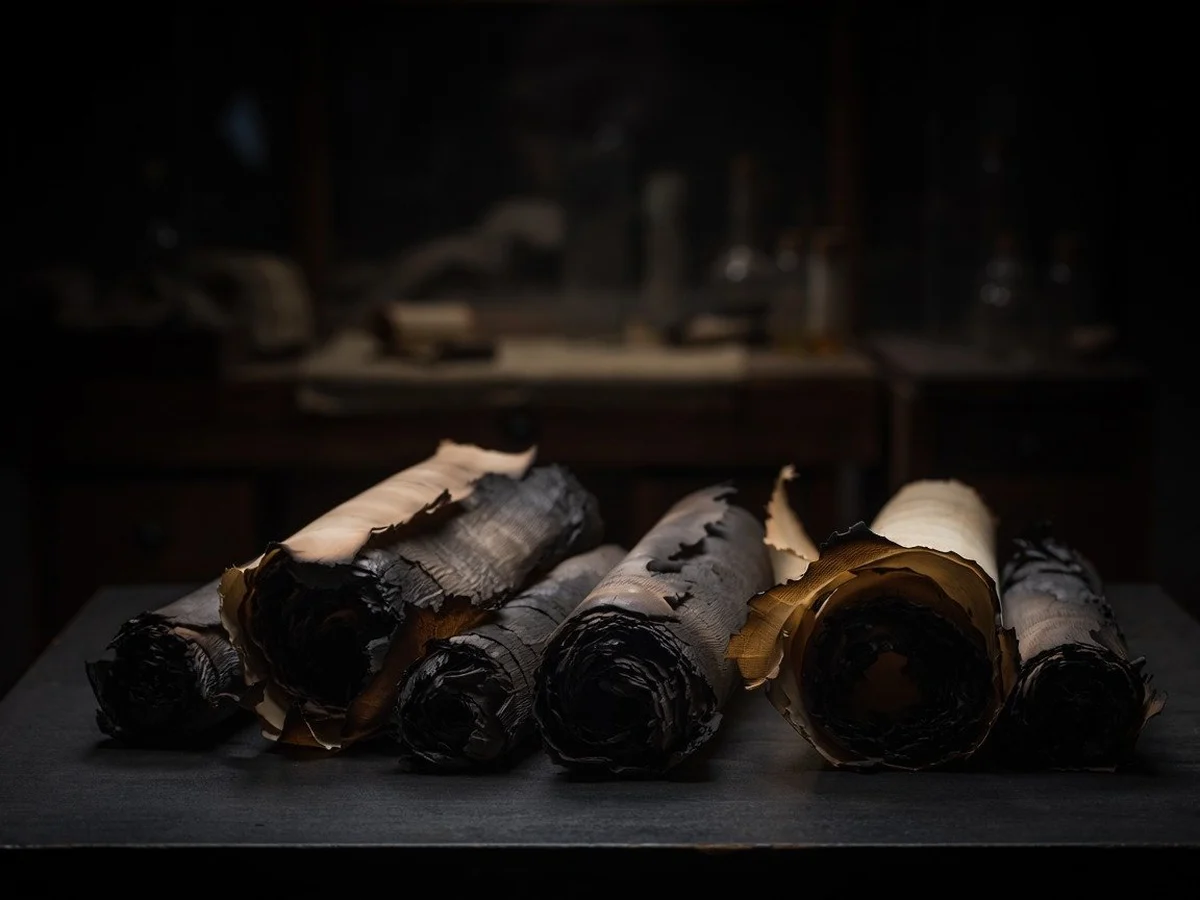
In AD 79, the eruption of Mount Vesuvius buried the Roman towns of Pompeii and Herculaneum. At Herculaneum, a grand seaside house now called the Villa of the Papyri held a private library. The extreme heat of the volcanic flow did not burn the scrolls to ash, but it carbonised them, turning soft papyrus into fragile, blackened rolls. When workers digging in the 1750s uncovered about 1,800 of them, they at first mistook them for lumps of coal. It is the only library to survive intact from the ancient Greek and Roman world.
Why they could not be opened
Over the following centuries, scholars tried many ways to unroll the scrolls. Some were sliced apart, others peeled with special machines. Each attempt destroyed part of the text, and many scrolls crumbled into fragments. The words that were recovered, mostly philosophy in ancient Greek, showed how much was at stake. Yet hundreds of scrolls remained closed, because opening them almost certainly meant losing them for good. For more than 250 years, their contents stayed locked inside.
Seeing inside with X-rays
The breakthrough came from computer scientist Brent Seales of the University of Kentucky, who spent years developing what he calls virtual unwrapping. A rolled scroll is scanned with high-energy X-rays, often at a particle accelerator called a synchrotron, producing a detailed 3D image of its inside. Software then traces each tightly packed layer of papyrus and digitally flattens it into a sheet. The problem was that the ink used at Herculaneum was carbon-based, just like the charred papyrus, so in the scans the letters were almost invisible.
Where machine learning comes in
This is where artificial intelligence helps. The ink leaves tiny traces in the surface texture of the papyrus, patterns too subtle for people to pick out reliably. Researchers trained machine learning models to recognise those patterns, at first using fragments where the letters were visible to the eye. Once trained, the models could highlight likely ink across a virtually unwrapped sheet. The output is an image in which Greek letters slowly emerge from what looked like blank, dark papyrus.
The Vesuvius Challenge
In 2023, Seales joined technology investors Nat Friedman and Daniel Gross to launch the Vesuvius Challenge, a competition that released scan data to the public and offered prizes for reading it. Thousands of people joined in. In October 2023, student Luke Farritor found the first word read from inside an unopened scroll: the Greek for purple. In February 2024, Youssef Nader, Luke Farritor and Julian Schilliger won the grand prize for revealing more than 2,000 characters across several columns of text.
What the scrolls say
The recovered text appears to be by Philodemus, an Epicurean philosopher who lived in the first century BC and is linked to the villa's library. The passages discuss pleasure and what makes life enjoyable, themes central to Epicurean thought. Since then, teams have continued to scan further scrolls and to improve their tools, including efforts to identify titles and authors. Each success makes the next scroll faster to read, because the models learn from every new example.
Why carbon ink is so hard to see
Many ancient inks contained iron, which shows up clearly in X-ray scans because it absorbs X-rays differently from papyrus. The ink used in the Herculaneum library was mostly carbon, made from soot, so it looks almost identical to charred papyrus in the scans. That is why early efforts could map the layers but not the letters. Machine learning succeeded because it looks for tiny differences in texture and shape, such as the slight crackle pattern where ink once sat on the fibres.
Open science and teamwork
A key feature of the Vesuvius Challenge was openness. Scan data, software and progress reports were shared publicly, so contestants could build on one another's work. Smaller prizes rewarded steps such as better segmentation, the task of tracing the papyrus layers in 3D. Many winners were students and amateurs working from home. Experts in ancient Greek then checked the results, making sure the letters found by the models matched real words and grammar.
Why it matters
Most writing from the ancient world was lost long ago. If more of the Herculaneum scrolls can be read, they could return works by ancient authors that have not been seen for nearly two thousand years. The project also shows a wider lesson about AI in research: it works best alongside human experts. Papyrologists still check, read and interpret every word, while the machines do the patient work of finding ink that people cannot see.
Sources & further reading
General information; dates and details as reported by the Vesuvius Challenge and research teams. Photograph: original AI-generated illustration (Adobe Firefly). Reference organisations do not endorse this website.