

How the
world works.
Look closer. Everything connects.
From sunlight to a screen. From a forest to a financial system. Follow the invisible relationships behind everyday life.
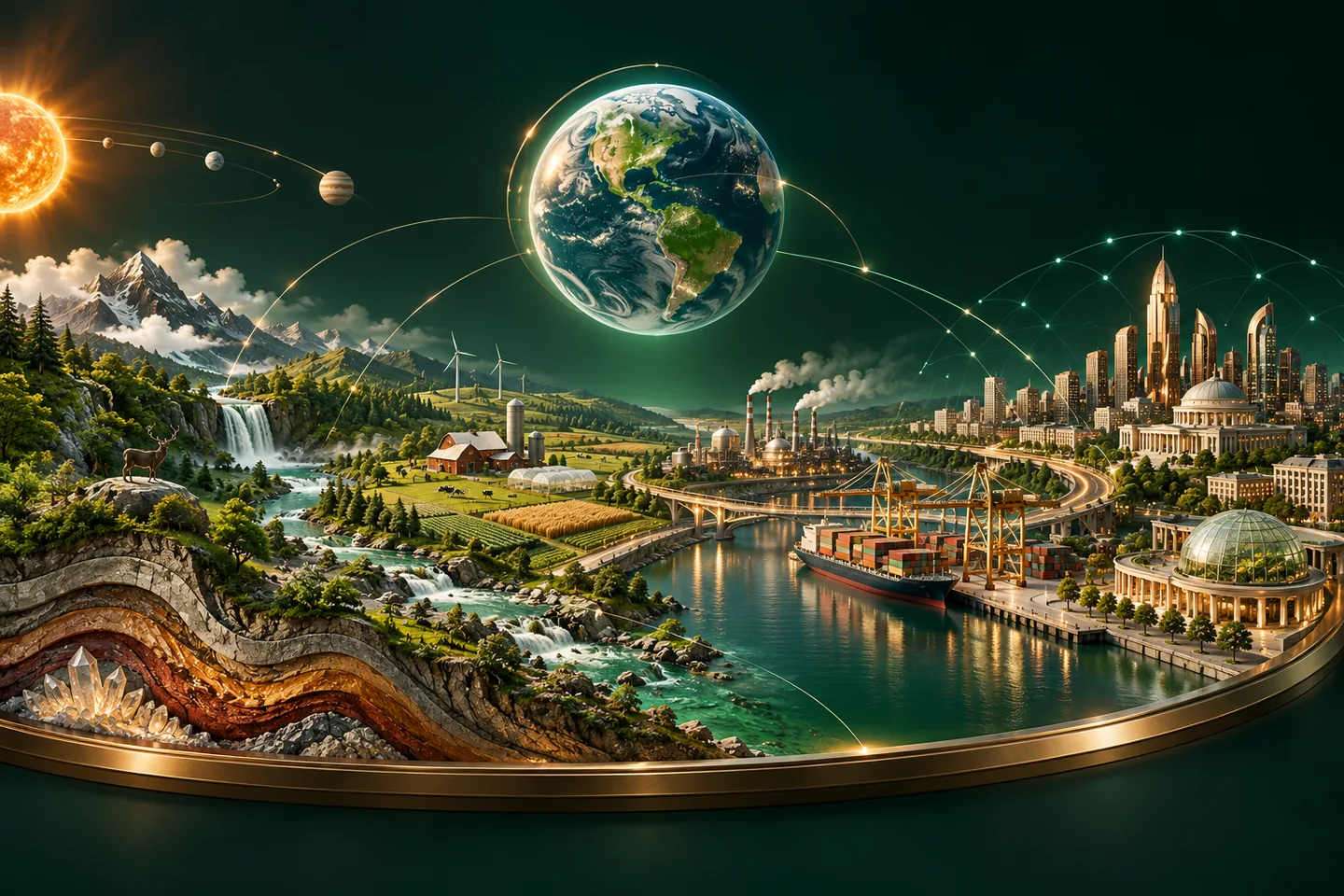
No system stands alone.
Each chapter reveals one layer. Together, they offer a way to ask better questions about the world around you.
The rules beneath everything.
Before there is a forest, a factory or a phone, there is a physical world.
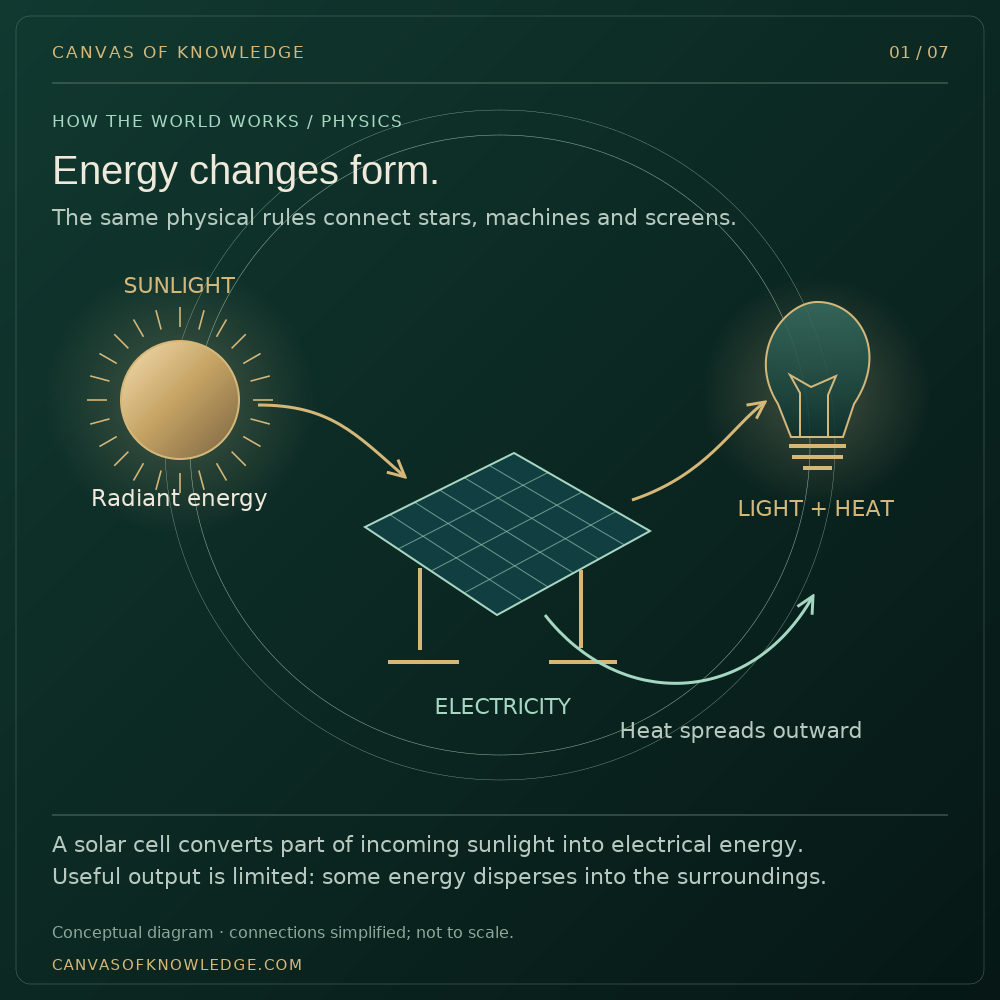
Energy changes form. Sunlight can become electricity; electricity can become movement, light or computation. Some energy spreads into heat, reducing the amount available for useful work.
Source: U.S. Energy Information Administration ↗Follow the energy.
Ask what enters a system, what it becomes, and where the heat goes.
 Explore full size ↗
The same sunlight that powers a solar panel also supports photosynthesis.
Next: Nature ↓Life makes connections.
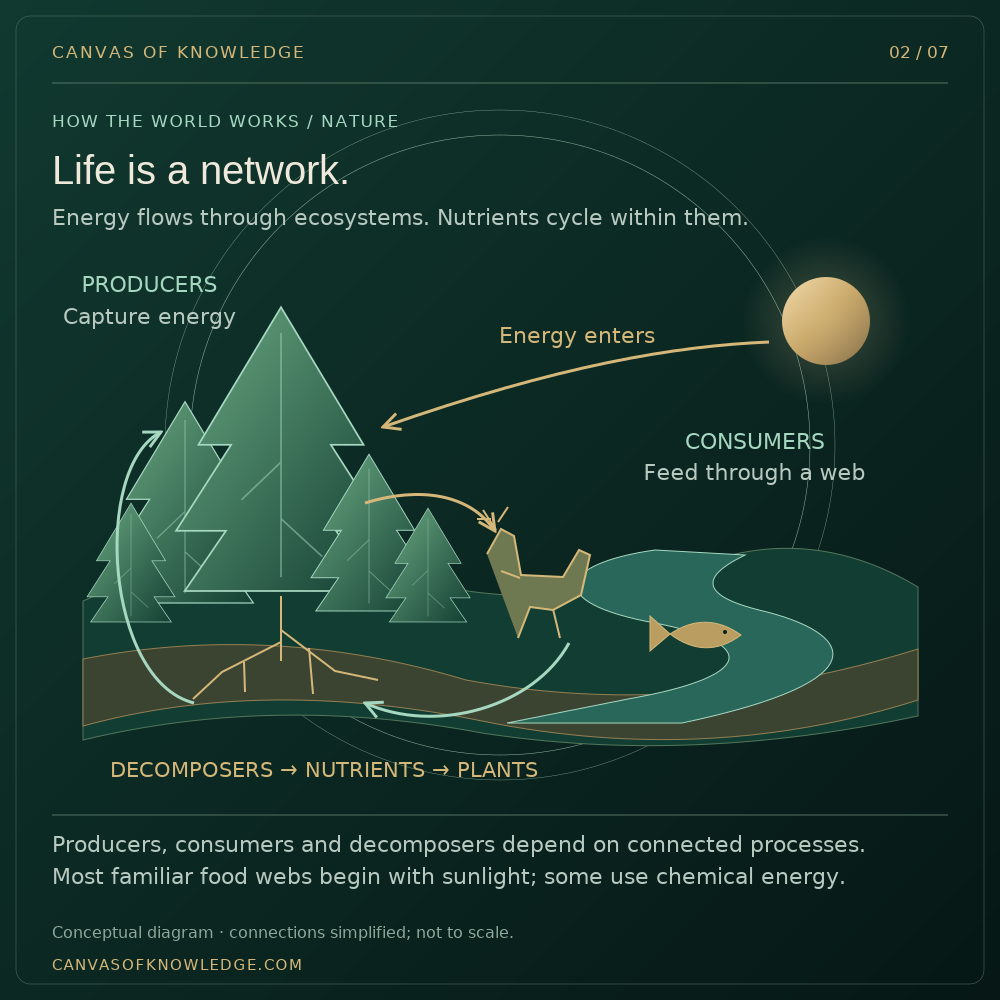
An ecosystem is a web of relationships, above the ground and beneath it.
Producers capture energy. Consumers obtain it through food. Decomposers return nutrients to the environment. Matter cycles through living and non-living parts of the system; energy flows through and disperses.
Source: NOAA ↗Look beyond one species.
A change to one population can affect the organisms connected to it. Most familiar food webs start with sunlight; some rely on chemical energy.
 Explore full size ↗
Human production draws on materials, water and living systems.
Next: Production ↓Many hands. One everyday object.
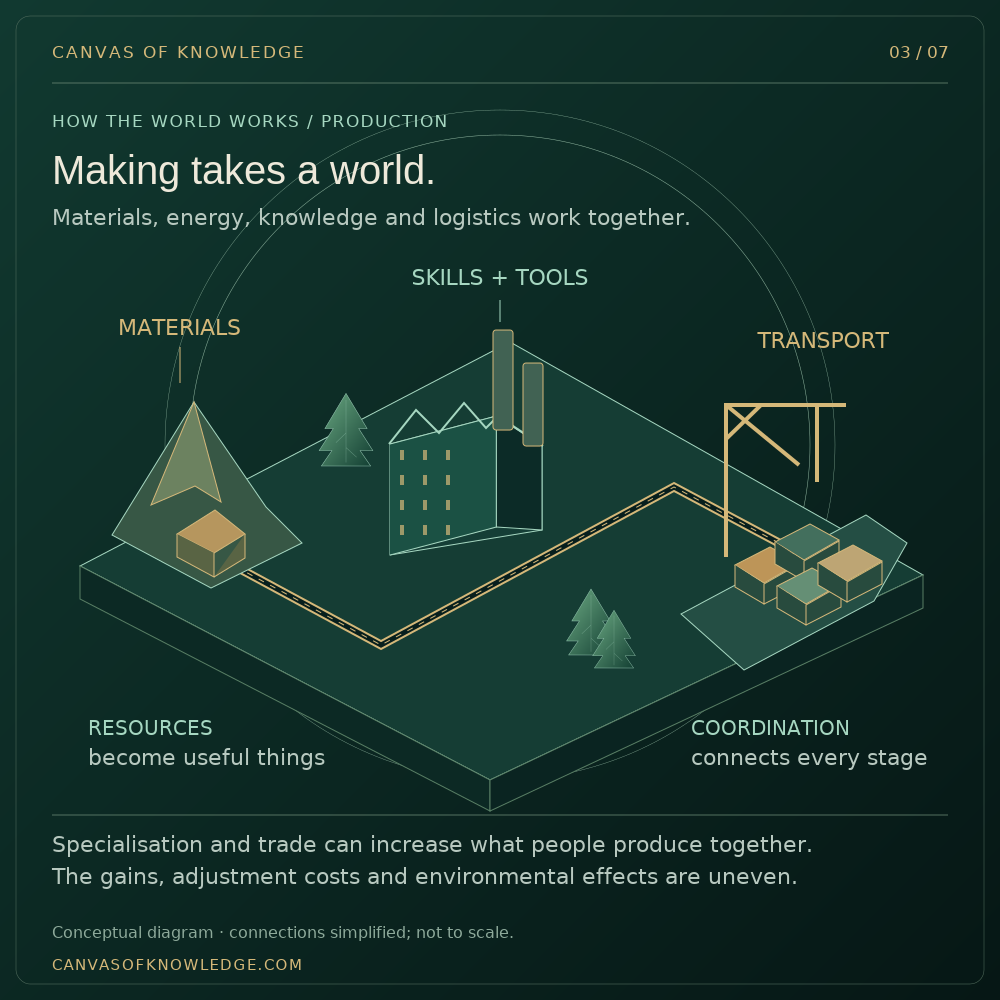
The things around us are the result of coordinated work.
Materials, energy, skills and tools become products. Transport connects producers with users. Specialisation and trade can expand what people collectively produce, but the gains and the costs of adjustment are uneven.
Source: International Monetary Fund ↗Trace the journey.
Look for the materials, the makers and the routes between them. A bottleneck in one place can delay the next stage.
 Explore full size ↗
Prices and payments help coordinate these exchanges.
Next: Money ↓A language we use to exchange.
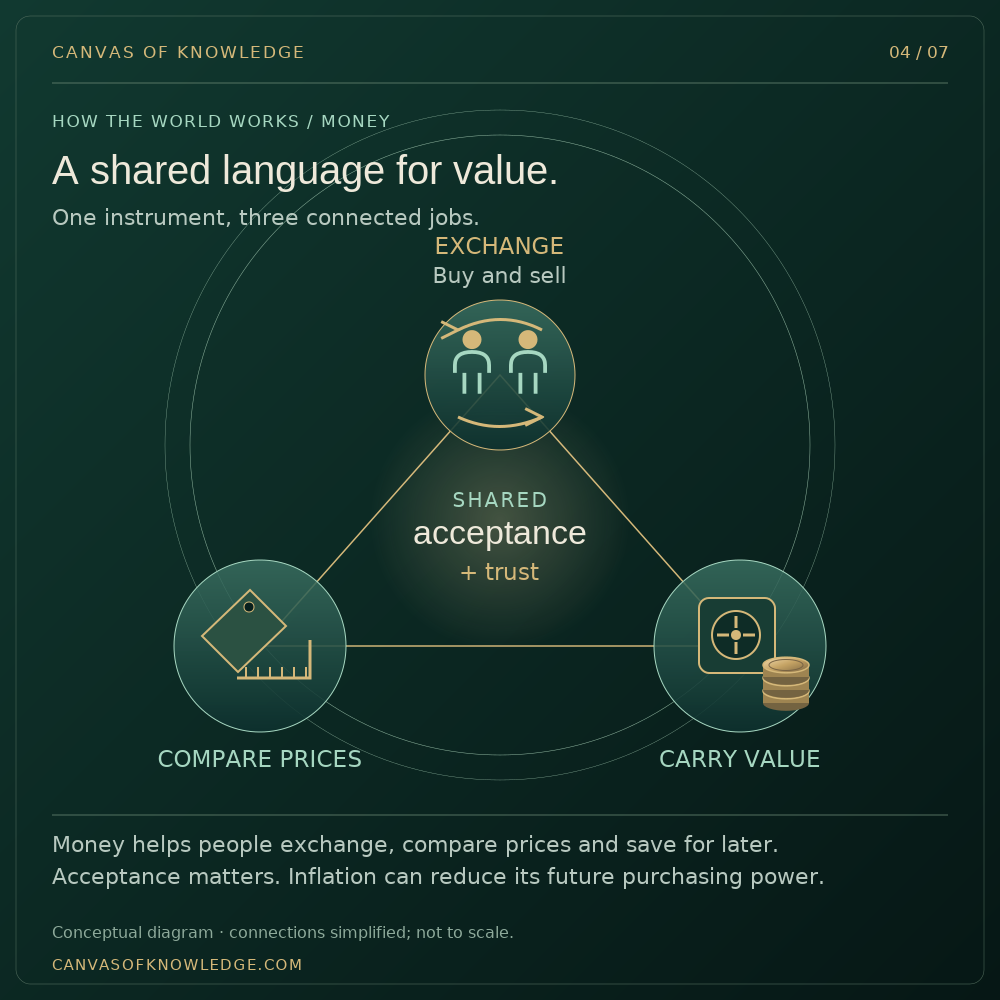
Money helps people cooperate without directly swapping one item for another.
It serves as a medium of exchange, a common unit for quoting prices and a way to carry purchasing power into the future. Acceptance matters. A fixed face value does not guarantee fixed purchasing power.
Source: Bank of England ↗Separate price from value.
A price expresses an exchange in money. It does not capture every environmental cost, social benefit or personal meaning.
 Explore full size ↗
Money and markets operate within rules, responsibilities and institutions.
Next: Institutions ↓Cooperation needs structure.
Shared life depends on how decisions are made—and how power is checked.
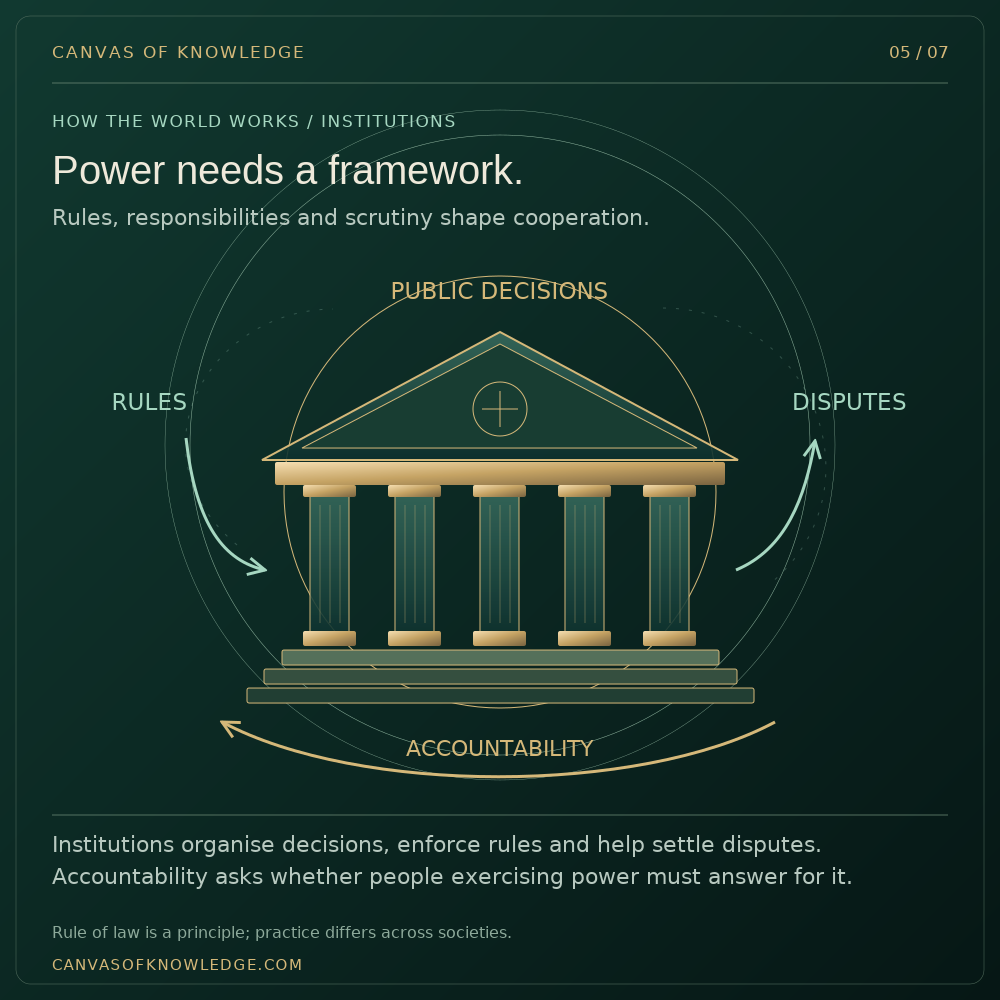
Institutions organise public decisions, define responsibilities and provide ways to resolve disputes. The rule-of-law ideal asks that people and institutions, including the state, are accountable to laws applied fairly.
Source: United Nations ↗Ask who decides.
Who makes the rules? Who applies them? Who can challenge a decision? The diagram is a framework for inquiry, not a description of every country.
 Explore full size ↗
People need information to understand decisions and question their effects.
Next: Information ↓Knowledge changes what happens next.
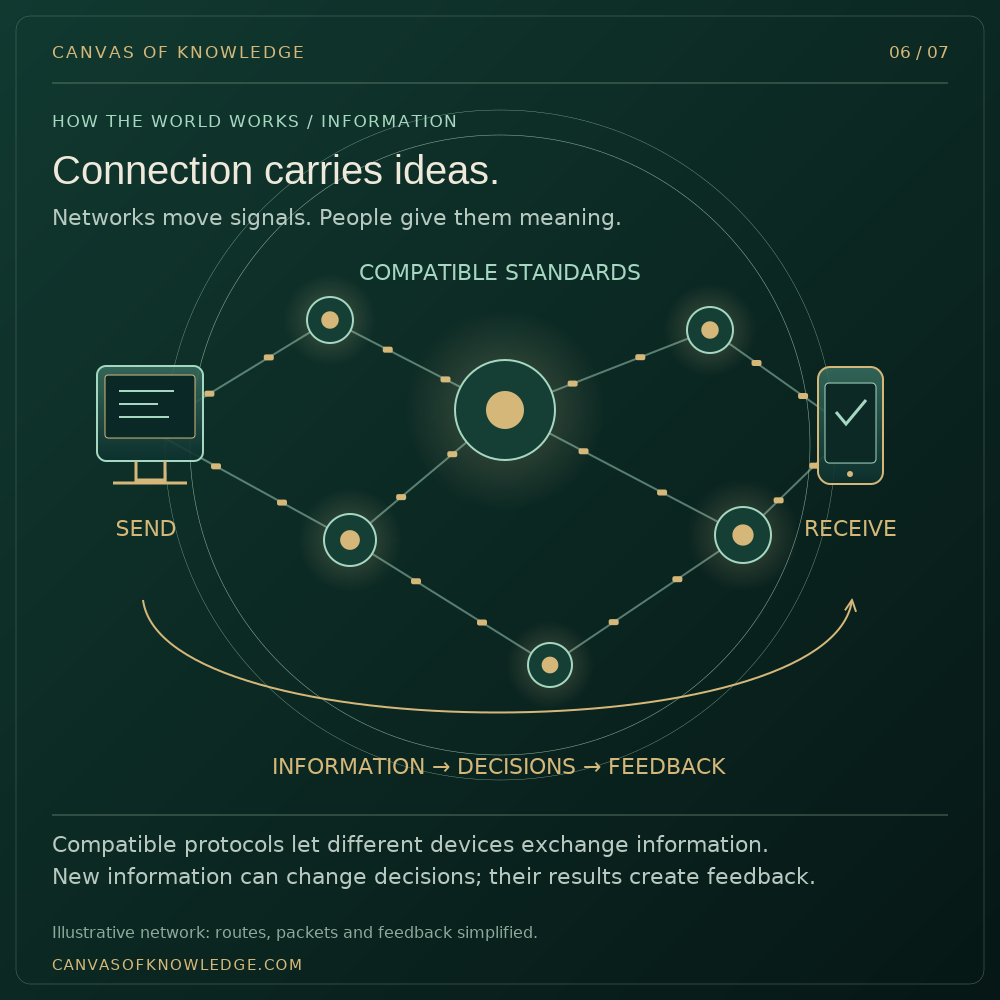
Information travels through networks. Its effects travel through people.
The Internet connects independently operated networks using compatible standards. People interpret the messages they receive, make decisions and create outcomes. Those outcomes become new information.
Source: Internet Society ↗Follow the feedback.
Connection does not guarantee accuracy. Distinguish the message, the evidence behind it, and the decision someone makes from it.
 Explore full size ↗
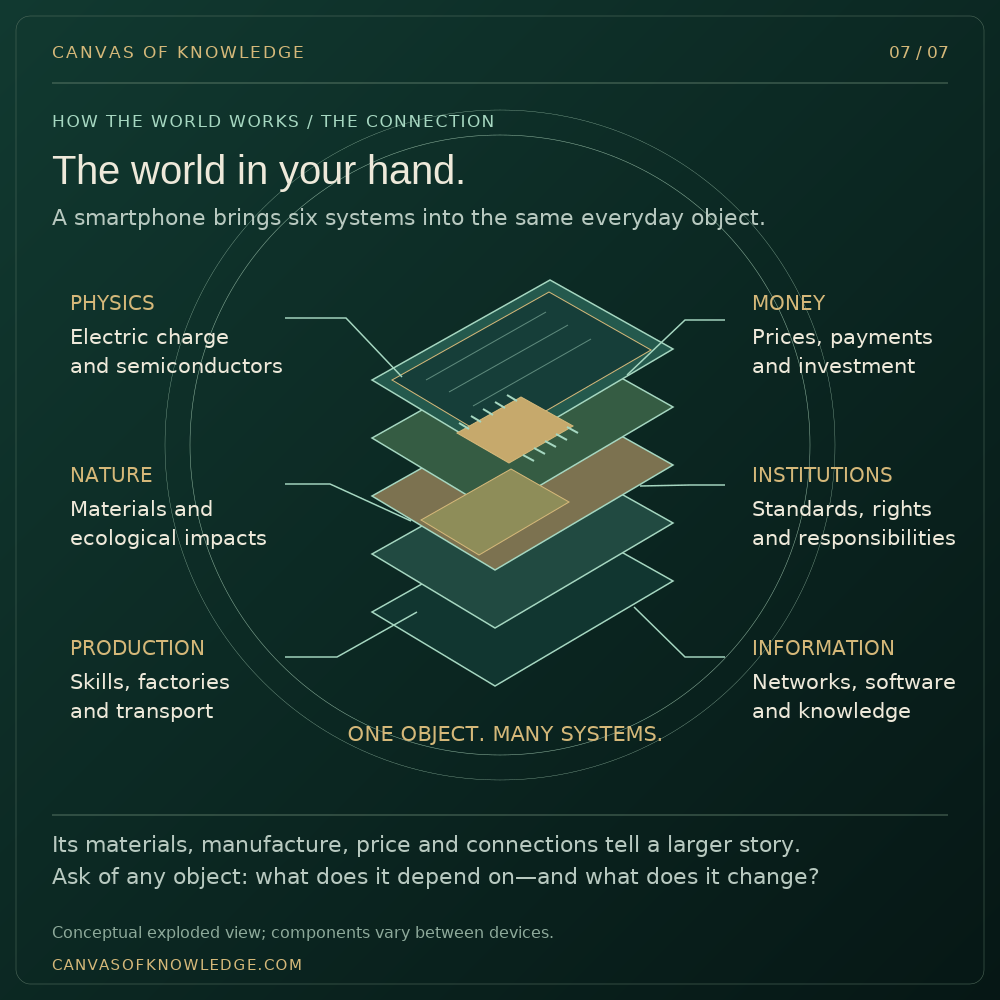
Every system comes together in an object you may be holding right now.
Next: The world in your hand ↓The world
in your hand.
A smartphone is a meeting point of all six systems. Change the lens and a familiar object reveals a different story.
 Explore full size ↗
Electricity becomes capability.
Electric charge powers circuits, displays and computation. The phone also releases heat.
Illustrative connections, not a component specification. Materials and design vary between devices. Mineral examples: USGS ↗
Keep exploring Technology →Curiosity,
with foundations.
Original visual explanations based on these educational sources. The diagrams simplify mechanisms; they are not measured data charts. The six-system framework and cross-system connections are our editorial synthesis.
Source review: 17 November 2026.
- 01U.S. Energy Information AdministrationLaws of energy ↗
- 02
- 03International Monetary FundInternational trade: commerce among nations ↗
- 04Bank of EnglandWhat is money? ↗
- 05United NationsWhat is the rule of law? ↗
- 06Internet SocietyHow the Internet works ↗
- 07U.S. Geological SurveyMinerals in mobile devices ↗
The more connections you see,
the more the world makes sense.