Before paper
For thousands of years, people wrote on whatever durable materials they could find. Mesopotamians pressed marks into clay tablets. Egyptians wrote on papyrus, made from reeds. Europeans used parchment made from animal skin, which was strong but expensive. In ancient China, writing was done on strips of bamboo or wood, which were heavy, or on silk, which was costly. All these materials had limits: they were bulky, rare or expensive, which kept writing in the hands of a few.
Invented in China
Archaeologists have found fragments of early paper in China dating back to the second century BC, made from plant fibres. The traditional story credits Cai Lun, an official at the Han dynasty court, with presenting an improved method of papermaking to the emperor around AD 105. He is said to have used tree bark, hemp, old rags and fishing nets. Whether he invented paper or refined it, his method made a cheaper, lighter writing surface widely available.
How paper was made
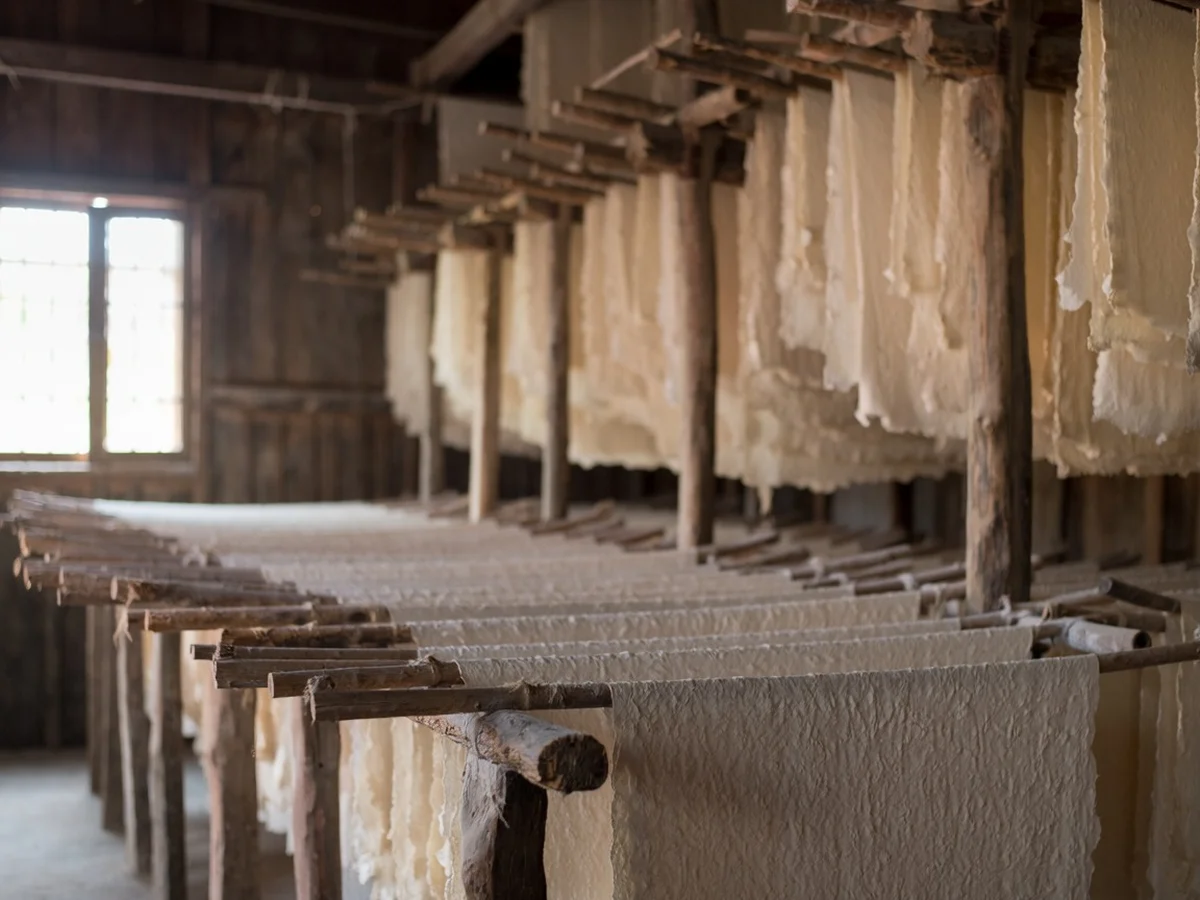
The basic process has changed little in principle. Plant fibres are soaked and beaten until they separate into a wet pulp. A frame with a fine screen is dipped into the pulp and lifted out, catching a thin, even layer of fibres. As the water drains, the fibres mat together. The sheet is then pressed to remove more water and left to dry. The result is a flat, flexible surface that takes ink well and can be cut, folded and bound.
Across Asia and into the Islamic world
For centuries papermaking stayed largely in China, though it spread to Korea, Japan and Vietnam. It reached Central Asia by the eighth century; a famous tradition says papermakers taken prisoner at the Battle of Talas in 751 brought the craft to Samarkand. By the end of the eighth century, Baghdad had paper mills. Paper fed the growth of libraries and scholarship in the Abbasid world, making books far more affordable than before.
Arriving in Europe
Paper reached Europe through the Islamic world. Mills were operating in Spain by the twelfth century, and in Italy by the thirteenth, where the town of Fabriano became famous for high-quality paper and for watermarks. At first many Europeans saw paper as less durable than parchment. But as demand for writing grew, its low cost won. When printing with movable type arrived in the fifteenth century, paper was ready to meet the enormous demand for books.
From rags to wood pulp
For most of its history, paper was made from rags and plant fibres, which limited supply. In the nineteenth century, new machines and the use of wood pulp made paper cheap enough for newspapers, school books and packaging to become part of everyday life. Today paper is still produced on a vast scale, and a large share is recycled. The same basic idea, a mat of fibres pressed into a sheet, remains at its heart.
Paper in the Islamic world
Baghdad, Damascus, Cairo and later Córdoba became important centres of papermaking. Cheaper paper supported the work of scholars, translators and government offices, and helped create a lively book trade. Libraries grew, and copyists produced works on mathematics, astronomy, medicine and literature. Paper also made it easier to keep administrative records and accounts, supporting the running of a large state stretching across many regions.
Paper beyond writing
Paper quickly found uses beyond books. In China it was used for wrapping, clothing, decorations and even early forms of toilet paper. During the Song dynasty, China issued some of the world's first paper money. Paper was used for kites, lanterns, fans and screens. Later, in Europe and beyond, it carried maps, playing cards, posters and newspapers, becoming part of almost every aspect of daily life.
Papermaking as an art
Handmade papermaking survives as a craft today. Japanese washi, made from the inner bark of shrubs such as kozo, is prized for its strength and texture and is recognised by UNESCO as intangible cultural heritage. Artists and conservators around the world still make paper by hand, using methods close to those described in China nearly two thousand years ago.
Why it matters
Paper made it possible to record laws, accounts, letters, maps, science and stories cheaply and in large numbers. It helped governments run large states, merchants keep records and scholars share ideas across great distances. Together with printing, it transformed how knowledge spread. Even in a digital age, the journey of paper from Han China to the rest of the world remains one of history's most important stories of a single invention changing everything.
Sources & further reading
General information; some early dates and stories are traditional and debated by historians. Photograph: original AI-generated illustration (Adobe Firefly). Reference organisations do not endorse this website.