A data deluge
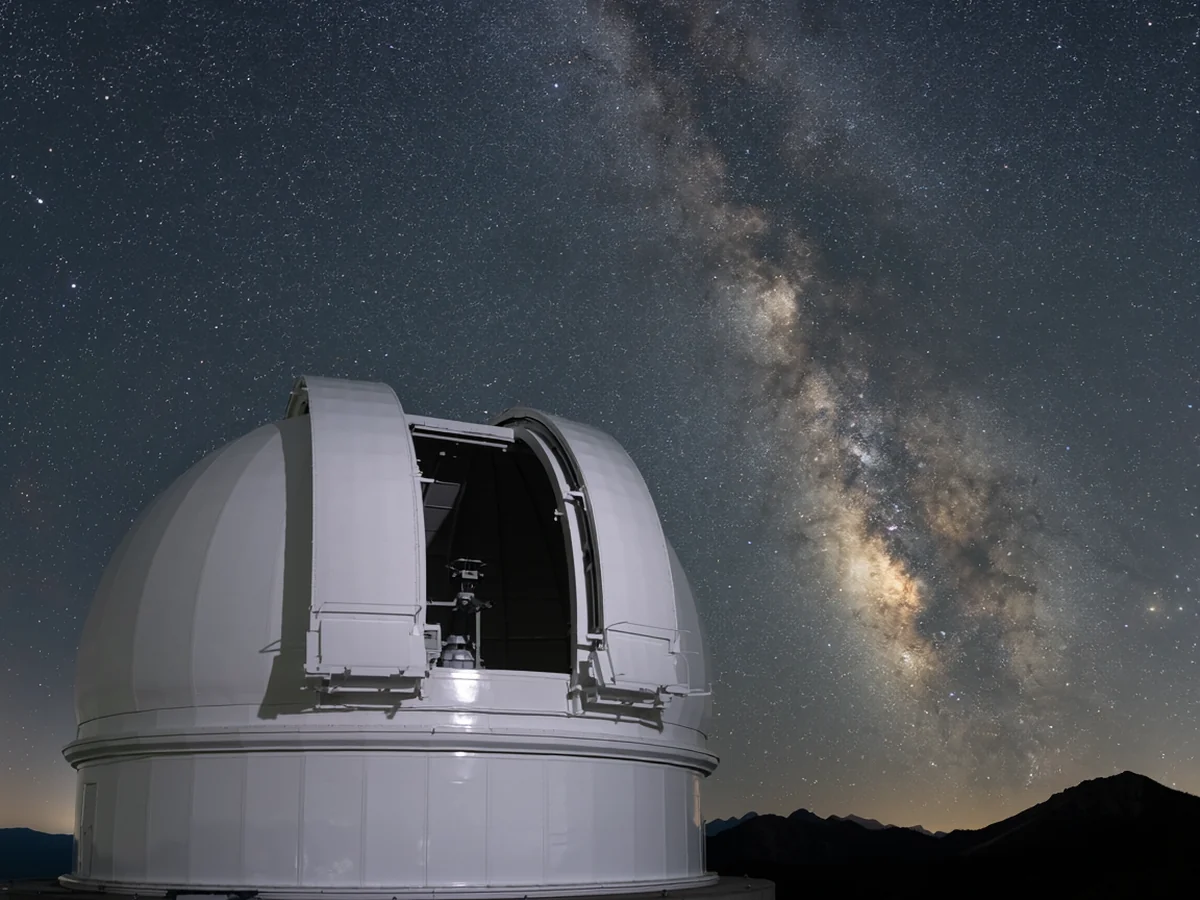
Astronomy has become a big data science. Space telescopes such as Kepler and TESS have monitored the brightness of hundreds of thousands of stars, and large ground-based surveys photograph the entire visible sky repeatedly. The Vera C. Rubin Observatory in Chile, which began operations in 2025, is expected to generate around 20 terabytes of data every night and millions of alerts about changing objects. No team of humans could examine all of it.
Finding planets
Many exoplanets, planets orbiting other stars, are detected by the transit method: when a planet passes in front of its star, the star's brightness dips slightly. The Kepler space telescope recorded such signals for about 150,000 stars, but distinguishing real planets from false signals caused by stellar activity, binary stars or instrument noise is difficult. Machine learning models can be trained on confirmed examples to recognise genuine planetary signals.
Kepler-90i
In December 2017, NASA announced that a neural network developed by Google researcher Christopher Shallue and astronomer Andrew Vanderburg had found an eighth planet around the star Kepler-90, about 2,500 light years away. The discovery made Kepler-90 the first known system to tie our solar system's eight planets. The AI had been trained on thousands of Kepler signals and then used to search for weak signals that previous methods had missed.
ExoMiner
In 2021, NASA researchers introduced ExoMiner, a deep learning system that analyses Kepler data and helps determine whether signals are likely to be real planets. It validated 301 new exoplanets at once, adding them to the catalogue of thousands known. ExoMiner was designed to be explainable, showing astronomers which features of the data supported its conclusions, which helps scientists trust and check its decisions.
Classifying galaxies
Sky surveys capture images of hundreds of millions of galaxies with different shapes, such as spirals, ellipticals and irregular forms, which reveal how they formed and evolved. Citizen science projects like Galaxy Zoo asked volunteers to classify galaxies, and their labels were later used to train AI models that can classify enormous numbers automatically. AI is also used to find gravitational lenses, where massive objects bend light from more distant galaxies.
Catching cosmic events
Some astronomical events last only hours or days: supernova explosions, flares from black holes, collisions of neutron stars and near-Earth asteroids. Automated systems using machine learning scan new images, compare them with older ones and flag changes that deserve follow-up observations. With the Rubin Observatory producing millions of alerts each night, AI-powered brokers are essential to identify the most interesting events quickly.
Radio signals
Radio telescopes also generate huge data volumes. AI helps detect fast radio bursts, brief and mysterious flashes of radio waves from distant galaxies, and filters out interference from human technology such as phones and satellites. Researchers have also used machine learning to search radio data for possible signals from extraterrestrial technology, so far finding nothing confirmed but demonstrating new ways to analyse large datasets.
AI in spacecraft
Spacecraft increasingly use AI to operate autonomously, since signals from distant missions can take minutes or hours to reach Earth. NASA's Mars rovers use AI-assisted navigation to plan safe routes and select interesting rocks to study. Earth observation satellites use onboard AI to filter out cloudy images before sending data down. Future missions to the outer solar system may rely heavily on AI to make decisions independently.
The UAE in space
The UAE has become an active space nation. Its Hope probe, which reached Mars orbit in 2021, studies the Martian atmosphere and has produced large datasets for scientists worldwide. The Mohammed bin Rashid Space Centre builds Earth observation satellites, and the country plans a mission to the asteroid belt. AI is increasingly used to analyse satellite and mission data, linking the UAE's ambitions in space and in artificial intelligence.
Why it matters
AI is transforming how we explore the universe, making it possible to find planets, galaxies and events hidden in oceans of data. It frees astronomers to focus on interpretation and new questions. As telescopes grow more powerful, AI will be essential for answering some of the biggest questions in science: how galaxies form, what dark matter and dark energy are, and whether life exists elsewhere.
Sources & further reading
- NASA · Artificial intelligence, NASA data used to discover eighth planet circling distant star (2017) ↗
- NASA · 301 new exoplanets validated with ExoMiner (2021) ↗
- Rubin Observatory · About the Legacy Survey of Space and Time ↗
Exoplanet counts change as new discoveries are confirmed. Photograph: original AI-generated illustration (Adobe Firefly). Reference organisations do not endorse this website.