The promise of fusion
Nuclear fusion joins light atomic nuclei, such as forms of hydrogen, releasing enormous energy, the same process that powers the Sun. A fusion power plant would produce no carbon emissions, use fuel derived from water and lithium, and create far less long-lived radioactive waste than today's nuclear fission reactors. For decades, fusion has been the ultimate clean energy goal, but making it work on Earth has proved extremely difficult.
The challenge of plasma
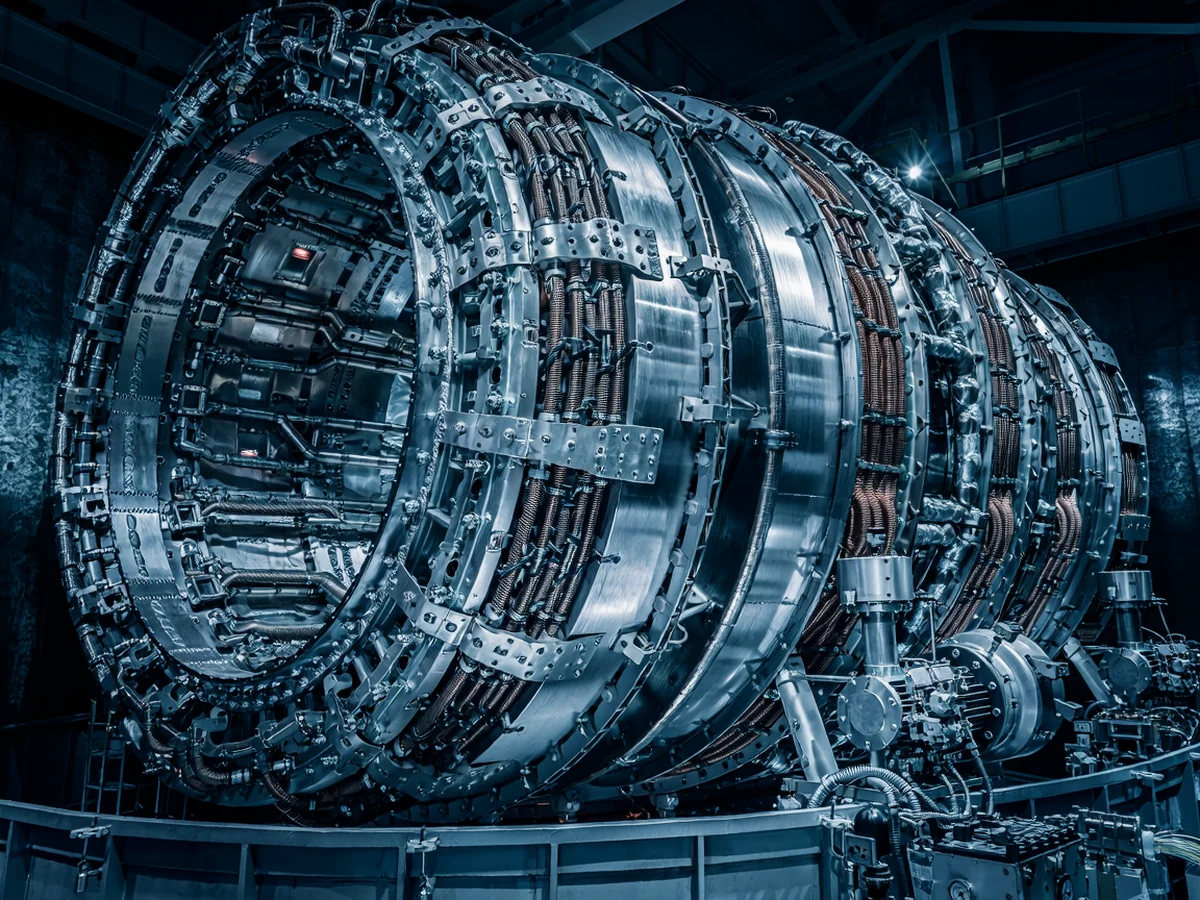
Fusion requires heating fuel to more than 100 million degrees Celsius, hotter than the Sun's core, turning it into plasma, a gas of charged particles. No material can hold such heat, so devices called tokamaks use powerful magnetic fields to suspend the plasma in a doughnut-shaped chamber. Plasma is unstable and can wriggle, escape or suddenly collapse, so controlling it requires constant, precise adjustments to the magnetic fields.
DeepMind and TCV
In February 2022, Google DeepMind and the Swiss Plasma Center at EPFL published research in Nature showing that a reinforcement learning system could control plasma in the TCV tokamak in Lausanne. The AI was trained in a simulation of the reactor and then took control of its 19 magnetic coils, adjusting them thousands of times per second. It successfully created and maintained a range of plasma shapes, including novel configurations, using a single control system.
Why this was significant
Traditional tokamak control systems use many separate controllers, each carefully designed by engineers for specific tasks and plasma shapes. The AI approach learned to achieve goals, such as a particular plasma shape, directly, potentially making it easier to explore new configurations that might improve performance. It demonstrated that AI trained in simulation could safely control a real, complex physical system, with lessons for other fields.
Predicting disruptions
One of the biggest risks in tokamaks is a disruption, a sudden loss of plasma confinement that can release energy violently and damage the machine. Researchers have used machine learning to predict disruptions from sensor data, giving control systems time to respond. In 2024, a team at Princeton reported in Nature an AI system that could forecast a dangerous type of plasma instability about 300 milliseconds in advance and adjust controls to avoid it in experiments at a US fusion facility.
Faster simulations
Designing and operating fusion reactors relies on complex simulations of plasma physics, which can take enormous computing time. AI models trained on simulation results can approximate them much faster, allowing researchers to explore more designs and operating scenarios. In 2025, Google DeepMind announced a research partnership with Commonwealth Fusion Systems, a US fusion company, to use AI simulation and control tools for its SPARC tokamak.
A fusion boom
Fusion research has seen a surge of private investment, with dozens of companies pursuing different approaches. In December 2022, the US National Ignition Facility achieved ignition, producing more energy from fusion reactions than the laser energy delivered to the fuel, a historic milestone. Technology companies have also signed agreements to buy power from future fusion plants: Microsoft with Helion, and Google with Commonwealth Fusion Systems, reflecting interest in clean power for AI.
ITER and beyond
ITER, a giant international fusion experiment being built in France by a coalition including the European Union, China, India, Japan, South Korea, Russia and the United States, aims to demonstrate fusion at a large scale. It has faced long delays and cost increases. AI tools are being developed to help operate such complex machines. Many experts expect the first fusion power plants to deliver electricity to grids in the 2030s or later.
A virtuous circle
Fusion and AI may help each other. AI needs vast amounts of clean electricity, which fusion could one day provide, while AI is helping to solve the scientific and engineering problems that have held fusion back. Some AI leaders have expressed optimism that AI could accelerate fusion development significantly. Sceptics caution that fusion still faces formidable challenges in materials, engineering and economics that AI alone cannot solve.
Why it matters
If fusion power becomes practical, it could transform the world's energy supply, providing abundant clean electricity for homes, industry and data centres. AI's role in controlling plasma and accelerating research is one of the most inspiring examples of how AI can contribute to solving humanity's biggest challenges. The journey to fusion energy is long, but AI may help shorten it.
Sources & further reading
- Nature · Magnetic control of tokamak plasmas through deep reinforcement learning (2022) ↗
- Nature · Avoiding fusion plasma tearing instability with deep reinforcement learning (2024) ↗
- Google DeepMind · Bringing AI to the next generation of fusion energy (2025) ↗
Fusion timelines are uncertain. Photograph: original AI-generated illustration (Adobe Firefly). Reference organisations do not endorse this website.