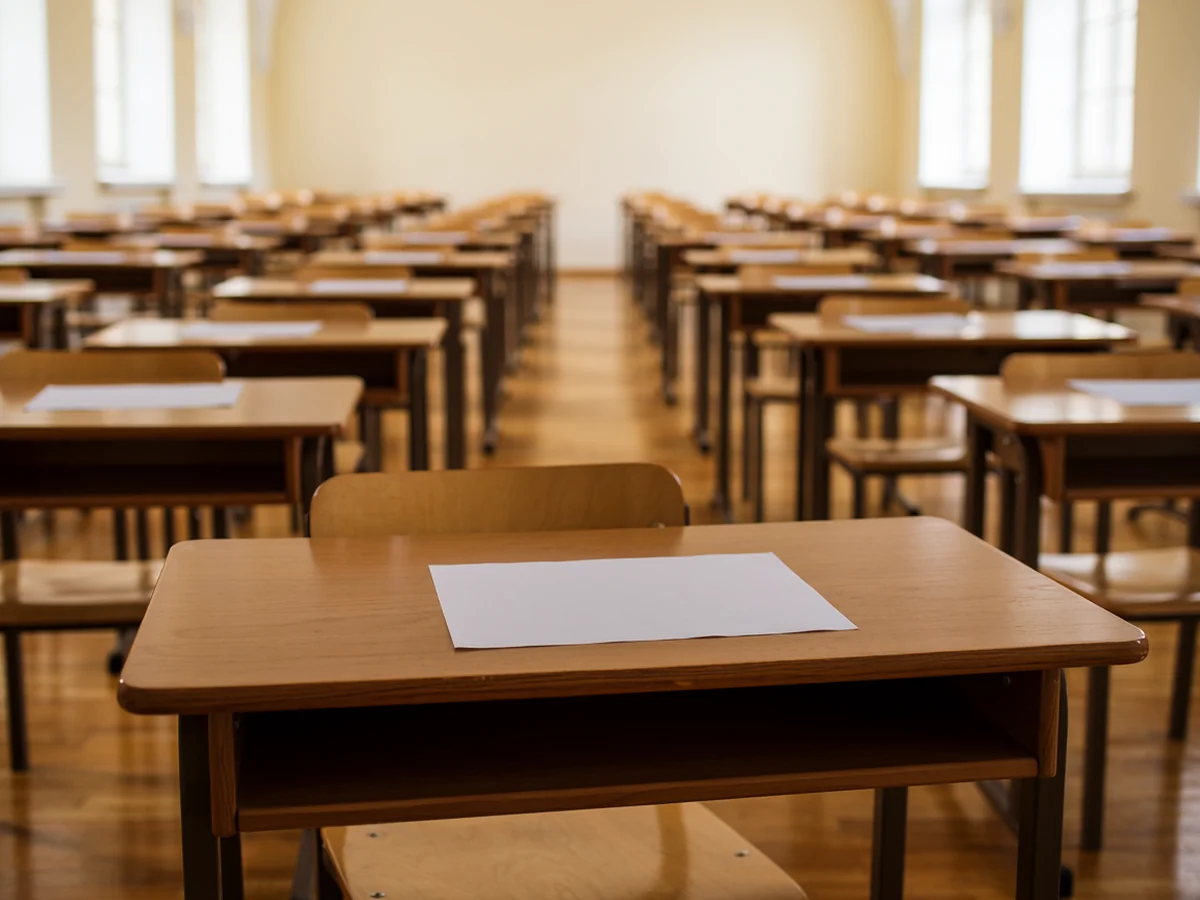
Exams cancelled
In March 2020, as the COVID-19 pandemic spread, the UK government cancelled the summer exams that students take at 16 and 18, including A-levels, which are crucial for university entry. Students still needed grades. Teachers were asked to submit the grade they believed each student would have achieved, along with a ranking of students in each subject, so that results could be calculated instead.
The standardisation model
England's exam regulator, Ofqual, was concerned that teacher predictions would be too generous, causing grade inflation compared with previous years. It developed a statistical standardisation model to adjust the grades. The model relied heavily on each school's historical results and the teachers' rankings of students. In effect, students' grades were influenced by how pupils at their school had performed in previous years.
Results day
When A-level results were released on 13 August 2020, about 39% of grades were lower than teachers had assessed, according to reported figures. Many students missed the grades needed for their university offers. Analysis showed the model tended to lower grades more for students at state schools with weaker historical results, while students at small classes, common in private schools, were less affected because the model relied more on teacher grades for small groups.
Anger and protests
There was a public outcry. Students, parents and teachers argued that it was deeply unfair for individual students to be judged by their school's past performance rather than their own work. Bright students at struggling schools were particularly affected. Students protested outside the Department for Education in London, chanting against the algorithm, and the story dominated the news. Opposition politicians and education experts criticised the approach.
Scotland moves first
Scotland, which runs its own exam system, had faced a similar controversy days earlier. Its exam body had downgraded about 125,000 results, again affecting pupils from poorer areas more. After protests, the Scottish government apologised and reinstated teachers' estimates on 11 August 2020. This added pressure on the government in England, where results were released two days later using a similar approach.
The U-turn
On 17 August 2020, the government and Ofqual announced that students in England would receive their teacher-assessed grades if these were higher than the algorithm's grades. Wales and Northern Ireland made similar decisions. Prime Minister Boris Johnson later blamed a mutant algorithm. Ofqual's chief regulator stepped down a week later. Many universities struggled to accommodate students whose grades rose after places had already been allocated.
Was it AI?
The Ofqual model was not artificial intelligence in the modern sense; it was a statistical formula rather than a learning system like ChatGPT. But the episode is widely discussed in debates about AI and automated decision-making, because it showed what can happen when a computer-based system makes important decisions about people without sufficient attention to fairness, transparency and individual circumstances.
Lessons learned
Experts drew several lessons. Systems that judge individuals based on group data can be unfair, even if they produce accurate averages. People affected by automated decisions need to understand how they are made and be able to challenge them. Testing a system's impact on different groups before using it is essential. And public trust depends not only on technical accuracy, but on whether decisions are seen as fair and legitimate.
Echoes today
Similar concerns arise whenever governments use algorithms to make decisions about people, such as welfare benefits, policing or immigration. In the Netherlands, a scandal over an algorithm used to detect childcare benefit fraud, which wrongly accused thousands of families, contributed to the government's resignation in 2021. Laws such as the EU AI Act now classify AI used in education and public services as high-risk, requiring safeguards.
Why it matters
The 2020 exam crisis showed that algorithms can have a profound effect on people's futures, and that fairness for individuals matters as much as accuracy for groups. As governments around the world, including in the Gulf, use AI to make decisions in education and public services, the episode is a powerful reminder to design systems carefully, explain them clearly and keep humans accountable.
Sources & further reading
- Wikipedia · 2020 United Kingdom school exam grading controversy ↗
- BBC News · A-levels and GCSEs: U-turn as teacher estimates to be used for exam results (2020) ↗
- GOV.UK · Ofqual ↗
Historical overview; figures are as reported. Photograph: original AI-generated illustration (Adobe Firefly). Reference organisations do not endorse this website.