Beyond board games
After AI mastered chess and Go, researchers looked for harder challenges. Modern strategy video games offered them. Unlike board games, they happen in real time, with players making many decisions per minute. Players see only part of the map, so they must scout and guess what opponents are doing. Games last a long time, so early choices affect outcomes much later, and there are vast numbers of possible actions at every moment.
Dota 2
Dota 2 is a popular multiplayer online battle arena game in which two teams of five players each control a hero with unique abilities, trying to destroy the other team's base. It requires individual skill, long-term strategy and close teamwork. Its professional scene offers large prizes. OpenAI, then a young research lab, chose Dota 2 to test whether AI could learn teamwork and long-term planning in a complex environment.
OpenAI Five
OpenAI built OpenAI Five, a team of five neural networks, each controlling one hero. They learned entirely through self-play, playing against copies of themselves, with OpenAI reporting that the system played the equivalent of about 45,000 years of Dota 2 over ten months of training. It used reinforcement learning, receiving rewards for actions that helped win. The networks learned to coordinate without directly communicating, through shared experience.
Beating the champions
In August 2018, OpenAI Five lost two exhibition matches against professional teams at Dota 2's world championship, The International. It kept training. In April 2019, in San Francisco, it defeated OG, the reigning world champion team, two games to none, becoming the first AI to beat world champions in an esports game. Shortly afterwards, OpenAI opened it to the public online, where it won 99.4% of more than 7,000 games.
StarCraft II
StarCraft II, made by Blizzard Entertainment, is a real-time strategy game in which players gather resources, build bases and armies and battle opponents, choosing between three different races with distinct units and strategies. It is played at a very high professional level, particularly in South Korea, and has been a long-standing grand challenge for AI researchers because of its complexity and need for both quick tactics and long-term planning.
AlphaStar
DeepMind developed AlphaStar to play StarCraft II. It first learned by imitating human games, then improved through a league of AI agents competing against each other, each exploring different strategies. In January 2019, AlphaStar beat two professional players in test matches. Critics noted it had advantages, such as seeing more of the map at once, so DeepMind added restrictions to make its play more comparable to humans.
Grandmaster level
In October 2019, DeepMind reported in Nature that AlphaStar had reached Grandmaster level on Blizzard's official online servers, playing under conditions designed to be fair to humans, including limits on how fast it could act. It was rated above 99.8% of officially ranked human players and reached Grandmaster level with all three races. It was the first AI to reach the top league of a widely played esport without simplifications.
What the AIs taught players
Human players studied the AIs' strategies. OpenAI Five favoured aggressive play and different approaches to sharing resources between heroes, which some professionals later experimented with. AlphaStar's play included unconventional tactics. However, some players found weaknesses, especially when using unusual strategies the AIs had not encountered, showing that even powerful AI can be brittle in unfamiliar situations.
Lessons for AI
These projects demonstrated that reinforcement learning and self-play could scale to extremely complex environments, but they also required enormous computing resources, raising questions about efficiency. The research contributed to methods later used in robotics, such as OpenAI's robotic hand that learned to solve a Rubik's Cube, and to training techniques for large AI models. OpenAI soon shifted its focus to language models such as GPT.
Why it matters
Real-world problems, from managing traffic to coordinating robots, involve real-time decisions, incomplete information and teamwork. OpenAI Five and AlphaStar showed that AI could learn such skills in complex virtual worlds. They marked the moment AI reached the top of esports, and they remain important milestones on the path from game-playing machines to more general AI systems.
Sources & further reading
- OpenAI · OpenAI Five defeats Dota 2 world champions (2019) ↗
- Nature · Grandmaster level in StarCraft II using multi-agent reinforcement learning (Vinyals et al., 2019) ↗
- Wikipedia · OpenAI Five ↗
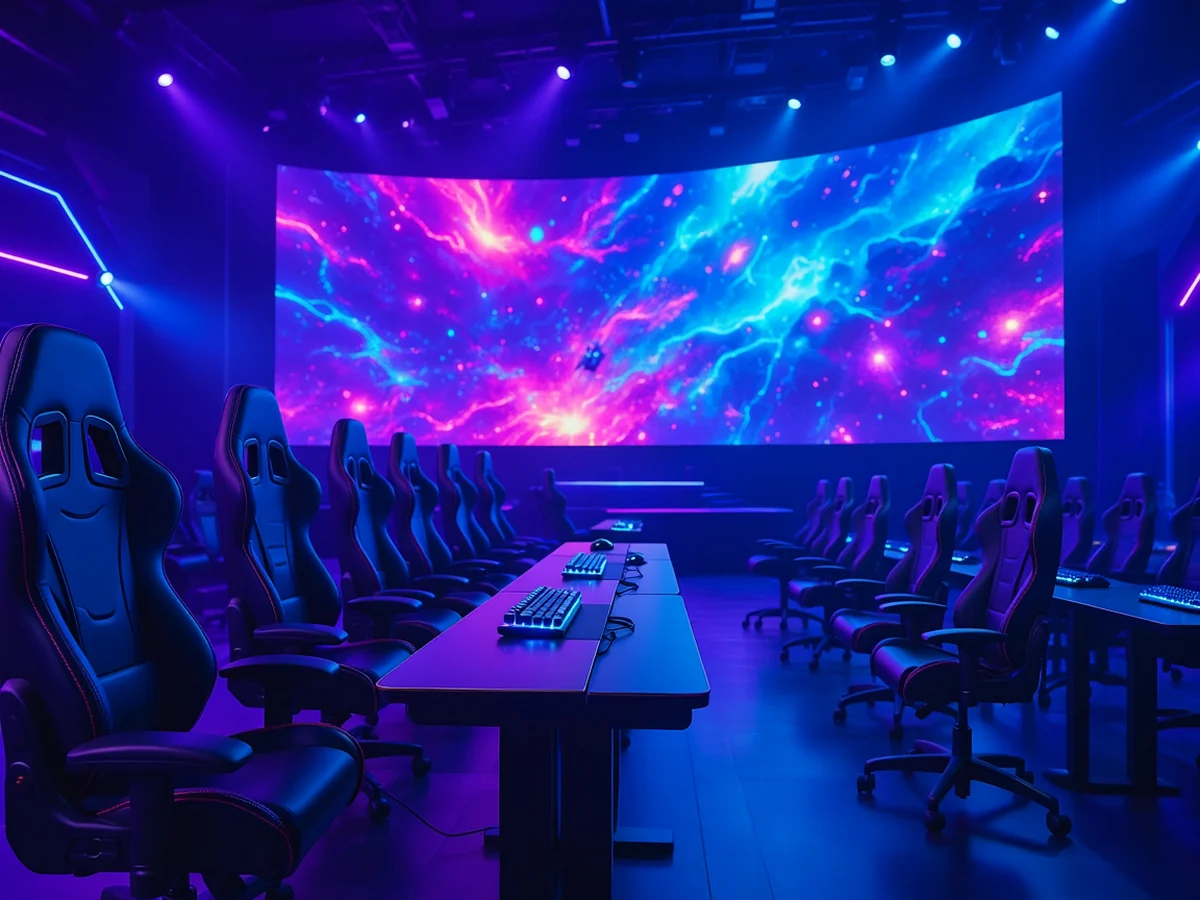
Historical overview. Photograph: original AI-generated illustration (Adobe Firefly). Reference organisations do not endorse this website.