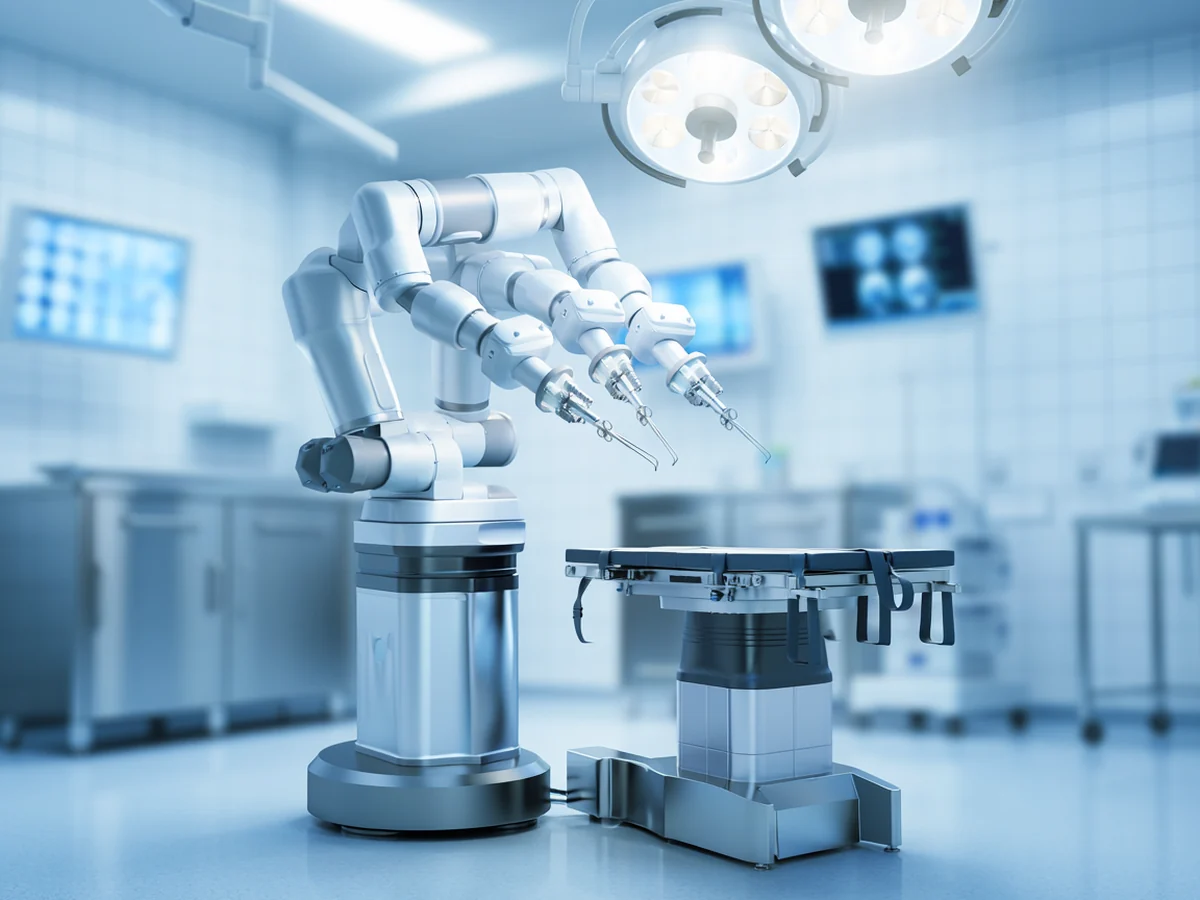
Robots in the operating room
Robotic surgery is already widespread. Systems such as the da Vinci, first cleared for use in the United States in 2000, allow surgeons to operate through tiny incisions using robotic arms that hold instruments and cameras. These robots offer steadiness and precision, but they do not make decisions: every movement is controlled by a surgeon sitting at a console. Researchers have long wondered whether AI could allow robots to perform parts of operations themselves.
Early autonomous steps
At Johns Hopkins University, medical roboticist Axel Krieger and colleagues developed the Smart Tissue Autonomous Robot, or STAR. In 2022, it performed the first autonomous laparoscopic surgery on a live animal, connecting two ends of a pig's intestine. But STAR needed specially marked tissue, a highly controlled environment and a rigid, predetermined plan. Krieger compared it to teaching a robot to drive along a carefully mapped route.
Learning from videos
The newer system, called Surgical Robot Transformer-Hierarchy, or SRT-H, was developed by researchers at Johns Hopkins, Stanford University and the company Optosurgical. It learned the gallbladder procedure by watching videos of Johns Hopkins surgeons performing it on pig cadavers, with captions describing each task. This approach, called imitation learning, is similar to how AI models for self-driving cars and robots learn from human demonstrations.
Two AI models working together
SRT-H combines two transformer models, the same type of AI behind chatbots. A high-level planner decides which step to take next, such as identifying a duct or placing a clip, and can describe its plan in words. A low-level model turns each decision into precise movements of the instruments of a da Vinci robot. This hierarchy allows the system to handle a sequence of steps and adapt when things do not go as expected.
The experiment
The researchers tested SRT-H on eight sets of gallbladders and livers removed from pigs, a realistic setting but not a living patient. The robot had to perform a lengthy phase of the operation: identifying the cystic duct and artery, placing clips and cutting them, using tools to grab, clip and cut. In the study published in Science Robotics in July 2025, the robot completed the task successfully in all eight trials.
Adapting like a surgeon
Unlike earlier systems, SRT-H could respond to unexpected situations, such as changes in the appearance of tissue, and could correct itself. It also responded to voice commands from the team, similar to a junior surgeon guided by a mentor, and learned from that feedback. The researchers said it performed with the skill of an expert surgeon, although it took longer than a human surgeon to complete the work.
Why autonomy could help
Supporters say autonomous surgical robots could one day help address shortages of surgeons, especially in rural and underserved areas, provide consistent results and reduce errors caused by fatigue. Surgeons could supervise several robots, intervening only when needed. The researchers compared the goal to a self-driving car able to handle any road, in any condition, while responding intelligently to whatever it encounters.
Long road ahead
There is a large gap between experiments on animal organs in a laboratory and operations on human patients. Living bodies bleed, move and vary enormously, and complications can be life-threatening. Autonomous systems would need extensive testing, clinical trials and regulatory approval. Questions about responsibility also arise: if an autonomous robot makes a mistake, who is accountable, the surgeon, the hospital or the manufacturer?
AI already in surgery
Even without autonomy, AI is already helping surgeons. AI can analyse surgical videos to assess skill and identify risky moments, help plan operations using 3D models built from scans, and highlight important structures during procedures. Hospitals in the UAE and elsewhere in the Gulf have adopted robotic surgery widely, and AI-assisted tools are increasingly part of how surgeons train and operate.
Why it matters
Surgery is among the most demanding human skills, and the idea of robots operating on their own raises both hope and concern. The SRT-H experiment shows that AI can learn complex surgical tasks from observation, a major step forward. Whether autonomous surgery becomes a reality will depend on rigorous evidence of safety, and on the trust of patients and doctors.
Sources & further reading
- Johns Hopkins University · Robot performs first realistic surgery without human help (2025) ↗
- EurekAlert! · System trained on videos of surgeries performs like an expert surgeon (2025) ↗
- The Batch (DeepLearning.AI) · Robot surgeon cuts and clips ↗
Experimental research; not yet used on patients. Photograph: original AI-generated illustration (Adobe Firefly). Reference organisations do not endorse this website.