Batteries everywhere
Lithium-ion batteries power phones, laptops and electric vehicles, and large battery systems increasingly store electricity from solar and wind farms for use when the sun is not shining or the wind is not blowing. Demand is rising quickly. Better batteries that store more energy, charge faster, last longer, cost less, are safer and use fewer scarce materials would accelerate the shift to clean energy.
A slow process
Developing new battery materials has traditionally been slow and expensive. Scientists must propose new chemical combinations, make them in the laboratory and test them over hundreds of charging cycles, which can take months or years. The number of possible materials is enormous, so researchers can only test a tiny fraction. AI offers a way to explore far more possibilities on computers before running costly experiments.
Screening 32 million materials
In January 2024, Microsoft and the Pacific Northwest National Laboratory, a US government research laboratory, announced that they had used AI and high-performance computing to screen about 32 million candidate inorganic materials for use in batteries. AI models predicted properties such as stability and conductivity, narrowing the list to 18 promising candidates in about 80 hours of computing, a task that would have taken years by traditional methods.
A new electrolyte
One candidate was a new solid electrolyte material that combines sodium and lithium. Researchers synthesised it and built a working prototype battery. Because it uses sodium, which is abundant and cheap, in place of part of the lithium, Microsoft said it could use about 70% less lithium than existing lithium-ion battery designs. The material is still at an early research stage, but the project showed how AI can rapidly identify new options.
Predicting battery life
Testing how long a battery will last normally requires charging and discharging it hundreds or thousands of times. In 2019, researchers from Stanford University, the Massachusetts Institute of Technology and the Toyota Research Institute showed in the journal Nature Energy that machine learning could predict a battery's lifetime accurately using data from only its first 100 cycles. This can greatly speed up testing and quality control in battery factories.
Faster charging
Charging batteries quickly can damage them and shorten their life. In 2020, the same research collaboration reported in Nature that an AI system had found fast-charging methods that maximised battery life, cutting the time needed for the experiments from an estimated 500 days to 16 days. AI-designed charging strategies can help electric vehicles charge faster without wearing out their batteries prematurely.
Smarter battery management
Every electric vehicle and grid battery has a battery management system that monitors temperature, voltage and charge. AI can improve these systems by estimating more accurately how much charge remains and how healthy the battery is, detecting early signs of problems that could lead to overheating or fires, and adjusting performance to extend lifespan. For grid batteries, AI helps decide when to store and release energy to maximise value.
Recycling and resources
As millions of electric vehicle batteries reach the end of their lives, recycling them will become essential to recover valuable materials such as lithium, nickel and cobalt. AI-powered vision systems can help sort batteries and components, and AI can optimise recycling processes. Reducing dependence on mined materials is important because mining can harm the environment and supply chains are concentrated in a few countries.
Batteries in the Gulf
Gulf countries are investing in large battery storage systems to support their growing solar power capacity. Abu Dhabi has announced a project combining a very large solar plant with massive battery storage to provide round-the-clock clean electricity, and Saudi Arabia is building large battery projects too. Extreme heat is challenging for batteries, so AI-based monitoring and cooling management are especially valuable in the region.
Why it matters
Better batteries are key to cutting emissions from transport and electricity. AI is transforming battery research by exploring millions of possibilities, predicting performance and optimising how batteries are used. While new materials still need years of testing before reaching the market, AI is helping scientists move faster towards cheaper, safer and more sustainable batteries for a clean energy future.
Sources & further reading
- Microsoft · How AI and HPC are speeding up scientific discovery (2024) ↗
- Nature Energy · Data-driven prediction of battery cycle life before capacity degradation (Severson et al., 2019) ↗
- Nature · Closed-loop optimization of fast-charging protocols for batteries with machine learning (Attia et al., 2020) ↗
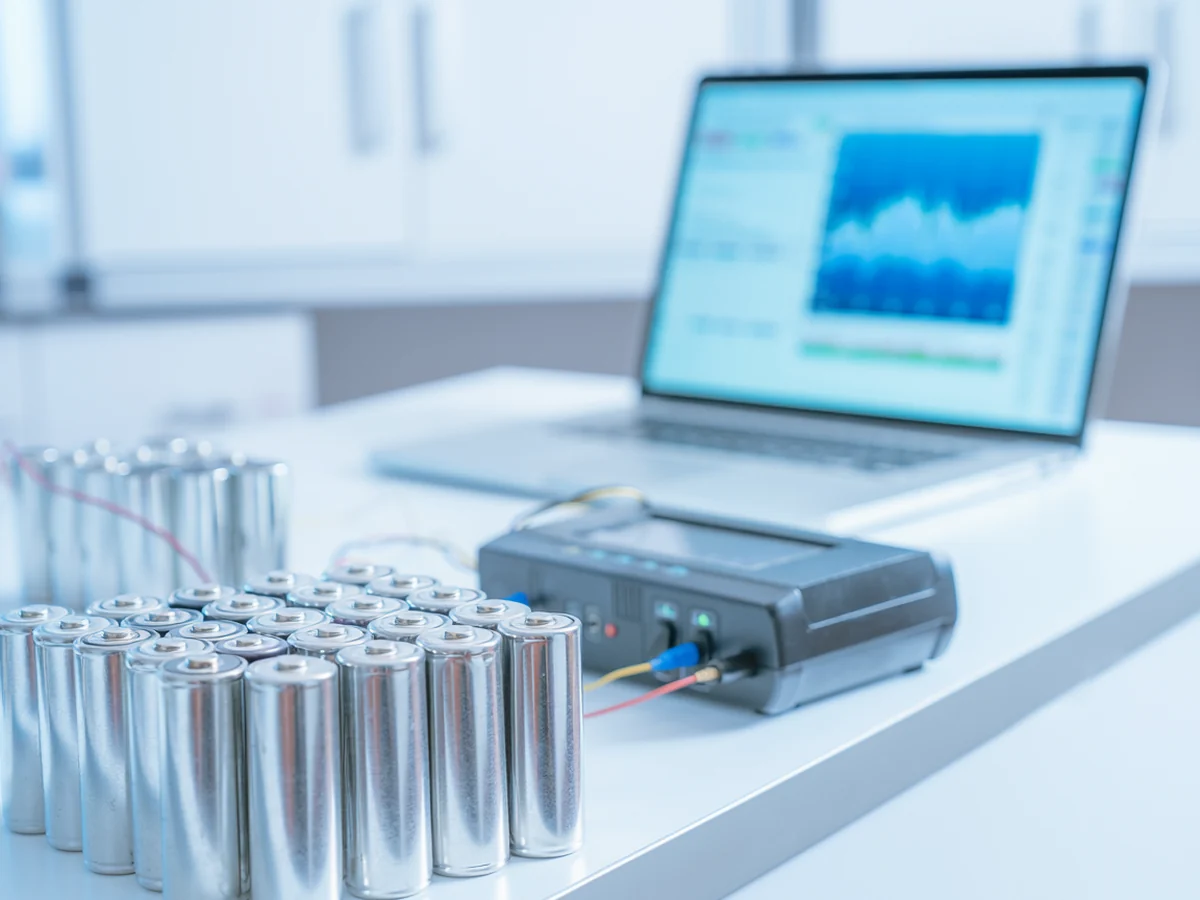
Research developments; new materials take years to reach products. Photograph: original AI-generated illustration (Adobe Firefly). Reference organisations do not endorse this website.