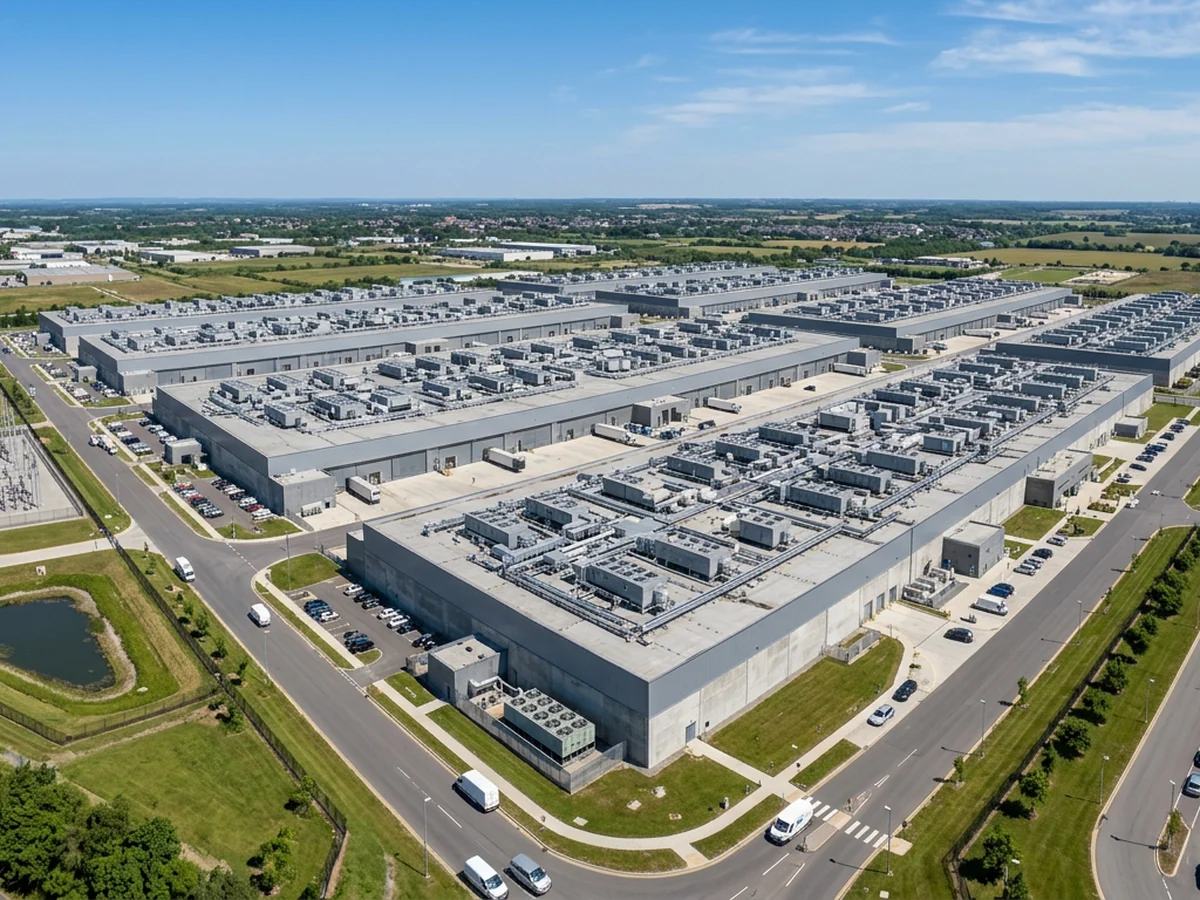
Counting the buildings
Several directories track data centres around the world. One of the most widely cited, Cloudscene, listed about 5,427 data centres in the United States in 2025, followed by Germany with 529, the United Kingdom with 523 and China with 449. Canada, France and Australia each had more than 300, and the Netherlands nearly as many. Different sources give somewhat different totals, because they define and count facilities in different ways, but every list shows the same pattern: the United States is far ahead of everyone else.
Why the US leads
The United States is home to the largest cloud providers and AI companies, the biggest market for digital services and deep capital markets willing to finance expensive infrastructure. It also has large amounts of land and, in many regions, available electricity. Northern Virginia alone is the world's biggest data centre market, built around early internet exchange points and dense fibre networks. Other clusters have grown in Texas, Oregon, Arizona, Georgia, Ohio and elsewhere. The International Energy Agency estimates the US accounted for about 45% of global data centre electricity use in 2024.
Why China looks small
China's position in the count is misleading. Directories rely on public listings and voluntary submissions, and many Chinese facilities, especially those run by state-owned telecom operators and large internet companies, are not well represented. By electricity consumption, the IEA estimates China accounted for about a quarter of global data centre use in 2024, second only to the United States. China has also launched a national programme to build computing hubs in its western provinces, where land and renewable power are more plentiful.
Buildings versus capacity
A count treats a small server room and a giant AI campus the same way. For AI, the more meaningful measure is power capacity, in megawatts or gigawatts, because computing power scales with electricity. Traditional enterprise data centres might draw a few megawatts. New AI campuses are being planned at hundreds of megawatts or even several gigawatts, comparable to large power stations. That is why the AI boom is concentrated in a relatively small number of very large sites, even as the number of facilities grows more slowly.
Europe's position
Germany and the United Kingdom lead in Europe, with Frankfurt and London among the world's largest hubs, followed by the Netherlands around Amsterdam, France around Paris and Ireland around Dublin. Together these are known in the industry as the FLAP-D markets. Europe faces constraints on power and land in its main hubs, and Ireland and the Netherlands have at times restricted new connections around Dublin and Amsterdam. New growth is spreading to the Nordic countries, Spain, Italy and Portugal, where renewable power is more available.
The Gulf's rise
The Gulf states are among the fastest-growing data centre markets. The UAE and Saudi Arabia have attracted large investments from global cloud providers and from their own state-backed companies, aiming to become regional hubs for AI computing. Plans announced in 2025 for a major UAE–US AI campus in Abu Dhabi, measured in gigawatts, illustrate the scale of ambition. Abundant land, sovereign investment and access to energy are advantages, while the hot climate makes efficient cooling a key engineering challenge.
Asia and beyond
Japan, India, Singapore, South Korea and Australia are major hubs in the Asia-Pacific region. Singapore paused new data centre approvals for several years to manage land and power use, then resumed with strict efficiency requirements, pushing growth into neighbouring Johor in Malaysia and to Indonesia. India's market is expanding rapidly with rising digital demand and data localisation rules. Africa and Latin America have far fewer facilities, which affects how quickly AI services can reach users there.
Why it matters
Where data centres are located shapes who controls AI computing, where jobs and investment flow, and which electricity grids bear the load. It also matters for data sovereignty, since many governments want sensitive data stored within their borders. As AI demand grows, the race is increasingly about securing power and building giant campuses quickly. Counting buildings is a useful starting point, but the real map of AI power is measured in gigawatts.
Sources & further reading
- Euronews · Which country in Europe has the most data centres (2026) ↗
- Statista · Data centers worldwide by country ↗
- IEA · Energy and AI (2025) ↗
Counts vary by source and date; capacity data are more relevant for AI. Photograph: original AI-generated illustration (Adobe Firefly). Reference organisations do not endorse this website.