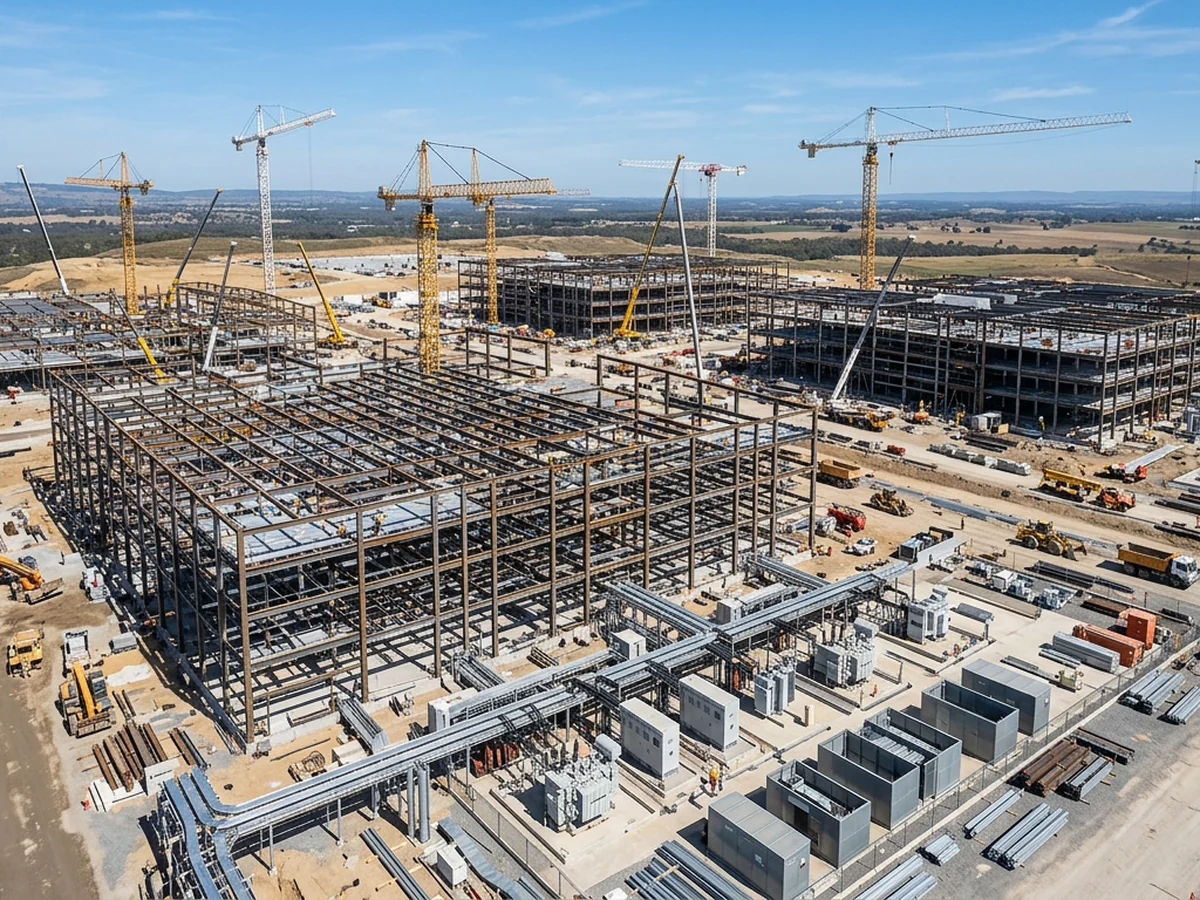
A spending surge
Capital expenditure, or capex, is money spent on long-lasting assets such as buildings and equipment. For the largest technology companies it has become the clearest measure of the AI race. According to figures compiled by the Financial Times, Microsoft, Alphabet, Amazon and Meta together spent about 150 billion dollars in 2023, 245 billion in 2024 and around 410 billion in 2025. A decade earlier the same companies spent only about 31 billion dollars a year, according to Bloomberg calculations. Estimates differ slightly depending on whether leased data centres are included.
Plans for 2026
Early in 2026 the companies told investors they planned to spend even more. Bloomberg calculated combined plans of roughly 650 billion dollars for 2026, and later updates compiled by the Financial Times after first-quarter results put the total at about 725 billion. Amazon alone said it expected to invest around 200 billion dollars across the company, including AI, chips, robotics and satellites, while Alphabet raised its forecast to between 180 and 190 billion. Rising prices for memory chips added billions to some budgets.
Where the money goes
Most of this spending goes on AI computing: graphics processors and custom AI chips, the servers and networking that link them, and the buildings, cooling and electrical systems that house them. A single large AI data centre can cost tens of billions of dollars. Companies are also paying for long-term electricity contracts, grid connections and, in some cases, power plants. Each of the four is developing its own AI chips, such as Google's TPUs and Amazon's Trainium, to reduce dependence on Nvidia, the dominant supplier.
Why they are spending
The companies argue that demand for AI services already exceeds their capacity. Cloud providers report long queues of customers wanting computing power, and executives have described themselves as compute-constrained. AI is also being built into their own products, from search and advertising to office software and online shopping. Leaders have said publicly that the risk of under-investing and falling behind is greater than the risk of over-investing, because whoever has the most capacity can serve the most customers and train the most capable models.
The doubts
Not everyone is convinced. Some investors worry that spending is running ahead of revenue, and that much of the infrastructure could become outdated quickly as chips improve. Analysts have noted that in some quarters several of the companies spent more on capex than their operations generated in cash, turning to debt markets to finance construction. Comparisons with past booms, such as railways in the nineteenth century or telecoms fibre in the late 1990s, are common: transformative technologies sometimes create overcapacity before demand catches up.
The wider ripple effects
The boom reaches far beyond Silicon Valley. Chip makers, memory producers, electrical equipment manufacturers, construction firms and utilities have all seen orders surge. In the United States, investment in data centres has become a noticeable contributor to economic growth. Countries and regions compete to host new campuses, offering land, power and tax incentives. The Gulf states, including the UAE and Saudi Arabia, have become major investors and hosts, partnering with US companies on large AI infrastructure projects.
Beyond the big four
The four companies are the largest spenders but far from the only ones. Oracle has expanded rapidly as an AI cloud provider. AI developers such as OpenAI and Anthropic have announced multi-gigawatt computing partnerships, and projects such as the Stargate initiative bring together technology companies, investors and governments. Chinese companies including Alibaba, Tencent and ByteDance are also investing heavily, as are sovereign wealth funds and specialised data centre operators. Total global AI infrastructure spending is therefore considerably higher than the big four's figures alone.
What to watch
The key question is whether AI revenue grows fast enough to justify the investment. Signs to watch include cloud revenue growth, how much businesses pay for AI tools, falling costs per AI task, and whether companies keep raising or begin trimming their spending plans. For the energy system, the spending translates directly into electricity demand, which is why it matters well beyond financial markets. Whatever happens, the scale of today's investment means AI infrastructure will shape the economy for years.
Sources & further reading
- Tom's Hardware · Big tech AI spending plans reach $725 billion (FT figures) ↗
- Axios · The AI investment surge is getting even bigger (2026) ↗
- S&P Global · Hyperscaler earnings quarterly (2026) ↗
Figures combine company reports as compiled by news organisations; definitions vary. Photograph: original AI-generated illustration (Adobe Firefly). Reference organisations do not endorse this website.