Why shape matters
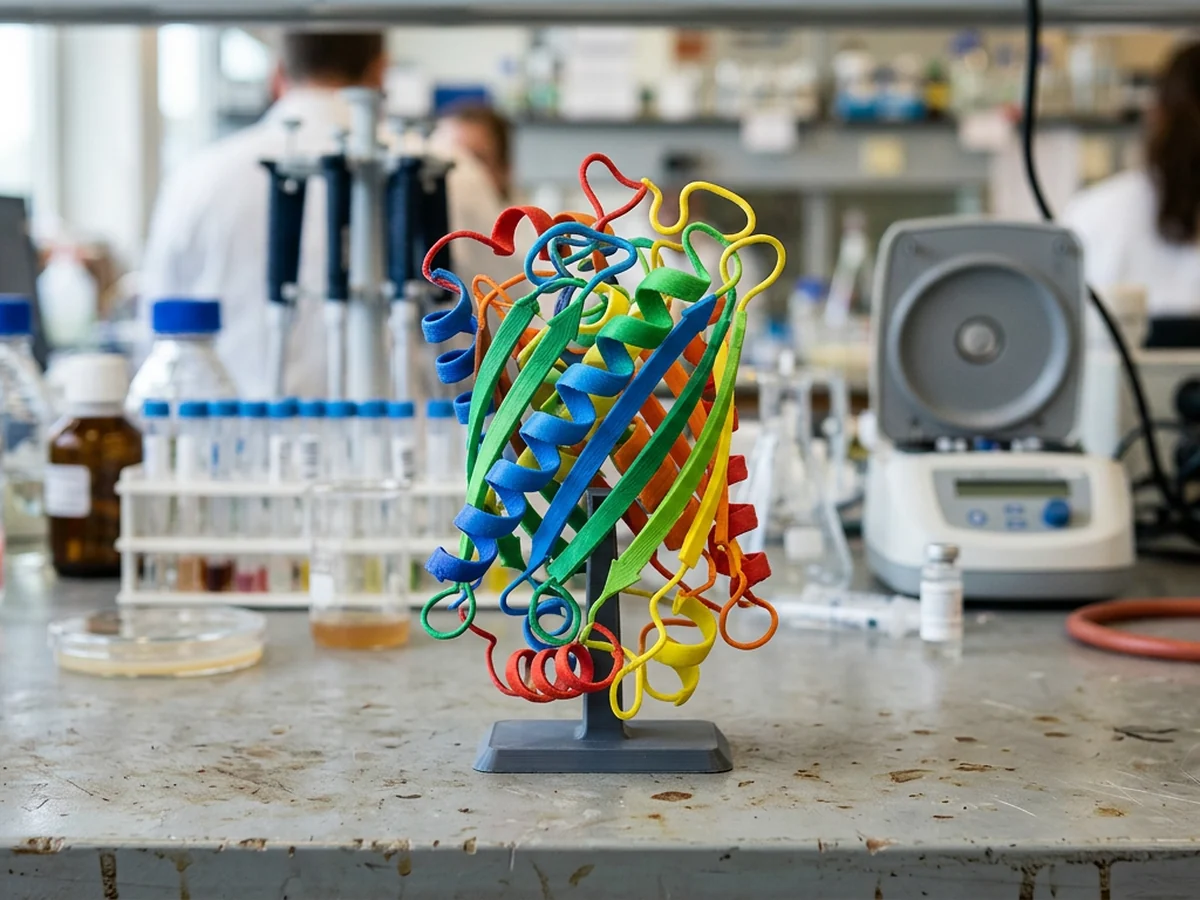
Proteins are long chains of building blocks called amino acids, strung together in an order set by our genes. Each chain folds into a precise three-dimensional shape, and that shape determines what the protein does, whether it carries oxygen, fights an infection or reads DNA. Diseases often involve proteins that fold incorrectly or work too much or too little. Drugs usually work by fitting into a pocket on a protein's surface. Knowing the shape is therefore a key to understanding biology and designing medicines.
A 50-year problem
In the early 1970s the chemist Christian Anfinsen argued that a protein's shape is determined by its sequence, implying it should be possible to predict one from the other. Doing so proved fiendishly difficult because a chain can fold in an astronomical number of ways. Scientists instead determined shapes experimentally, using techniques such as X-ray crystallography and cryo-electron microscopy, which can take months or years and considerable money for a single protein. After decades of effort, roughly 200,000 structures had been solved and deposited in the Protein Data Bank.
The breakthrough
Since 1994 a competition called CASP has tested prediction methods against newly solved structures that have not been published. In 2020 DeepMind's AlphaFold 2 achieved accuracy comparable to experimental methods for most targets, a result organisers described as solving the core problem. The system uses deep learning trained on known structures and on evolutionary information, recognising how amino acids that change together across species tend to sit close together in the folded shape.
A database for everyone
Rather than keep the technology private, DeepMind partnered with the European Bioinformatics Institute to release predictions freely. In 2022 the AlphaFold Protein Structure Database expanded to more than 200 million structures, covering nearly every protein known to science, from humans to plants and bacteria. The code was also made available to researchers. Scientists in nearly every country have since used the database, many in places that could never afford large structural biology facilities.
What it has enabled
Researchers have used AlphaFold predictions to study the proteins of malaria parasites for vaccine design, to understand antibiotic resistance, to design enzymes that break down plastic and to investigate diseases linked to misfolded proteins. It has sped up drug discovery by giving chemists likely target shapes before experiments begin. In 2024 a newer version, AlphaFold 3, extended predictions to how proteins interact with DNA, RNA and small drug-like molecules, which is especially valuable for medicine.
The Nobel Prize
In October 2024 the Nobel Prize in Chemistry was awarded half to David Baker of the University of Washington for computational protein design and half jointly to Demis Hassabis and John Jumper of Google DeepMind for protein structure prediction. It was one of the clearest signs that AI had become a genuine tool of scientific discovery. The same year, the Nobel Prize in Physics went to John Hopfield and Geoffrey Hinton for foundational work on artificial neural networks, recognising AI's roots in physics.
Open science at scale
A crucial decision was to make the predictions free. Anyone with an internet connection can search the database, download a structure and inspect how confident the model is about each part of it. That openness let small laboratories, students and researchers in lower-income countries use tools once available only to well-funded institutes. DeepMind also spun out a company, Isomorphic Labs, in 2021 to apply the same ideas commercially to drug discovery, signing partnerships with major pharmaceutical firms.
Limits to keep in mind
AlphaFold's predictions are not perfect. It is less reliable for proteins that are naturally floppy or that change shape when they work, and its confidence scores must be read carefully. Predicting a static shape is also not the same as understanding how a protein moves, interacts and behaves in the crowded environment of a cell. Experimental methods remain essential to confirm important findings. Many scientists see AlphaFold as a powerful starting point rather than a final answer.
Why it is a model for AI in science
AlphaFold showed what AI can do when a scientific problem has clear rules, a large body of reliable data and a rigorous way to test answers. It has inspired similar efforts in materials science, chemistry and genomics, and helped launch companies that design proteins and drugs with AI. For many researchers it marked the moment AI moved from a promising technique to an indispensable instrument, alongside microscopes and sequencers, in the laboratory.
Sources & further reading
- Nobel Prize · Chemistry 2024 press release ↗
- EMBL-EBI · AlphaFold Protein Structure Database ↗
- Nature · Highly accurate protein structure prediction with AlphaFold (2021) ↗
Simplified explanation of a complex field. Photograph: original AI-generated illustration (Adobe Firefly). Reference organisations do not endorse this website.