How forecasts have been made
For decades weather forecasting has relied on numerical weather prediction: dividing the atmosphere into a three-dimensional grid and solving equations of fluid dynamics and thermodynamics to project how it will evolve. Centres such as the European Centre for Medium-Range Weather Forecasts, known as ECMWF, and national weather services run these models on some of the world's largest supercomputers several times a day. Accuracy has improved steadily, roughly one day of extra useful forecast for every decade of progress, but each run is expensive and slow.
A different approach
AI models skip the equations. Instead, they learn patterns from reanalysis data, a reconstruction of the global atmosphere every few hours stretching back decades, combining observations with physics models. Given the current state of the atmosphere, the AI predicts what it will look like six hours later, then repeats the step to build a forecast days ahead. Once trained, which takes significant computing, producing a forecast is extremely fast and cheap, requiring a single specialised chip instead of a supercomputer.
The results
In 2023, Google DeepMind published GraphCast in the journal Science, reporting that it outperformed ECMWF's high-resolution forecast on about 90% of 1,380 test variables and lead times, producing a ten-day forecast in under a minute. Huawei's Pangu-Weather and Nvidia's FourCastNet showed similar promise. In 2024 DeepMind's GenCast, published in Nature, produced ensembles of many possible futures and beat ECMWF's leading ensemble system on most measures. These results surprised many meteorologists who had doubted machine learning could match physics.
Into daily operations
ECMWF developed its own AI model, the Artificial Intelligence Forecasting System, or AIFS, and made it operational in February 2025, running alongside its traditional model and making the output freely available. National weather services in many countries now consult AI forecasts every day. The models have shown particular skill in predicting the tracks of tropical cyclones several days ahead, information that helps emergency services prepare evacuations and position supplies.
Where AI still struggles
AI models are trained on the past, so they can struggle with record-breaking events that lie outside their experience, a growing concern as the climate warms. Early versions produced smoother, less detailed fields than physics models and could underestimate the peak strength of storms. They also still depend on traditional data assimilation, the physics-based process of combining satellite, balloon and ground observations into an accurate picture of the present atmosphere, which is the starting point for any forecast.
Lowering the cost of a forecast
Running a world-class physics model requires a supercomputer costing hundreds of millions of dollars, which only a few centres can afford. An AI model, once trained, can run on a single graphics processor or a small server. That changes who can produce high-quality forecasts. ECMWF publishes its AI forecasts as open data, and researchers in developing countries are experimenting with running and fine-tuning AI models locally, which could narrow the gap in warning services between rich and poor nations.
Why it matters for everyone
Faster and cheaper forecasts make it possible to run many more scenarios, improving estimates of uncertainty, such as the probability of heavy rain or the range of possible hurricane tracks. Countries without supercomputers could run high-quality models on modest hardware. Energy companies use forecasts to predict solar and wind output, farmers to plan planting and harvests, and airlines to route flights. Better warnings of heatwaves, floods and storms save lives, especially in vulnerable regions.
Relevance to the Gulf
In the Gulf, forecasting challenges include sudden heavy rain, dust storms, fog and extreme heat. The record rainfall that flooded parts of the UAE in April 2024 showed how valuable accurate early warnings are. AI models trained on global data can help, and regional researchers are working to improve predictions of local phenomena such as fog and sandstorms, which affect aviation, shipping and public safety. Higher-resolution AI models for specific regions are an active area of development worldwide.
A hybrid future
Few meteorologists expect AI to replace physics entirely. The most likely future combines both: physics to understand the current state of the atmosphere and to handle unprecedented conditions, and AI to speed up forecasts, sharpen details and generate large ensembles. Researchers are also building AI models that include physical constraints directly. Within a few years, the forecast on your phone is likely to be shaped in part by models that learned the weather by studying decades of it.
Sources & further reading
- Science · GraphCast: learning skillful medium-range global weather forecasting (2023) ↗
- ECMWF · AIFS becomes operational (2025) ↗
- Nature · GenCast probabilistic weather forecasting (2024) ↗
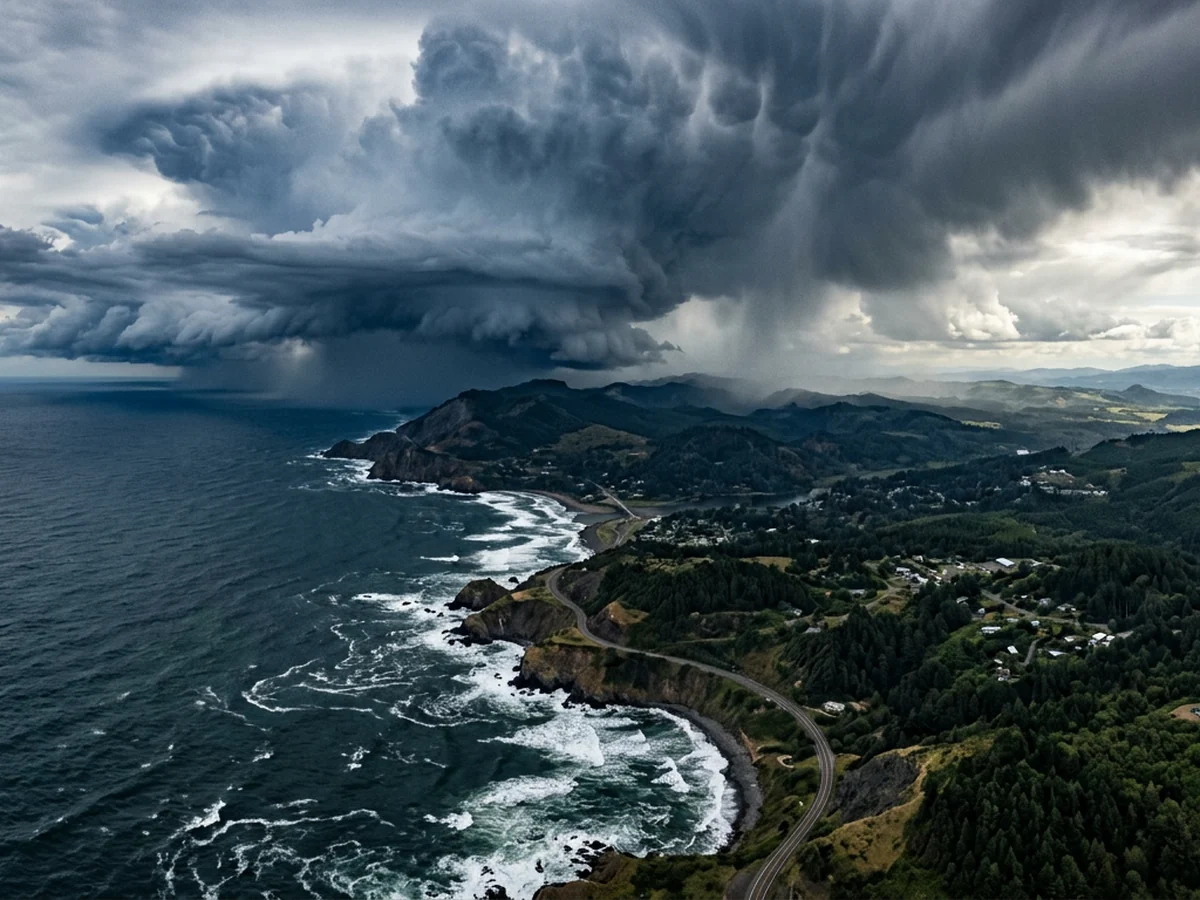
Model comparisons depend on the measures and periods tested. Photograph: original AI-generated illustration (Adobe Firefly). Reference organisations do not endorse this website.