Life's tiny machines
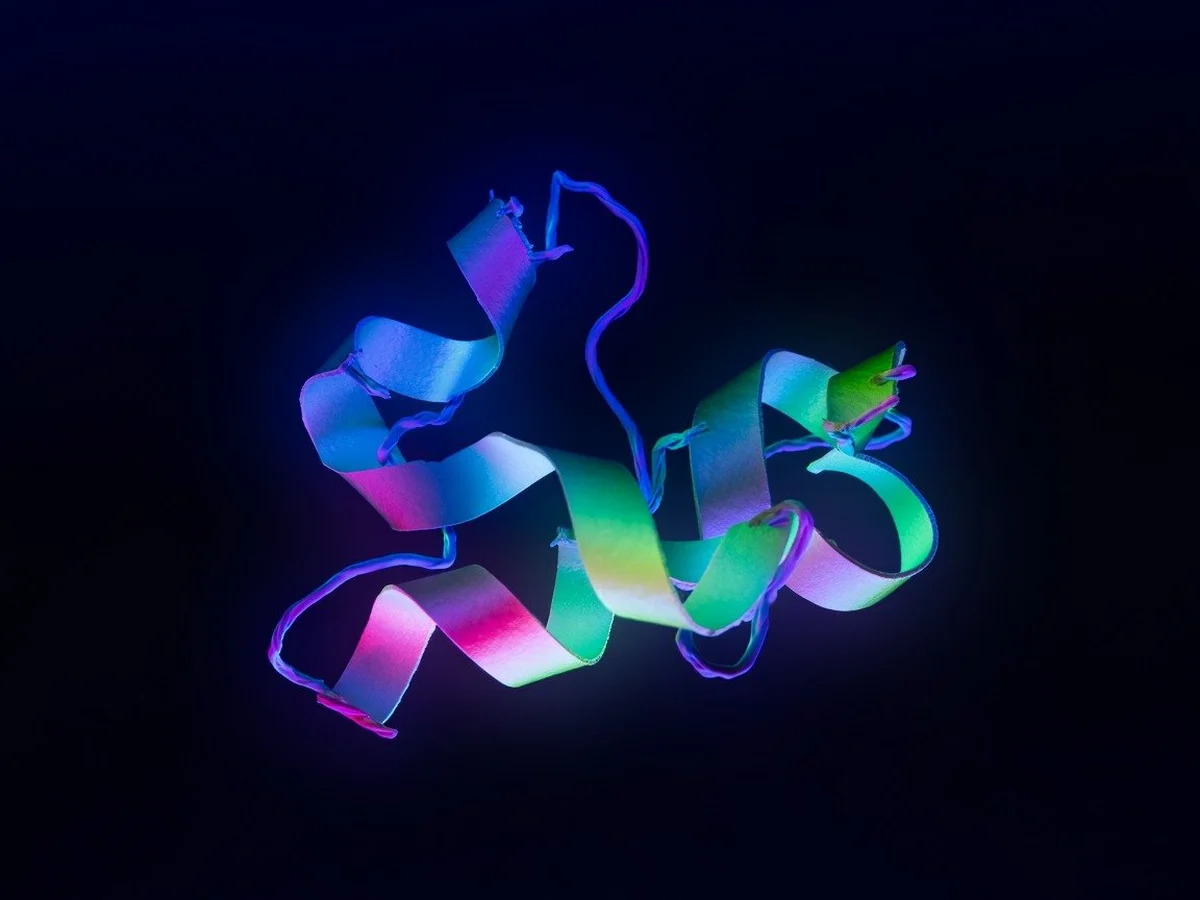
Proteins do almost everything in living things. They digest food, carry oxygen, fight infections, build muscle and copy DNA. Each protein starts as a chain of building blocks called amino acids, drawn from a set of 20. Within moments of being made, the chain folds into a precise three-dimensional shape. That shape is what lets an enzyme grip its target or an antibody latch onto a virus. Knowing the shape is therefore key to understanding a protein and to designing medicines.
A fifty-year puzzle
Scientists have long been able to read the sequence of amino acids in a protein, but working out its folded shape was slow and expensive. Methods such as X-ray crystallography and cryo-electron microscopy could take months or years for a single protein. In 1972, chemist Christian Anfinsen won a Nobel Prize partly for showing that the sequence alone should determine the shape. Predicting that shape by computer became one of biology's great unsolved problems, often called the protein folding problem.
A competition for predictions
Since 1994, researchers have tested their methods in a contest called CASP, short for Critical Assessment of protein Structure Prediction. Teams receive sequences of proteins whose shapes have been solved in the lab but not yet published, and they try to predict them. For decades, progress was steady but limited. Then, in 2020, Google DeepMind's AlphaFold 2 produced predictions so accurate that many were close to experimental quality, and organisers said the core problem had largely been solved.
How AlphaFold works
AlphaFold is a deep-learning system trained on the structures already stored in the Protein Data Bank, a public archive built up by scientists over decades. It also compares a protein's sequence with related sequences from other species, because amino acids that change together over evolution tend to sit close together in the folded shape. Using these clues, the network refines its guess step by step until it produces a 3D model, along with a score showing how confident it is in each part.
A database for everyone
In 2021 and 2022, DeepMind and the European Bioinformatics Institute released predicted structures for almost every protein known to science, more than 200 million in total, free to anyone. By comparison, experiments had solved only about 200,000 structures over half a century. Researchers studying malaria, antibiotic resistance, plant diseases and plastic-eating enzymes have used the database to speed up their work, often skipping months of trial and error before even starting an experiment.
From predicting to designing
Predicting nature's proteins is one thing; inventing new ones is another. David Baker's laboratory at the University of Washington spent years developing software to design proteins that do not exist in nature. Newer AI tools, such as RFdiffusion, released in 2023, work a little like image generators: they start from noise and gradually shape it into a protein backbone that fits a chosen task, such as binding tightly to a particular virus protein or speeding up a chemical reaction.
The 2024 Nobel Prize
In October 2024, the Nobel Prize in Chemistry was awarded to David Baker for computational protein design, and jointly to Demis Hassabis and John Jumper of Google DeepMind for protein structure prediction. The award was a striking recognition of AI's role in basic science. The committee highlighted that the work could help scientists understand how life functions, why some diseases develop, how antibiotic resistance arises, and how to design enzymes that break down plastic.
What it means for medicine
Designed proteins are already being tested as vaccines, antidotes and diagnostic tools. A vaccine for COVID-19 based on a designed protein nanoparticle was approved in South Korea in 2022. Drug companies use structure prediction to understand targets and screen possible medicines faster. Still, a predicted or designed protein must be made and tested in the lab, and later in clinical trials, before it can help patients. AI shortens the path, but it does not remove the need for careful experiments.
Limits and next steps
AlphaFold is less reliable for proteins that change shape, for flexible regions and for how proteins interact with many partners at once. Newer versions aim to model proteins together with DNA, RNA and small drug molecules. Scientists also discuss safety, since tools that design useful proteins could in principle be misused, and many researchers have signed commitments on responsible use. The field is moving fast, and protein design is becoming one of the clearest examples of AI accelerating discovery.
Sources & further reading
General information; figures are approximate and the field changes quickly. Photograph: original AI-generated illustration (Adobe Firefly). Reference organisations do not endorse this website.