Where it stands
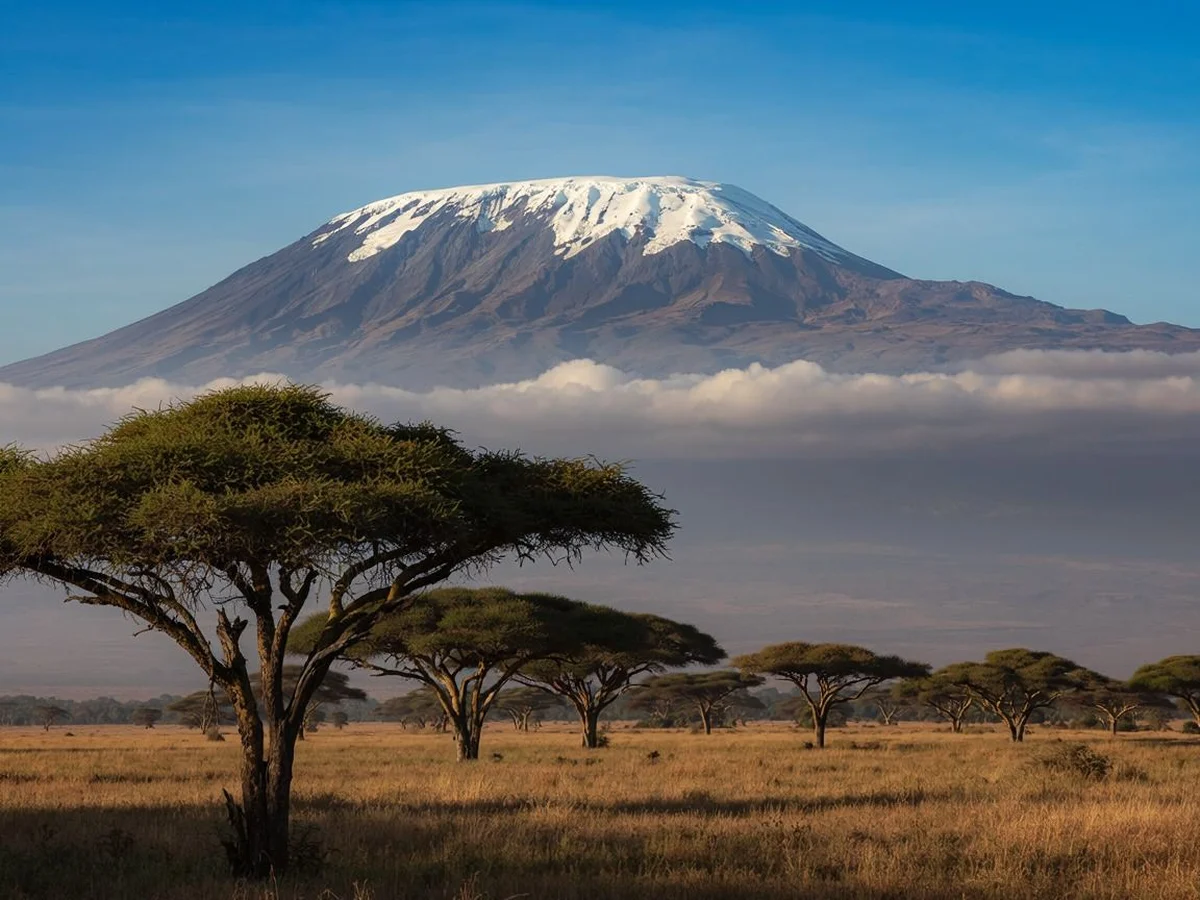
Mount Kilimanjaro lies in north-eastern Tanzania, close to the border with Kenya and about 300 kilometres south of the equator. It rises from savanna at around 1,000 metres to 5,895 metres at Uhuru Peak, the highest point in Africa. Because it is not part of a mountain range, it is often described as the tallest free-standing mountain in the world. On clear days it can be seen from far across the plains, including from parts of Kenya.
A sleeping volcano
Kilimanjaro is a huge stratovolcano made of three cones. Kibo, the highest and youngest, holds the summit crater. Mawenzi is a jagged, eroded peak to the east, and Shira, the oldest, has collapsed into a broad plateau to the west. Volcanic activity began more than a million years ago. Kibo is considered dormant, not extinct: gas vents called fumaroles still release steam in the crater, but there has been no major eruption in recorded history.
Climbing through climate zones
Climbing Kilimanjaro is often compared to walking from the equator to the Arctic in a few days. The lower slopes are covered in farms and then dense rainforest, home to monkeys and many birds. Above about 2,800 metres comes heath and moorland, with strange giant groundsels and lobelias. Higher still is an alpine desert with few plants, wide temperature swings and strong sun. The summit zone is a cold world of rock, ice and thin air.
The summit
Uhuru Peak sits on the rim of the Kibo crater. Uhuru means freedom in Swahili, and the name was chosen in 1961 when Tanganyika gained independence. Most climbers start the final push around midnight, walking slowly by headlamp to reach the crater rim at sunrise. At the top, the air holds only about half as much oxygen as at sea level. Signs, glaciers and views over the clouds make it one of the world's most famous summits.
First recorded ascent
Local Chagga people lived on the mountain's lower slopes for centuries before Europeans arrived. The first recorded ascent to the summit was made in 1889 by the German geographer Hans Meyer and the Austrian climber Ludwig Purtscheller, helped by local guide Yohani Lauwo and a team of porters. Lauwo lived to an exceptional age and was honoured in Tanzania for his role. Today, tens of thousands of people attempt the climb every year.
Disappearing ice
Kilimanjaro's glaciers and ice fields have shrunk dramatically. Scientists estimate that more than 80% of the ice present in the early twentieth century has disappeared. The causes are complex, involving changes in rainfall, cloud cover and sunshine as well as warming temperatures, because much of the ice loses mass by evaporating directly in the dry, sunny air. Some studies suggest the remaining ice could vanish within decades, changing the mountain's famous appearance.
A protected landscape
Kilimanjaro National Park was established in 1973 and was listed as a UNESCO World Heritage Site in 1987. The park protects the mountain above the forest line and several corridors through the forest. The mountain's forests are vital water towers, catching moisture from clouds and feeding streams and springs that supply farms and towns below. Tourism brings important income for local guides, porters, cooks and communities around the mountain.
Altitude and safety
Kilimanjaro needs no ropes or climbing skills on its main routes, but altitude sickness is a real risk. Symptoms include headache, nausea, dizziness and fatigue, and in severe cases fluid can build up in the lungs or brain. Experts recommend choosing longer routes of seven or eight days, walking slowly, drinking water and descending immediately if serious symptoms appear. Licensed guides are required, and good guides watch their clients closely.
Why it inspires
Kilimanjaro's lone snowy summit above the African plains has inspired writers, artists and travellers for generations, including Ernest Hemingway's short story The Snows of Kilimanjaro. For many visitors, climbing it is a once-in-a-lifetime challenge that raises money for charity or marks a personal milestone. For scientists, it is a natural laboratory for studying climate, ecosystems and how mountains respond to change in a warming world.
Sources & further reading
- UNESCO · Kilimanjaro National Park ↗
- Wikipedia · Mount Kilimanjaro ↗
- Encyclopaedia Britannica · Kilimanjaro ↗
Heights are commonly cited values; ice loss estimates vary between studies. Photograph: original AI-generated illustration (Adobe Firefly). Reference organisations do not endorse this website.