
Follow tasks across borders
Global value chains divide production into tasks that can take place in more than one economy. A final product may depend on imported components, specialist business services and transport networks. The World Bank’s work on these chains distinguishes gross trade from trade measured in value added. This matters geographically: a border crossing records a shipment’s value, but does not imply that the exporting economy created every dollar embodied in it.
Count value without counting it twice
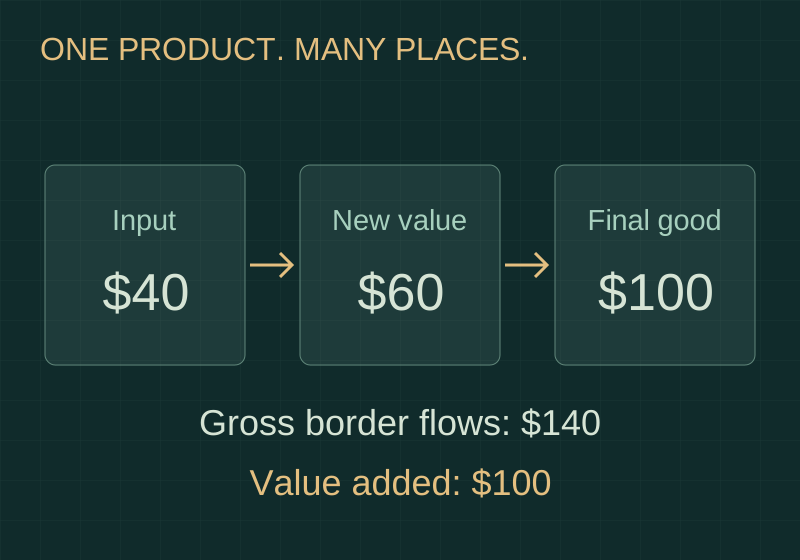
Our deliberately simplified example has two production stages. Economy A creates a component worth $40 and exports it to B. B adds $60 of value and exports the finished good for $100 to a consumer elsewhere. Recorded gross exports across the two stages total $140. The value added in A and B totals $100. The difference is the repeated counting of the component as it crosses another border. This illustration excludes subsequent distribution, taxes and other stages; value added is not the same as corporate profit.
Connections have unequal outcomes
Connections can create opportunities, but participation is not a guarantee of broadly shared gains. The tasks performed, local suppliers, skills, infrastructure and policy environment influence how places participate. A map of factories alone also misses less visible functions such as research, finance and software. Read a production network by asking which activities occur where, who depends on whom and which communities gain access to employment and capabilities. A long supply chain is neither automatically prosperous nor automatically fragile; its organisation matters.