
Begin with the accounting
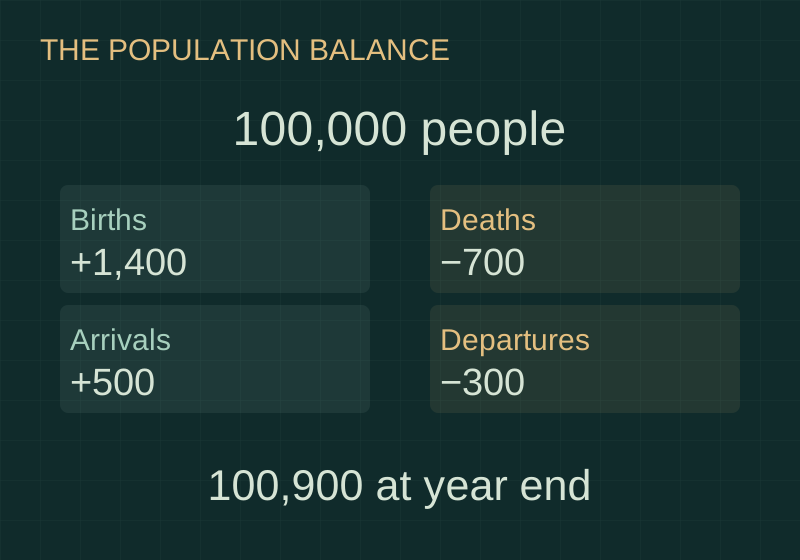
The population balance connects two dates: closing population equals opening population plus births, minus deaths, plus immigration, minus emigration. Births less deaths give natural increase; arrivals less departures give net migration. The equation describes the change, but it does not by itself explain the social conditions producing it. At a smaller geographic scale, moves between regions also matter; at the world scale, international migration redistributes people without directly changing the global total.
Keep the boundary and the clock consistent
A valid comparison needs the same territorial boundary, resident-population definition and time interval. Border crossings are not automatically changes of usual residence. Census revisions, incomplete registration and boundary changes can also complicate the published numbers. A statistical adjustment may be needed to reconcile independently measured stocks and flows. The arithmetic is exact as an accounting identity; the measurements are not necessarily exact.
A stable total can conceal large movements
In the illustration, 1,400 births and 700 deaths add 700 people. Arrivals of 500 and departures of 300 add another 200. A starting population of 100,000 therefore becomes 100,900. The net change of 900 is much smaller than the gross movements behind it. Planning schools, homes and transport requires the composition and location of those changes, not merely the final total.