
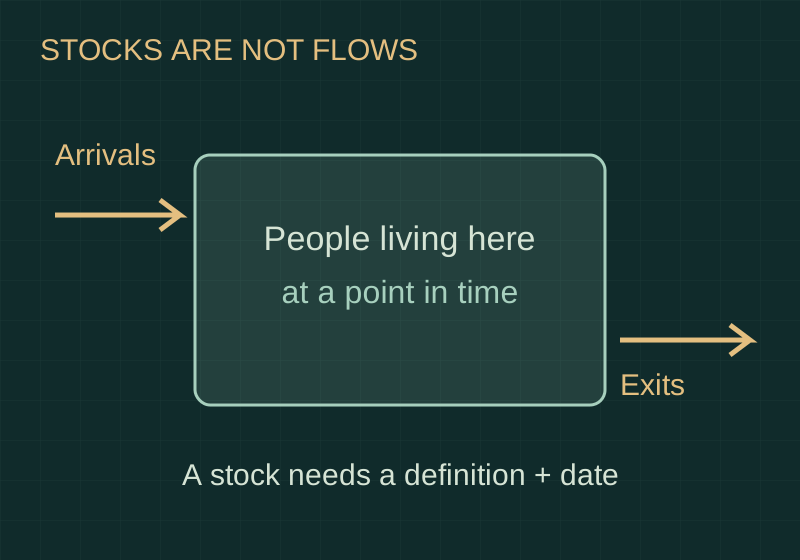
Stocks and flows answer different questions
International migrant stock generally counts people living in a country other than their country of birth at a specified time; citizenship is used where birth-country information is unavailable. A migration flow counts qualifying moves over an interval. A large stock can coexist with a modest annual inflow because many residents arrived long ago. Birthplace and nationality are also different characteristics: acquiring citizenship need not change whether a person is counted as foreign-born.
Net movement conceals gross movement
If 30,000 people immigrate and 25,000 emigrate during a year, net migration is 5,000. Both gross flows remain important for households, services and labour markets. Not every immigrant is foreign-born, and not every emigrant belongs to the existing foreign-born stock. Its change also reflects deaths and the statistical definition. Subtracting two migrant-stock totals therefore does not, by itself, reveal the number of people who arrived that year.
Protection categories are not interchangeable
Refugees, asylum-seekers and internally displaced people describe distinct circumstances and protection or statistical categories. An asylum claim may be pending; internal displacement occurs without crossing an internationally recognised border. International migrant stock and forced-displacement statistics can overlap, so simply adding their totals risks double counting. People’s movements can also change over time, including return or onward movement. Read the source’s definitions and coverage before turning a corridor or a total into a story about why people move.