
Read the visible landscape
Cultural geography examines how people give meaning to places and how those meanings become embedded in everyday life. UNESCO’s cultural-landscape framework recognises interactions between human activity and the natural environment: cultivated terraces, gardens and places with spiritual associations are different expressions of that relationship. The visible landscape is therefore more than scenery. It can record practices of water management, farming, settlement and design, although a photograph alone cannot establish the histories or meanings attached to it.
Living heritage keeps changing
Living heritage adds a less tangible layer. UNESCO includes oral traditions, knowledge, skills, social practices and associated cultural spaces, with language acting as a vehicle for transmission. Such heritage is recreated as communities respond to their circumstances. It is not a sealed package belonging uniformly to everyone inside a national border. A multilingual market, for example, may connect different memories and practices in one place. That example is conceptual; it does not assign a particular identity to any real community.
Three layers, many perspectives
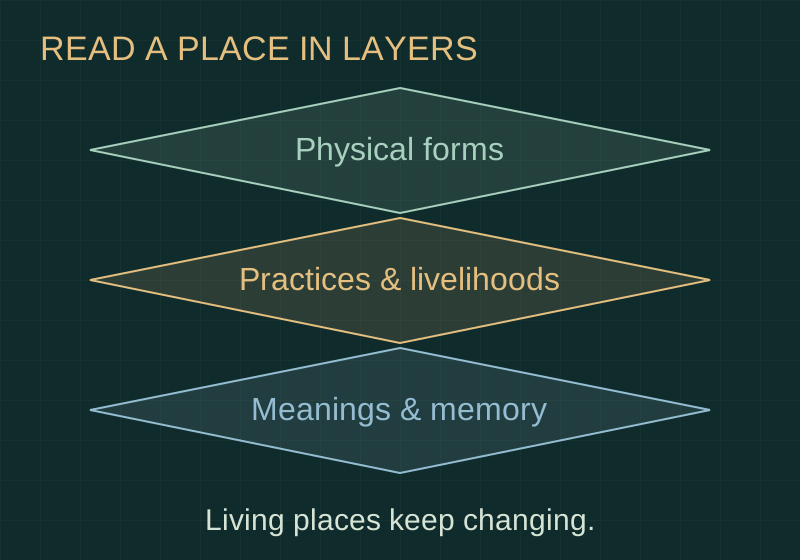
Our illustration separates three analytical layers: material form, everyday practice and shared or contested meaning. An irrigation terrace is a landform modified through labour; maintaining it involves practical knowledge; its significance may include livelihood, inheritance or collective memory. These layers interact rather than form a hierarchy. Responsible interpretation involves listening to the people concerned, recognising internal diversity and identifying whose account is being presented. Preserving a living practice does not necessarily mean freezing it unchanged, and a heritage designation does not describe all the cultural life of a place.