
Measure what movement enables
Mobility concerns movement; accessibility concerns what that movement enables. A faster road can improve a journey, but the relevant question may be how many suitable jobs, clinics or schools become reachable. Straight-line distance leaves out the transport network, interchange delays and the location of destinations. OECD research treats accessibility as a relationship between the distribution of opportunities and the performance of transport, rather than as speed alone.
The destinations stay in place
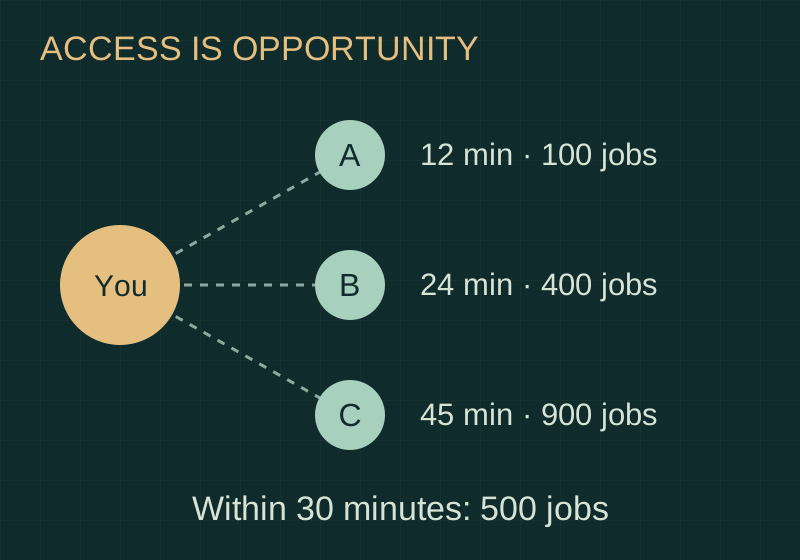
In our hypothetical network, three employment centres contain 100, 400 and 900 jobs. The journey times from one neighbourhood are 12, 24 and 45 minutes. With a 30-minute threshold, 500 jobs are reachable. A new connection reduces the last journey to 28 minutes, bringing the illustrated total to 1,400. The centres have not moved and no jobs have been created. The change is in their accessibility from this origin under the chosen travel-time rule.
Access differs between people
Real accessibility is also personal. A service available to a driver may be impractical for somebody without a car; stairs can make a short route unusable. Fares, reliability, service frequency, care responsibilities and operating hours matter. Counting reachable jobs is only a first measure: it does not establish whether someone is qualified, can afford the journey or will be hired. Good interpretation states the transport mode, time of day, threshold and population whose experience the measure is intended to represent.