The problem it solves
Most large data centres have relied on evaporative cooling, which uses relatively little electricity but loses water to the air. A single facility using cooling towers can consume hundreds of millions of litres a year, and Microsoft's own figures put the range for towers at roughly 750 to 1,150 megalitres annually for a large site. As AI chips have become hotter and denser, cooling them with air alone has become harder, and pressure from communities in dry regions has grown. Engineers have therefore been looking for ways to remove more heat with less water, ideally with none evaporated at all.
How the sealed loop works
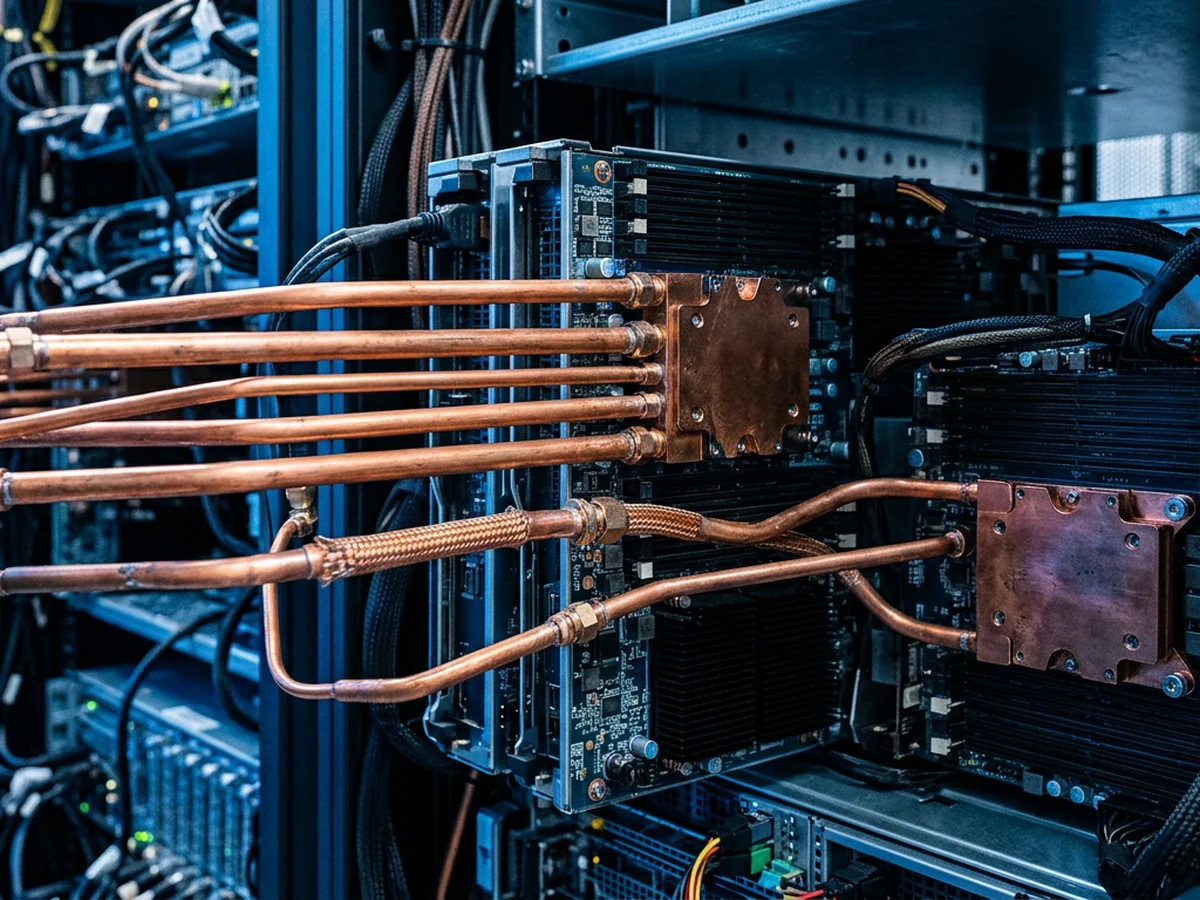
In direct-to-chip cooling, a metal cold plate sits on top of each processor. A coolant, usually treated water or a water-glycol mix, flows through tiny channels in the plate, absorbing heat much more efficiently than air. The warmed liquid travels through pipes to heat exchangers and chillers, where it cools down before returning to the chips. Because the circuit is sealed, the same liquid circulates for years. Microsoft describes its version as filling the system once during construction. Water is still needed for kitchens and restrooms, but the cooling itself no longer evaporates any.
Microsoft's commitment
Microsoft announced in December 2024 that, starting in August of that year, all of its new data centre designs would use this zero-water-for-cooling approach. The company says each such facility avoids the need for more than 125 million litres of water a year. The first sites using the design, in Phoenix, Arizona and Mount Pleasant, Wisconsin, were scheduled to begin piloting it in 2026, with more following from 2027. Across its existing fleet, Microsoft reports that water usage effectiveness improved from 0.49 litres per kilowatt-hour in 2021 to 0.30 in fiscal 2024, and by nearly 90% since its first generation of data centres in the early 2000s.
Other ways to save water
Closed loops are not the only route. Some operators cool with recycled or reclaimed wastewater instead of drinking water, and Google has used treated wastewater at sites such as Douglas County, Georgia. Others harvest rain: Microsoft expects its data centres in Quebec to collect up to 1.5 million litres a year. In cool climates such as the Nordic countries, outside air can do most of the cooling for much of the year. Immersion cooling, where whole servers sit in tanks of non-conductive fluid, is also spreading for the densest AI hardware, and it removes heat with very little water.
The trade-off with electricity
Evaporation is an efficient way to dump heat, so replacing it often means running mechanical chillers harder, which uses more electricity. Designers balance the two depending on local conditions: in a water-stressed desert the extra power may be worthwhile, especially if it comes from solar or wind, while in a wet, cool region evaporative or free-air cooling may be the better overall choice. Liquid cooling also recovers some ground, because pumping liquid to the chips is more efficient than blowing huge volumes of air, and it allows warmer operating temperatures that need less chilling.
Why liquid cooling is spreading anyway
Beyond water, liquid cooling is becoming a practical necessity. The latest AI accelerators can each draw more than a kilowatt, and racks packed with them can exceed 100 kilowatts, far beyond what air cooling handles comfortably. Chip makers and server builders now design many AI systems for liquid cooling from the start. That shift means water savings can arrive as a side effect of the industry's need to cool more powerful hardware, which makes the change likely to stick rather than depend on goodwill alone.
What to watch
The real test is reporting. Useful disclosures show water use site by site, the source of that water, and how much is withdrawn versus consumed, alongside the electricity used. Several companies have pledged to be water positive, replenishing more than they consume, by 2030. Pilots of zero-water designs in hot places like Arizona will show whether the approach delivers as promised. If it does, the image of AI as a thirsty technology could change quickly, at least for the newest generation of data centres.
Sources & further reading
- Microsoft · Next-generation datacenters consume zero water for cooling (2024) ↗
- Microsoft · Two decades of cutting water intensity ↗
- IEA · Energy and AI (2025) ↗
Company figures are self-reported and refer to cooling water only. Photograph: original AI-generated illustration (Adobe Firefly). Reference organisations do not endorse this website.