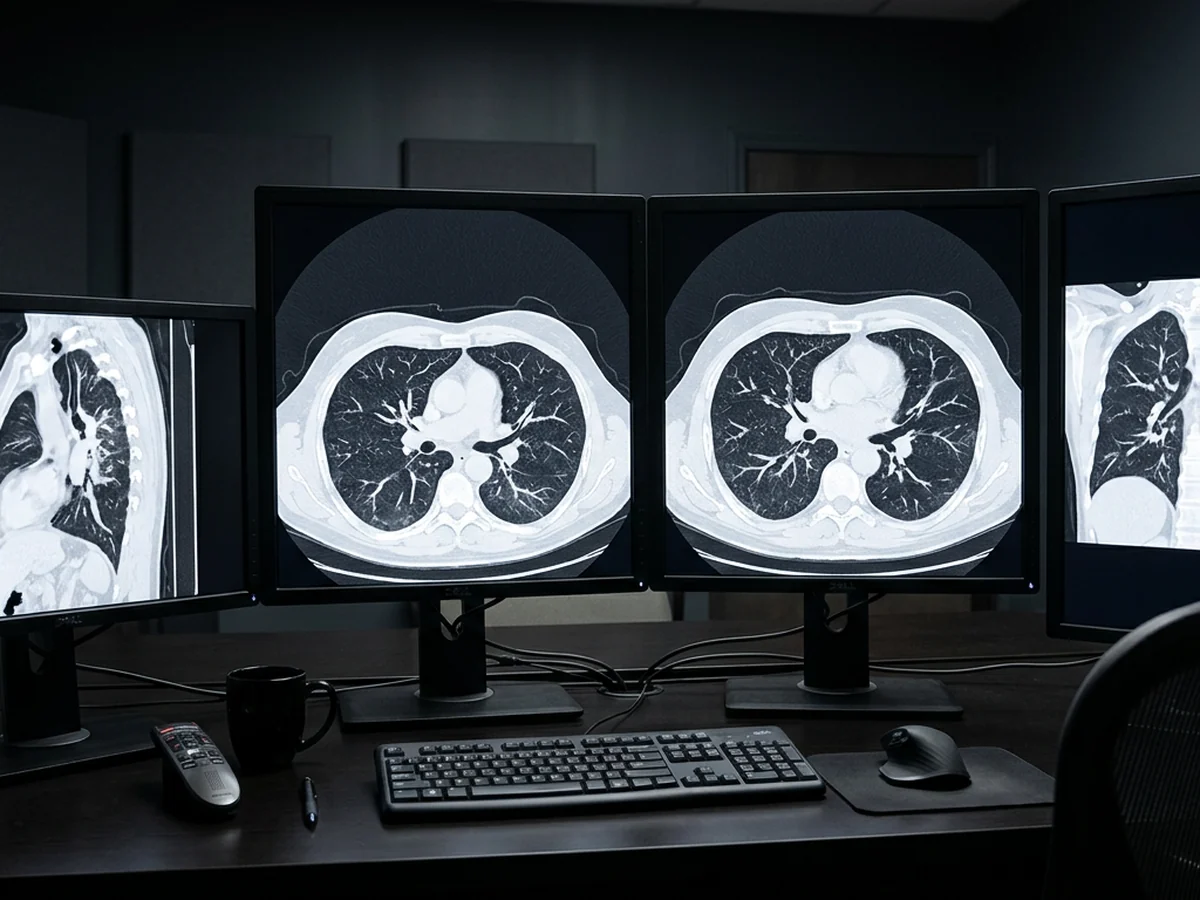
Why imaging came first
Medical imaging was a natural starting point for AI. Scans are already digital, they are stored in large standard archives, and many tasks involve spotting visual patterns, which is exactly what deep learning does well. A radiologist may read hundreds of images a day, and demand for scans has grown faster than the number of specialists in most countries. Software that can flag likely abnormalities or measure structures automatically promises to save time, reduce variation between readers and shorten waits for results.
What the numbers show
The US Food and Drug Administration keeps a public list of medical devices that use AI. A 2026 analysis of that list found about 1,430 devices authorised between 1995 and the end of 2025. Radiology accounted for around 1,094 of them, roughly 76%. The pace has changed dramatically: from fewer than two a year on average between 1995 and 2014 to about 264 a year between 2023 and 2025, with roughly 331 in 2025 alone. Cardiology and neurology follow radiology, and many of their devices also analyse images such as heart scans or brain CTs.
Detecting what eyes might miss
Detection tools mark suspicious areas, such as lung nodules on a chest CT, fractures on an X-ray or signs of breast cancer on a mammogram. They act as a second pair of eyes, prompting the radiologist to look again. Studies show they can catch findings that tired readers overlook, though they also produce false alarms that a human must dismiss. The best results usually come from combining human and machine judgement rather than relying on either alone, as large trials in breast screening have shown.
Triage that saves minutes
In emergencies, time matters. Triage tools scan incoming images for urgent conditions, such as a large blood clot in the brain or bleeding in the skull, and push those cases to the top of the reading list or alert the stroke team directly. For a stroke patient, treatment delayed by even a few minutes can mean more brain damage, so getting the right specialist to the right scan sooner is one of the clearest benefits of medical AI. Several hospital networks report faster treatment times after introducing such alerts.
Measuring and speeding up scans
Other tools take on tedious measurements: the volume of a tumour, the pumping fraction of the heart, the density of bones or the size of brain structures over time. AI is also used before an image is read at all, reconstructing clearer pictures from faster or lower-dose scans. That can cut the time a patient spends in an MRI machine or reduce radiation from CT. These behind-the-scenes uses rarely make headlines, but they affect a large share of the scans performed in modern hospitals.
How regulators check them
Most AI imaging devices reach the US market through the 510(k) route, which requires a company to show that its product is substantially equivalent to one already cleared. Newer kinds of tools go through the De Novo pathway, and the riskiest need full premarket approval. Because AI can be retrained, the FDA finalised guidance in late 2024 on predetermined change control plans, which let manufacturers agree in advance how an algorithm may be updated without a fresh submission each time. Europe regulates such software under its medical device rules, and the UAE and Saudi Arabia have their own approval processes for AI in healthcare.
Limits and open questions
Most devices are cleared by showing they are similar to an existing product, rather than through large randomised trials, and published evidence on real-world performance is uneven. An algorithm trained on images from one population or one scanner brand may perform worse elsewhere, so hospitals must check results locally. Responsibility remains with the clinician. Researchers also note that, as of 2025, the devices on the FDA list were based on traditional machine learning; regulators are still working out how to evaluate tools built on large generative models.
What patients can expect
For most patients, AI in imaging will be invisible: a quicker report, a measurement checked automatically, or an urgent finding spotted sooner. Health systems in the Gulf, Europe and Asia are adopting similar tools, often to cope with rising demand and shortages of specialists. The direction is clear, with approvals rising each year. The challenge is to pair that growth with strong evidence, monitoring after deployment and clear communication, so that patients and doctors can trust what the software adds.
Sources & further reading
- FDA · Artificial Intelligence-Enabled Medical Devices list ↗
- JMIR · FDA AI/ML devices 1995–2025, longitudinal analysis (2026) ↗
- AuntMinnie · Radiology dominates thirty years of FDA AI approvals ↗
Counts are based on the FDA list as analysed by researchers; this is not medical advice. Photograph: original AI-generated illustration (Adobe Firefly). Reference organisations do not endorse this website.