Power before engines
Before the steam engine, almost all work was done by muscle: human or animal. Mills were the great exception. By capturing the motion of flowing water or moving air, they could turn a millstone, lift a hammer or pump water day after day without tiring. A single mill replaced the effort of many people grinding grain by hand. Mills spread across Europe, the Middle East and Asia and became fixtures of village life, often owned by lords or monasteries who charged a share of the flour. For more than a thousand years, they were the most powerful machines most people would ever see, and their gears and shafts trained generations of engineers.
The waterwheel
Water power came first. Greek and Roman engineers used waterwheels by the first century BC, and the Roman architect Vitruvius described a vertical wheel turning a millstone through gears. Some mills used a simple horizontal wheel on a vertical shaft, turning the stone directly. Later designs varied by how water met the wheel. Undershot wheels dipped into a flowing stream; overshot wheels received water at the top from a channel, using its weight as well as its speed, and were more efficient. A Roman complex at Barbegal in southern France used a series of wheels down a hillside. By 1086, England's Domesday Book listed roughly 5,600 watermills.
Counting the power
The power of a water mill can be estimated from the flow and the drop. Power equals water density times gravity times flow rate times height, multiplied by the wheel's efficiency. Take a stream delivering 0.3 cubic metres of water a second, falling 3 metres onto a wheel that is 60 per cent efficient. The result is about 5,300 watts, or 5.3 kilowatts. A healthy adult working steadily produces perhaps 75 watts, so such a wheel matched the effort of dozens of people, around the clock, for as long as the stream flowed. Overshot wheels on good sites with higher falls could deliver considerably more power.
Windmills east and west
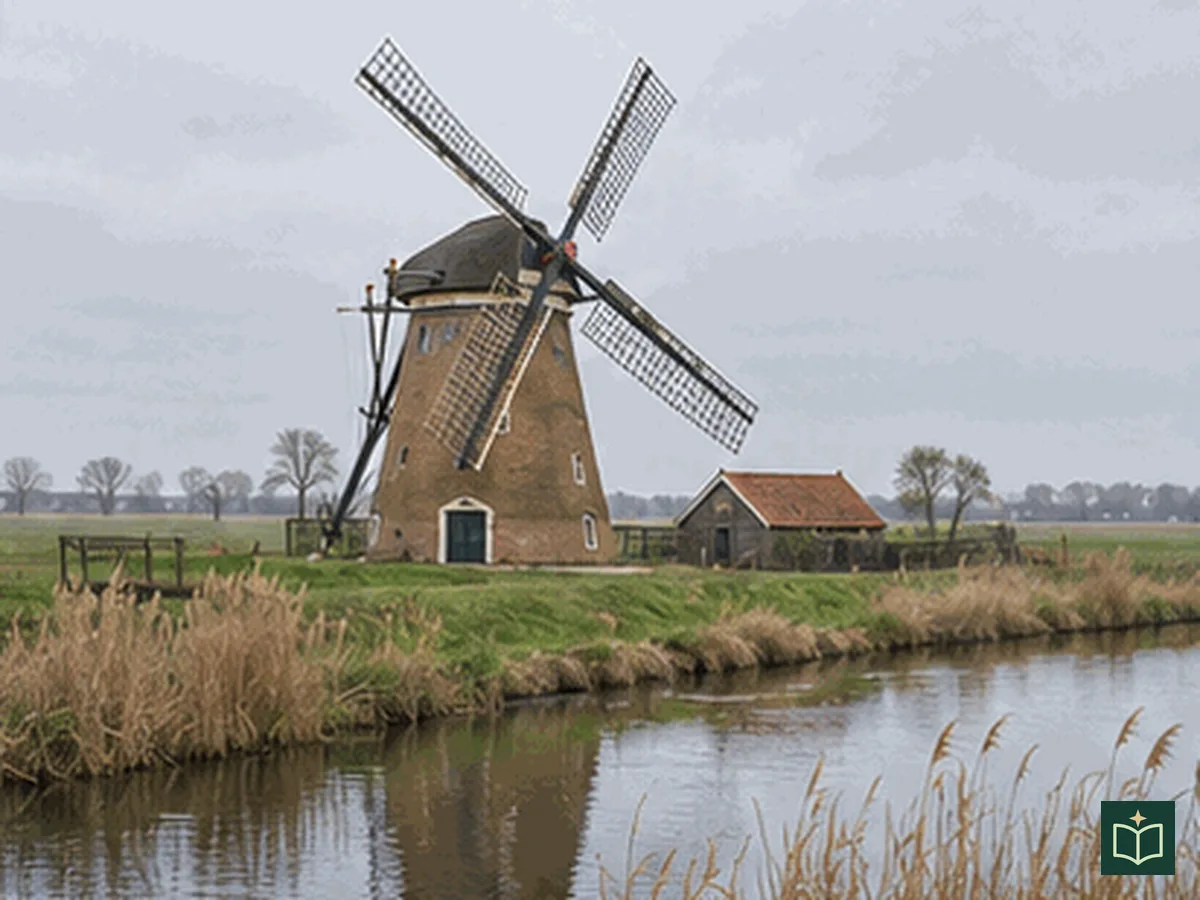
Wind power followed. The earliest well-documented windmills come from the region of Sistan, on today's border between Iran and Afghanistan, described by writers from around the ninth and tenth centuries. They used vertical-axis designs: sails of reed matting on a vertical shaft, set inside walls that channelled the strong seasonal wind. Some, at Nashtifan in Iran, still turn. Europe developed its own design in the late twelfth century: the post mill, whose whole wooden body rotated on a central post to face the wind. Tower mills and smock mills followed, with only a cap that turned. In 1745 the fantail added a small wheel that turned the cap automatically.
More than grain
Grinding grain was the main task, but mills did much more. Water and wind drove saws that cut timber; a Dutch inventor, Cornelis Corneliszoon, patented a wind-powered sawmill in the 1590s, helping the Netherlands build its fleets. Mills crushed seeds for oil, pounded cloth to thicken it, powered bellows and hammers for ironworks, ground pigments and made paper. In the Netherlands, rows of windmills pumped water out of low-lying land, helping to create and protect the polders. The mills of Kinderdijk, built in the 1730s and 1740s, are a surviving example. In Britain, water-powered textile mills launched the early Industrial Revolution before steam took over.
Why mills faded, and returned
Mills had clear limits. Water mills had to sit beside suitable rivers, and dry seasons or frozen winters stopped them. Windmills worked only when the wind blew. During the nineteenth century, coal-fired steam engines, and later electric motors, offered power anywhere and on demand, and most traditional mills closed. Many survive as museums or homes. Yet their principles never vanished. Hydroelectric turbines are refined descendants of the waterwheel, and modern wind turbines are, in effect, highly engineered windmills that turn generators rather than millstones. The story of mills shows that harnessing renewable flows is not new; what changed was turning that motion into electricity.
Sources & further reading
Figures are rounded and widely published; check the linked organisations for the latest editions. These organisations do not endorse this website.