Irradiance and irradiation
Two similar words describe sunshine for engineers. Irradiance is the power of sunlight arriving on a surface at a given moment, measured in watts per square metre. It rises from zero at dawn to a peak around noon and falls again by dusk, dipping whenever cloud or dust passes. Irradiation, sometimes called insolation, is the energy that accumulates over a period, measured in kilowatt-hours per square metre per day or per year. The distinction mirrors that between power and energy in electricity. Irradiance tells a solar plant's operator how much it can generate right now; irradiation tells a developer how much it can expect to generate over a year.
From space to the ground
Above the atmosphere, sunlight arrives at about 1,361 watts per square metre on a surface facing the Sun, a figure known as the solar constant. On its way down, some light is absorbed by gases and water vapour and some is scattered by air molecules, dust and cloud. On a clear day at noon, about 1,000 watts per square metre typically reaches a surface facing the Sun at sea level, which is why panels are tested at that standard value. Irradiance also depends on angle. When the Sun is low, its light spreads over a larger area and passes through more air, so each square metre receives less.
Direct and diffuse
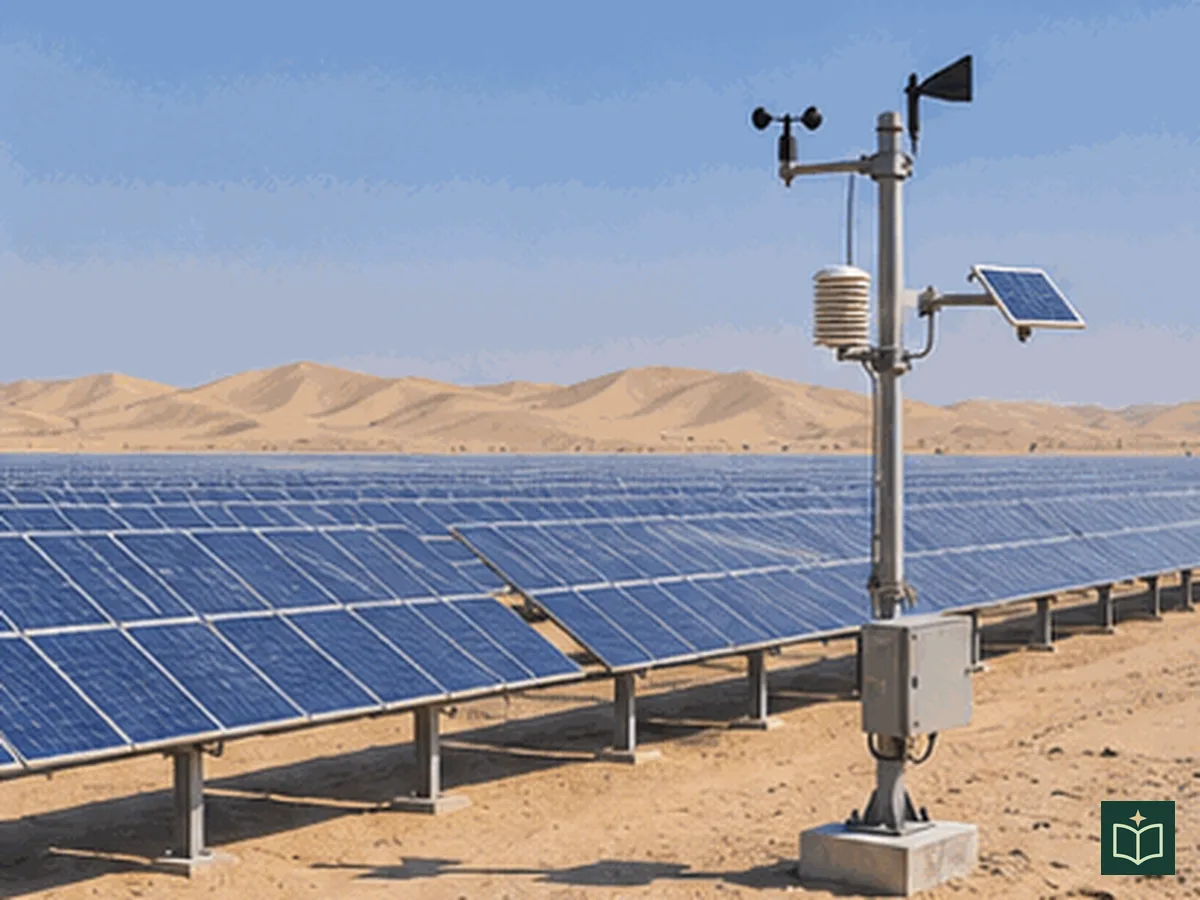
Sunlight reaching the ground comes in two forms. Direct normal irradiance is the beam arriving straight from the Sun's disc, measured on a surface that tracks the Sun. Diffuse irradiance is light scattered by the sky, arriving from all directions; it is why shade is not completely dark. Global horizontal irradiance combines both on a flat surface. Ordinary solar panels use global light, so they still produce power on hazy days. Concentrating solar plants, which focus sunlight with mirrors, can use only the direct beam. Instruments called pyranometers measure global light, while pyrheliometers that follow the Sun measure the direct beam; satellites fill gaps between ground stations.
Peak sun hours
Daily irradiation is often expressed as peak sun hours: the number of hours at 1,000 watts per square metre that would deliver the same energy. A site receiving 6 kWh per square metre in a day has six peak sun hours, even though the Sun shines for longer at lower strength. The measure makes rough estimates simple. A one-kilowatt array of panels at such a site, with a typical performance ratio of 0.8 to account for heat, dust, wiring and inverter losses, would produce about 4.8 kWh a day. Over a year of similar days, that comes to roughly 1,750 kWh, before allowing for seasonal changes or long-term panel degradation.
Why the Gulf shines
The Arabian Peninsula lies in the subtropical belt where dry, sinking air keeps skies clear for most of the year. Global horizontal irradiation across much of the UAE, Saudi Arabia and Oman is roughly 2,000 to 2,200 kWh per square metre a year, about twice that of Germany or the United Kingdom. Summer days are long and the Sun climbs high. That resource underpins large solar parks such as the Mohammed bin Rashid Al Maktoum Solar Park in Dubai. The region does have drawbacks: dust and haze scatter the direct beam and coat panels, and high temperatures reduce panel efficiency, so plants need regular cleaning and careful design.
Reading solar maps
Solar resource maps, such as the World Bank's Global Solar Atlas, show long-term average irradiation for any location. They are the starting point for planning a rooftop system or a solar farm, but they need careful reading. A map may show global horizontal, direct normal or tilted-surface values, which differ considerably. Averages hide year-to-year variation, and local factors such as shading from buildings, dust storms or coastal humidity can change actual output. Developers usually combine satellite records with a year or more of ground measurements before financing a large plant. For households, the key lesson is simple: more irradiation means more kilowatt-hours from the same panels.
Sources & further reading
Figures are rounded and widely published; check the linked organisations for the latest editions. These organisations do not endorse this website.