A train without a tank
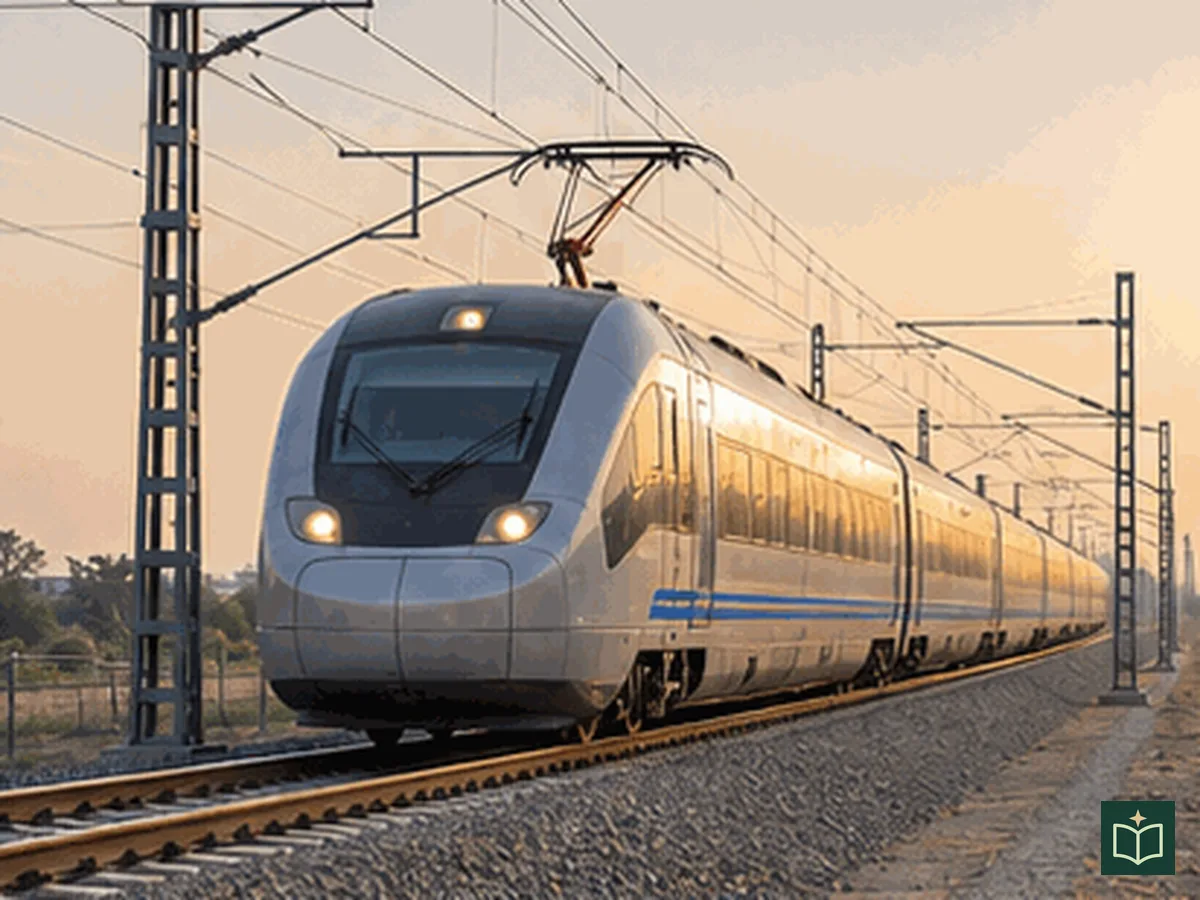
A diesel train carries its fuel and its own power station. An electric train does neither. It draws electricity continuously from the track side as it moves, and electric motors drive its wheels. This makes electric trains lighter for their power, quieter, cleaner at the point of use and able to accelerate quickly. They are also more efficient than diesel, because large power stations and modern grids convert energy better than a small onboard engine. The trade-off is infrastructure: every kilometre of route needs a live wire or rail and a chain of substations. That cost is easiest to justify on busy lines, which is why metros and major mainlines are electrified first.
Overhead wires
Most mainline and high-speed railways use overhead lines, known as catenary. A contact wire hangs above the track, held level by a supporting cable and droppers, and kept under tension so it does not sag in heat. The wire zigzags slightly from side to side so that it wears the carbon strip on the train's pantograph evenly rather than cutting a groove. The pantograph, a spring-loaded frame on the roof, presses gently upwards to keep contact at speed. Many modern systems use 25,000 volts alternating current. Older networks may use 1,500 or 3,000 volts direct current, and some countries run several systems that trains must switch between.
The third rail
Many metros use a third rail instead: an extra conductor laid beside the running rails, usually carrying 600 to 750 volts direct current. A metal shoe on the train's bogie slides along it to collect current. Third rails are compact, suit tunnels and keep viaducts free of overhead clutter, but they are dangerous at ground level, so they are covered and stations are fenced or fitted with platform screen doors. The Dubai Metro uses a 750-volt third rail on its driverless trains. Low voltage brings a problem, however: to deliver the same power, a train must draw a much larger current, which causes greater losses in the rails.
Why voltage matters
The relationship is simple: power equals voltage times current. Imagine a train drawing 3 megawatts while accelerating. At 750 volts, it needs about 4,000 amperes. At 25,000 volts, it needs only 120 amperes. Because resistive losses rise with the square of current, the low-voltage system wastes far more energy over distance. That is why direct-current metros need substations every few kilometres, while 25-kilovolt mainlines can space them tens of kilometres apart. Substations take power from the regional grid, step its voltage down and, for direct-current lines, convert it with rectifiers. Each feeds a section of track, with backups so a single failure does not stop the service.
Braking that gives back
When an electric train brakes, its motors can act as generators, turning the train's momentum back into electricity. This is regenerative braking. On alternating-current mainlines, the energy can flow back into the grid. On direct-current metros, it is usually absorbed by another train accelerating nearby on the same section, so timetables are sometimes arranged to match one train's braking with another's departure. If no train can use it, the energy is burnt off in resistors unless the line has inverting substations or wayside batteries to capture it. Operators commonly report that regeneration recovers a meaningful share of traction energy, especially on metros with frequent stops.
Electrifying more lines
Worldwide, railways are among the most electrified forms of transport, and passenger journeys by electric train make up a large share of rail travel. The main barrier to wider electrification is the cost of wires, substations and grid connections, which is hard to justify on lightly used lines. For those routes, battery trains that charge under short wired sections, and hydrogen trains, are being tested. In the Gulf, metros in Dubai, Riyadh and Doha run on electricity, while long-distance freight networks have so far largely used diesel locomotives. As grids add more low-carbon power, each electrified line becomes cleaner without any change to the trains themselves.
Sources & further reading
Figures are rounded and widely published; check the linked organisations for the latest editions. These organisations do not endorse this website.