Galen's ancient model
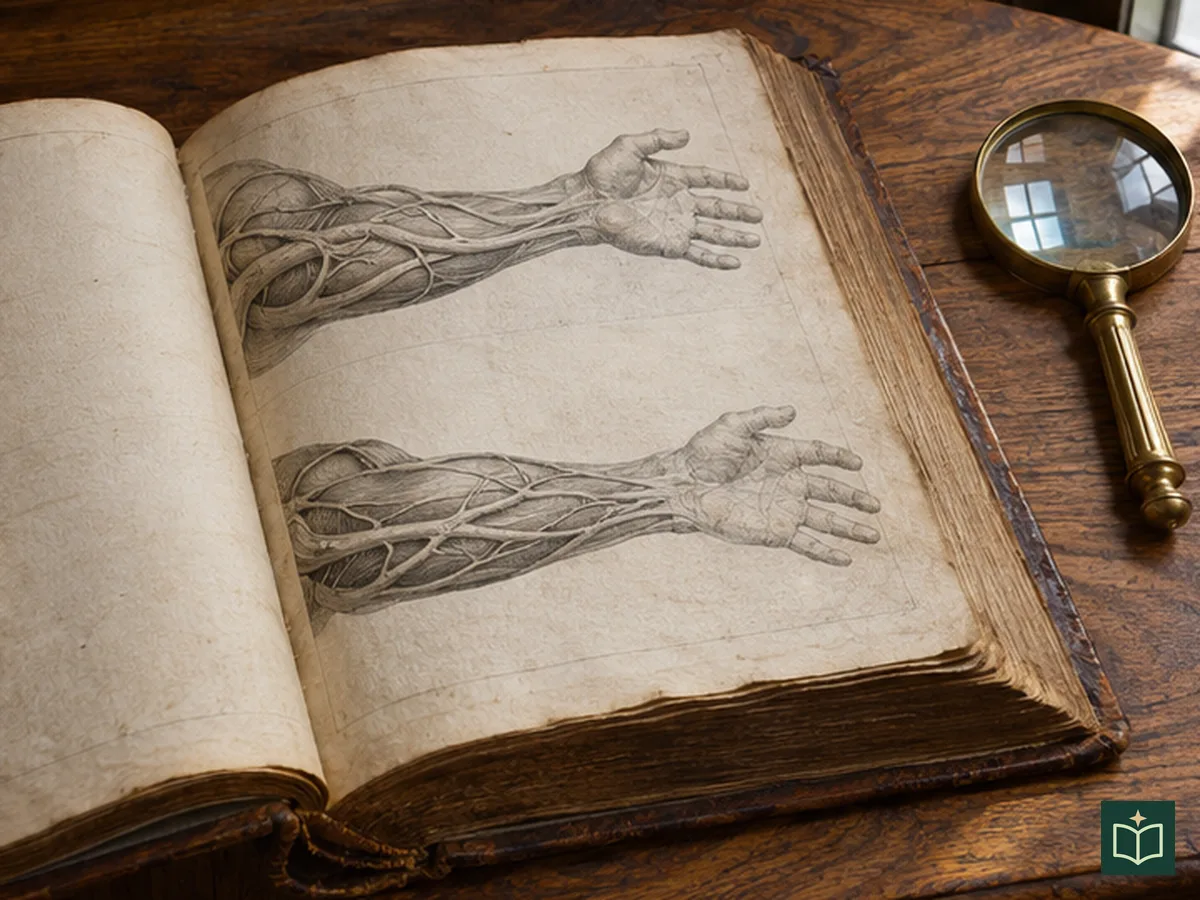
For about 1,400 years, medicine in Europe and the Islamic world followed the Greek physician Galen, who worked in Rome in the second century AD. In his view, the liver turned digested food into blood, which flowed out through the veins to nourish the body and was used up there. Some blood seeped through tiny invisible pores in the wall dividing the heart's two sides, where it mixed with air from the lungs to form a vital spirit carried by the arteries. The theory was detailed and based on real dissection, mostly of animals. Its central claim was that blood was constantly made and consumed, not reused.
An early challenge from Cairo
The first known challenge to part of Galen's model came from the Arab physician Ibn al-Nafis, who worked in Damascus and Cairo and died in 1288. In a commentary on the anatomy in Ibn Sina's Canon of Medicine, he argued that the wall between the heart's chambers was thick and had no passages. Blood, he reasoned, must instead travel from the right side of the heart through the lungs, mixing with air there, before returning to the left side. This is the pulmonary circulation. His work seems to have been little known in Europe, where similar ideas were published in the sixteenth century by Michael Servetus and Realdo Colombo.
Harvey's evidence
William Harvey, born in Kent in 1578, studied medicine at Padua, where his teacher Fabricius had described small valves inside the veins. Back in London he became a physician at St Bartholomew's Hospital and to King James I and later Charles I. Harvey studied the hearts of many living animals, especially cold-blooded ones whose hearts beat slowly, and concluded that the heart's forceful action was contraction, squeezing blood out into the arteries. He also used a simple experiment on the human arm. A tight band stopped blood in the arteries; a looser band let arterial blood in but stopped it returning, so the veins below swelled.
The decisive arithmetic
Harvey's most powerful argument was a calculation. He estimated, cautiously, that the heart might push out half an ounce of blood with each beat, and that it beats about a thousand times in half an hour. That gives about 500 ounces, roughly 14 kilograms, in half an hour, far more than the total blood in the body and far more than food could replace. Modern figures make the point stronger: an adult heart pumps around 70 millilitres per beat, so at 70 beats a minute it moves about 4.9 litres a minute, or nearly 300 litres an hour, while the body holds only about five litres. The blood must be going round.
The missing link
Harvey published his findings in 1628 in a short Latin book usually known as De Motu Cordis. His argument had one gap: he could not see how blood passed from the smallest arteries to the smallest veins, and assumed there must be connections too fine to observe. The answer came after his death in 1657. In 1661 the Italian anatomist Marcello Malpighi used a microscope to see capillaries, tiny vessels linking arteries and veins, in the lungs of a frog. Harvey's ideas met resistance at first; the antiquarian John Aubrey later reported that his medical practice suffered. But within a few decades circulation was widely accepted.
Why it mattered
The discovery changed medicine in practical and intellectual ways. If blood circulates, then substances injected into a vein reach the whole body, an insight that encouraged early experiments with injections and blood transfusion in the 1660s and, much later, intravenous medicine. Harvey's method mattered as much as his result. He combined careful observation, controlled experiments and quantitative reasoning, rather than relying on the authority of ancient texts. That approach became central to the new experimental science of the seventeenth century. Today's understanding of the heart, blood pressure and the cardiovascular system all builds on his description of a closed circuit driven by a pump.
Sources & further reading
Figures are rounded and widely published; check the linked organisations for the latest editions. These organisations do not endorse this website.