Last of the large lands
Aotearoa New Zealand was one of the last major land masses to be settled by people. Its two main islands cover about 268,000 square kilometres, more than all the other islands of Polynesia combined. The first settlers came from East Polynesia, the region including the Society Islands and the Cook Islands, part of a remarkable expansion of seafaring peoples across the Pacific. Māori tradition recalls voyaging canoes, or waka, and the navigator Kupe, and many iwi, or tribes, trace their ancestry to particular canoes. The settlers named the land Aotearoa, often translated as 'land of the long white cloud', though the name has several interpretations.
Dating the arrival
For much of the twentieth century, estimates of first settlement ranged from about AD 800 to 1350. More reliable dating has narrowed this down. Radiocarbon dates from early sites, from the bones of the Pacific rat, or kiore, which travelled with the settlers, and from seeds gnawed by those rats, point to arrival in the second half of the thirteenth century. A layer of volcanic ash from the Kaharoa eruption of Mount Tarawera, dated to around 1314, lies just above some of the earliest human traces. Genetic studies suggest a founding population of a few hundred people, probably arriving on several voyages.
A land of birds
Before people arrived, New Zealand had no land mammals except bats. Birds filled many niches. The most striking were the moa, nine species of flightless birds; the largest females stood around 3.6 metres tall with necks stretched upwards and weighed perhaps 230 kilograms. Their only predator was Haast's eagle, the largest eagle known. For the new arrivals, moa were an abundant source of meat, eggs, bone and feathers. Early sites such as Wairau Bar, at the north of the South Island, contain moa bones alongside East Polynesian tools and ornaments, and the burials of some of the first generations of settlers.
A rapid extinction
Moa reproduced slowly, matured late and had never before faced human hunters. Studies combining population models with radiocarbon dates suggest that all species were extinct within about 150 to 200 years of human arrival, probably by around 1450. Haast's eagle, which depended on moa, disappeared with them. Forest clearance by fire, along with rats and dogs brought by the settlers, also drove several other bird species to extinction. New Zealand's experience is one of the clearest examples of how quickly the arrival of humans can transform an isolated ecosystem, and of how small a starting population can achieve that change.
Adapting to a cooler climate
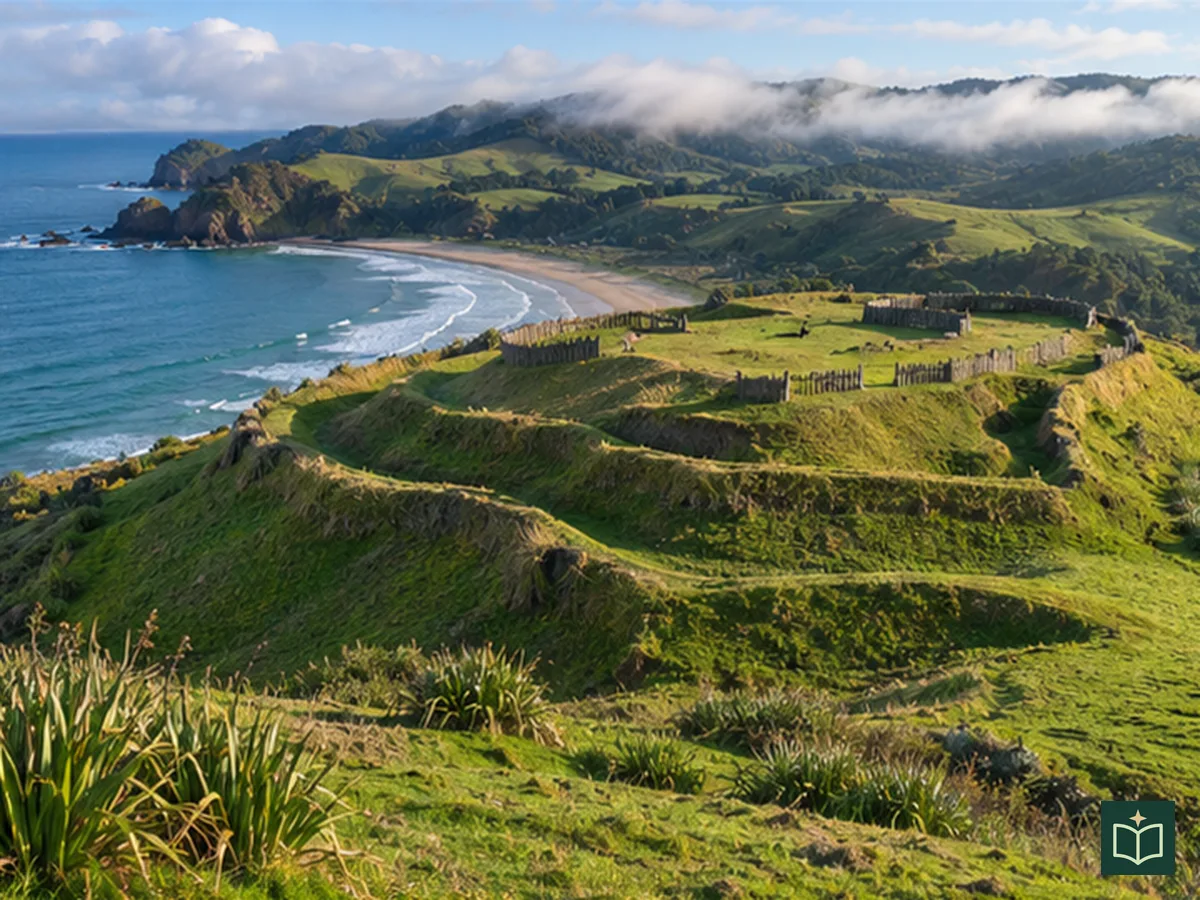
Settlers brought tropical crops including kūmara, the sweet potato, taro, yam and gourd. Coconuts and breadfruit could not survive the cooler climate, and even kūmara grew only in the warmer north and along sheltered coasts. To get through winter, people developed underground storage pits to keep kūmara tubers dry and protected until the next planting season. They also relied on bracken fern root, fish, shellfish, birds and seals. As moa and seals declined, communities settled into new patterns. Fortified villages called pā appeared on hills and headlands, and the working of pounamu, New Zealand greenstone, into tools and ornaments became highly skilled.
From Polynesian to Māori
Over the following centuries the descendants of the first settlers developed the distinct culture now known as Māori, with its own carving styles, social structure and oral traditions tied to land and genealogy. Around 1500 some people sailed east to the Chatham Islands, where their descendants became the Moriori. European contact began with Abel Tasman's brief visit in 1642 and James Cook's voyage of 1769, after which colonisation brought profound and often devastating change. Today archaeology, genetics and Māori oral history together tell the story of settlement, and are increasingly studied in partnership with iwi rather than separately from them.
Sources & further reading
Figures are rounded and widely published; check the linked organisations for the latest editions. These organisations do not endorse this website.