The problem with a solid axle
A car's wheels can turn at different speeds through a differential, letting the outer wheel travel further on a bend. Train wheels cannot. Each pair is pressed firmly onto a single steel axle, forming a wheelset that turns as one piece. That design is strong and simple, but it creates a puzzle. On a curve, the outer rail is longer than the inner rail. If both wheels had the same diameter, one would have to slip and scrape along the rail, wasting energy and causing wear. Something else must allow the outer wheel to cover more distance in the same number of turns. The answer is in the shape of the wheels.
A cone on each side
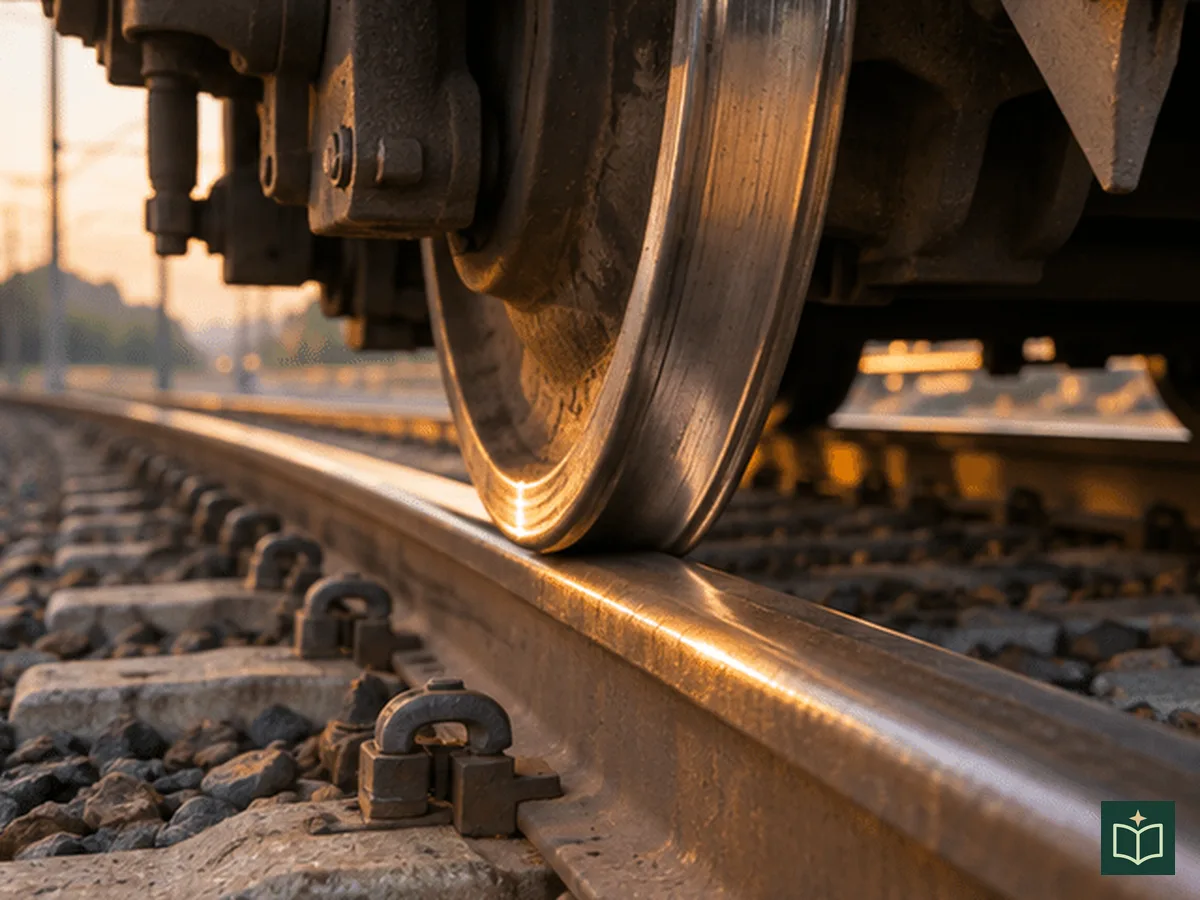
Look closely at a train wheel and the tread, the part touching the rail, is not flat. It slopes gently, so the wheel is slightly larger in diameter near the inner flange than at its outer edge. Both wheels on an axle slope towards each other, so together they resemble two cones joined at their wide ends. When the wheelset sits centred on straight track, both wheels roll on the same diameter. If it drifts to the left, the left wheel rolls on a larger diameter and the right on a smaller one. The left wheel covers more ground with each turn, steering the axle back towards the right and the centre.
Going round a curve
On a curve, the same effect does the steering. Centrifugal effects and the track push the wheelset slightly towards the outer rail, so the outer wheel rolls on a larger diameter than the inner one. Suppose a wheel of 45 centimetres radius has a taper of 1 in 20 and the rail contact points sit about 1.5 metres apart. On a gentle curve with a radius of 1,000 metres, the wheelset only needs to shift about 7 millimetres outwards for the difference in diameter to match the extra length of the outer rail. On a tight 300-metre curve, it would need about 22 millimetres, more than the clearance available, so flanges and rail lubrication help there.
Flanges are a backstop
Many people assume flanges, the raised lips on the inside of each wheel, keep trains on the track. They are vital for safety, guiding the wheelset through tight curves and switches and preventing derailment if something goes wrong. But in normal running on straight track and gentle curves, they should rarely touch the rail. Flange contact causes squealing, high wear on wheels and rails and extra rolling resistance. The conical tread allows the wheelset to self-centre with only around a centimetre of sideways movement, so the flanges serve as a backstop. Rails are also tilted slightly inwards and given rounded heads to match the wheel profile, which steadies the contact point.
Hunting and history
The self-centring effect has a side effect. A wheelset that shifts sideways is steered back, overshoots slightly and is steered back again, producing a gentle side-to-side wave as it rolls along. The German engineer Johann Klingel described this motion mathematically in 1883, and it is known as hunting. At low speed, the motion is damped and harmless. Above a critical speed, it can grow violent, damaging track and making rides rough. High-speed trains manage hunting with carefully chosen wheel tapers, suspension dampers and bogie designs. The physicist Richard Feynman later popularised the cone explanation, noting how elegantly a simple shape solves a difficult steering problem.
Why it still matters
Wheel profiles are not fixed forever. As wheels wear, their cone shape changes, so railways periodically reprofile them on special lathes, often without removing them from the train. Engineers also choose tapers for each network: steeper tapers steer better on curvy lines, while shallower ones keep high-speed trains stable. The same principles apply to new lines in the Gulf, such as Etihad Rail, which uses the 1,435-millimetre standard gauge common across much of the world, and to metros and trams with tight curves. A common misconception is that train wheels are flat cylinders. They are carefully shaped cones, and that shape is one of railway engineering's quiet triumphs.
Sources & further reading
Figures are rounded and widely published; check the linked organisations for the latest editions. These organisations do not endorse this website.