Farming without fields
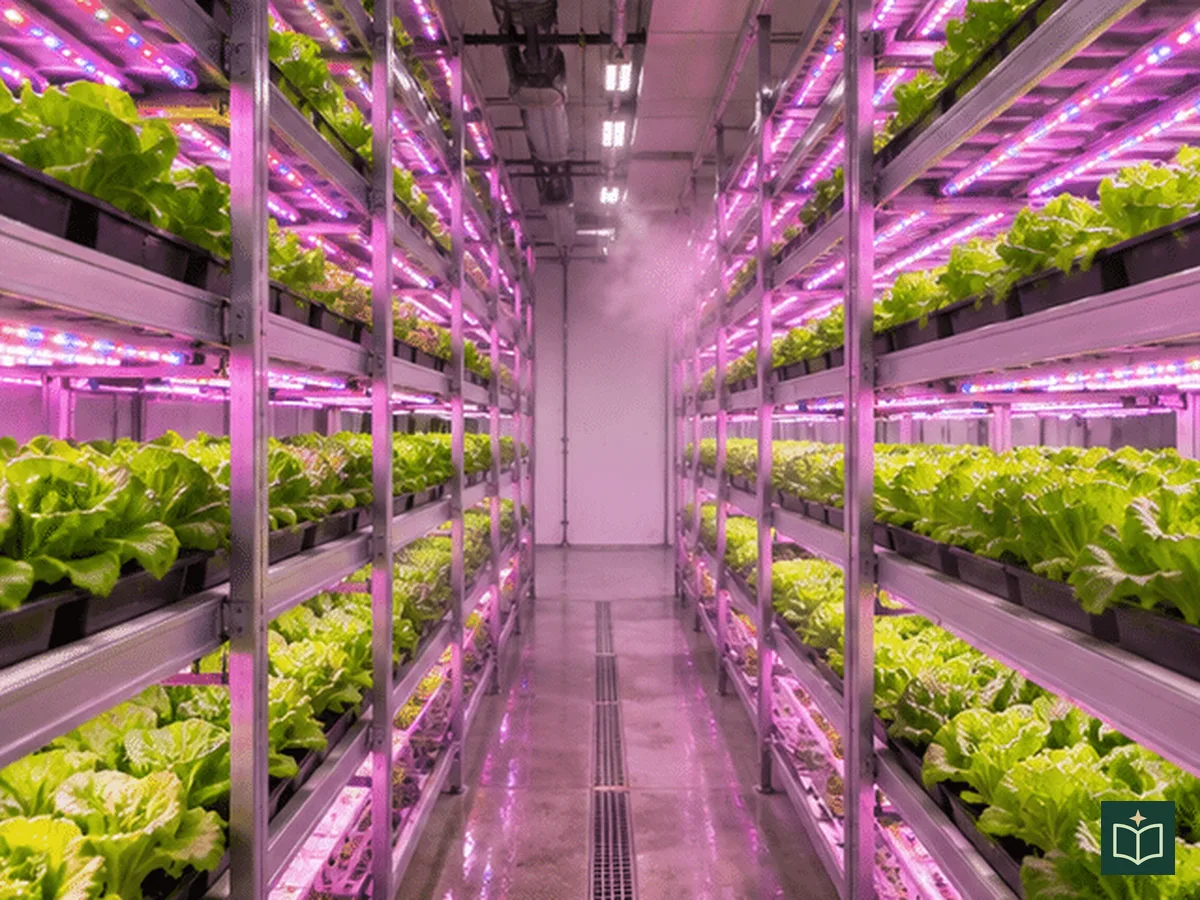
A vertical farm grows plants indoors, stacked in layers on shelves that can rise many metres high. There is no soil and no sunlight. Instead, every condition a plant needs is supplied and controlled: light, water, nutrients, temperature, humidity and carbon dioxide. The idea builds on greenhouses and hydroponics, which have been used commercially for decades, but takes control further by closing off the outside world entirely. Because the trays are stacked, a vertical farm can produce far more per square metre of floor than a field. Buildings can be placed near cities, cutting transport times so salad leaves reach shelves within a day or two of harvest.
Roots in water
Most vertical farms use hydroponics, in which plant roots sit in or above flowing water containing dissolved nutrients such as nitrogen, phosphorus and potassium. Seeds are started in small plugs of material like coconut fibre or mineral wool, then moved into trays. Some farms use aeroponics, spraying a fine mist of nutrient solution onto roots hanging in the air. Either way, the water is collected, filtered, topped up with nutrients and recirculated. Moisture released by the leaves is captured by air-conditioning units and returned to the system. That is why vertical farms can use only a small fraction of the water needed in fields, a major advantage in arid regions.
Light from LEDs
Plants use mainly red and blue light for photosynthesis, so vertical farms use LEDs tuned to those wavelengths, which is why many farms glow pink or purple. LEDs are efficient and run cool enough to sit close to the leaves, making stacking possible. Growers can adjust the light's colour, intensity and hours each day to speed growth or change flavour and colour. Without seasons, pests or weather, crops can be harvested on a predictable schedule throughout the year, often with little or no pesticide. Lettuce that takes two months or more in a field can be ready in a few weeks, and some farms produce many harvests a year.
The electricity bill
The big trade-off is energy. Sunlight is free; LEDs and air conditioning are not. Electricity is often the largest operating cost, alongside labour and the building. To illustrate, if a farm used 15 kilowatt-hours to grow a kilogram of leafy greens and paid AED 0.40 per kilowatt-hour, power alone would cost AED 6 per kilogram before wages, rent or packaging. Real figures vary widely between farms and are improving as LEDs become more efficient. The maths explains why vertical farms grow light, fast, high-value crops such as lettuce, herbs, microgreens and strawberries, rather than staple crops like wheat or rice, which would need impossible amounts of electricity.
Vertical farms in the Gulf
Gulf countries import most of their food and have little fertile land or fresh water, so controlled-environment farming fits national food-security goals. In 2022, Emirates Flight Catering and a partner opened Bustanica near Dubai's Al Maktoum airport, described at the time as the world's largest vertical farm, producing more than a tonne of leafy greens a day for airline meals and supermarkets. Other vertical farms and high-tech greenhouses have opened in Abu Dhabi, Saudi Arabia and Qatar, some supported by government investment programmes. Relatively low electricity costs and high prices for fresh imported greens help the economics, though cooling buildings in the desert summer adds a significant extra load.
Hype and limits
Vertical farming attracted large investments in the late 2010s and early 2020s, but several well-known companies in the United States and Europe went bankrupt or scaled back after 2022 as energy prices rose and funding tightened. That does not mean the idea has failed; it means it works best in particular conditions, for particular crops. A common misconception is that vertical farms can replace traditional agriculture. They supply only a small share of food and cannot feasibly grow grains, pulses or oil crops at scale. Their strengths are freshness, consistency, water savings and local supply. Their weaknesses are high energy use and capital costs, which decide where they make sense.
Sources & further reading
- FAO · Food and Agriculture Organization ↗
- Britannica · Vertical farming ↗
- US Department of Agriculture ↗
Figures are rounded and widely published; check the linked organisations for the latest editions. These organisations do not endorse this website.