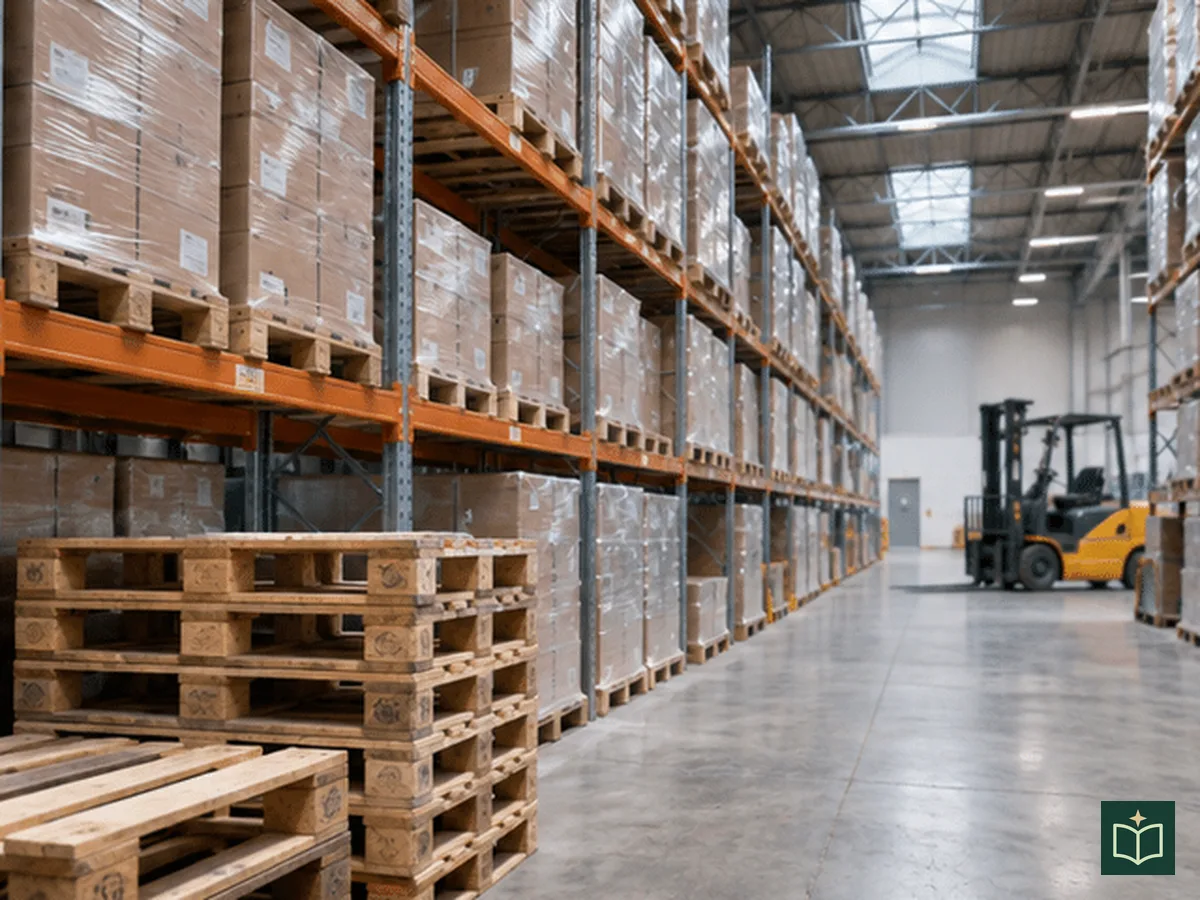
The unit load idea
A pallet is a flat platform, usually of wood but also plastic or metal, with gaps underneath for forklift forks. Its power lies in an idea called the unit load. Instead of handling hundreds of boxes one by one, workers stack them on a pallet, wrap them in plastic film and move the whole block as a single item. A forklift can then lift in seconds what once took a team of people an hour to carry. The idea spread rapidly during the Second World War, when military logistics depended on moving supplies quickly, and it became the foundation of modern warehousing alongside the forklift truck and, later, the shipping container.
A few standard sizes
Pallets work best when everyone uses the same sizes, though the world never agreed on just one. The international standard ISO 6780 recognises six sizes. In Europe, the Euro pallet measures 1,200 by 800 millimetres and is managed by an association that licenses manufacturers and marks approved pallets. Another widespread size is 1,200 by 1,000 millimetres, used in Britain, parts of Asia and much of the Gulf. North America mostly uses a 48 by 40 inch pallet, about 1,219 by 1,016 millimetres, while 1,100 by 1,100 millimetres is common in parts of Asia. These sizes did not appear by chance; they follow lorry and rail wagon widths.
Fitting lorries and containers
The dimensions matter because they must fill vehicles efficiently. A standard European articulated trailer is 13.6 metres long and about 2.45 metres wide inside. Euro pallets fit three across, 800 millimetres each, and 11 deep, 1,200 millimetres each, giving 33 pallets. The same trailer takes 26 pallets of 1,200 by 1,000 millimetres. Shipping containers are less forgiving because they were designed around American measurements. A 40-foot container about 12 metres long and 2.35 metres wide can take 25 Euro pallets if one row is turned sideways: 15 placed crosswise and 10 lengthwise. In practice, loaders often fit 23 or 24 because of door frames and loading gaps.
Pallets shape buildings too
Once pallets were standardised, the rest of the logistics world was built around them. Warehouse racks have beams spaced to hold two or three pallets side by side, at heights matched to forklift reach. Conveyors, automated storage systems and dock doors are sized for pallet loads. Retailers design shelf-ready displays that arrive on pallets and go straight onto the shop floor. Product packaging is often designed so that cartons fill a pallet's footprint without overhang, which would risk damage. Even the size of a cereal box can be traced back, in part, to how many cartons fit neatly on a pallet layer in a distribution centre. Standards ripple outward through the whole system.
Pools, swaps and recycling
Billions of pallets circulate worldwide, and someone has to own them. Some companies buy and keep their own pallets. Others exchange like for like: a lorry driver delivering 20 pallets of goods collects 20 empty pallets in return. Pallet pooling companies rent pallets to manufacturers, then collect, inspect and repair them before sending them out again. Wooden pallets crossing borders must usually be heat-treated or fumigated and stamped under the international ISPM 15 standard, to stop pests travelling in the wood. Damaged pallets are repaired with salvaged boards, and those beyond repair are chipped for animal bedding, mulch or fuel, so the material rarely goes straight to landfill.
Common misconceptions
Pallets are often treated as disposable scrap, yet a good wooden pallet can make many trips and is worth tracking, which is why pooling businesses exist. Another misconception is that one global size would be easy to adopt. Changing would mean redesigning racks, lorries and packaging across entire industries, so regions keep their sizes and international shippers juggle several. Plastic pallets are not automatically better either: they are cleaner and longer-lasting, suiting food and pharmaceuticals, but cost more and are harder to repair. Finally, upcycled pallet furniture is popular, but pallets that have been chemically fumigated or carried hazardous goods are unsuitable for home use.
Sources & further reading
Figures are rounded and widely published; check the linked organisations for the latest editions. These organisations do not endorse this website.