A question a child could ask
Why is the sky dark at night? The obvious answer, that the Sun has set, turns out to be incomplete. For centuries, many astronomers pictured the universe as infinite in size, unchanging and evenly filled with stars. If that were true, something strange would follow. Look in any direction and your line of sight would eventually end on the surface of a star, just as in a large enough forest every line of sight ends on a tree trunk. The entire sky would then glow as brightly as the surface of the Sun, day and night. The contradiction between that prediction and the dark sky is known as Olbers' paradox.
The numbers behind the paradox
Distance does not rescue the argument. Imagine the universe divided into thin shells centred on Earth, like the layers of an onion. A star twice as far away appears four times fainter, because light spreads out with the square of distance. But a shell twice as far away has four times the area and so, if stars are spread evenly, holds four times as many stars. The two effects cancel exactly: every shell contributes the same amount of light. Add up an infinite number of shells and the total brightness has no limit, until nearer stars block the ones behind them, leaving a sky as bright as a stellar surface.
An old puzzle with a long history
The paradox carries the name of Heinrich Olbers, a German physician and astronomer who discussed it in 1823, but others had raised it earlier. Johannes Kepler used the dark sky in 1610 to argue that the universe of stars must be finite. Edmond Halley and the Swiss astronomer Jean-Philippe Loys de Chéseaux returned to the problem in the eighteenth century. A popular proposed solution was that clouds of dust between the stars absorb the light. That fails: over a long enough time the dust would absorb so much energy that it would heat up and glow as brightly as the stars themselves, so the sky would still shine.
The answer: a universe with an age
The modern resolution rests on two facts: light travels at a finite speed, and the universe has a finite age, about 13.8 billion years. We can only see light that has had time to reach us since the universe began, which limits how far we can see. Beyond that horizon there may be more stars and galaxies, but their light has not arrived. Stars also do not shine forever; they burn for millions to billions of years and then fade. The writer Edgar Allan Poe hinted at this answer in 1848, and Lord Kelvin worked through it quantitatively in 1901. There are simply not enough stars visible to fill the sky.
The role of expansion
The expansion of the universe adds a further effect. As space stretches, light from distant galaxies is stretched to longer, redder wavelengths, carrying less energy, and the more distant the source, the stronger this redshift. Expansion also thins out the galaxies over time. Cosmologists have calculated that the finite age of the universe is the main reason the sky is dark, with expansion playing a smaller supporting role. Remarkably, the sky is not completely dark. In every direction there is a faint glow of microwaves, the cosmic microwave background, the light of the hot early universe, stretched by expansion until it now corresponds to a temperature only 2.7 degrees above absolute zero.
Why darkness matters
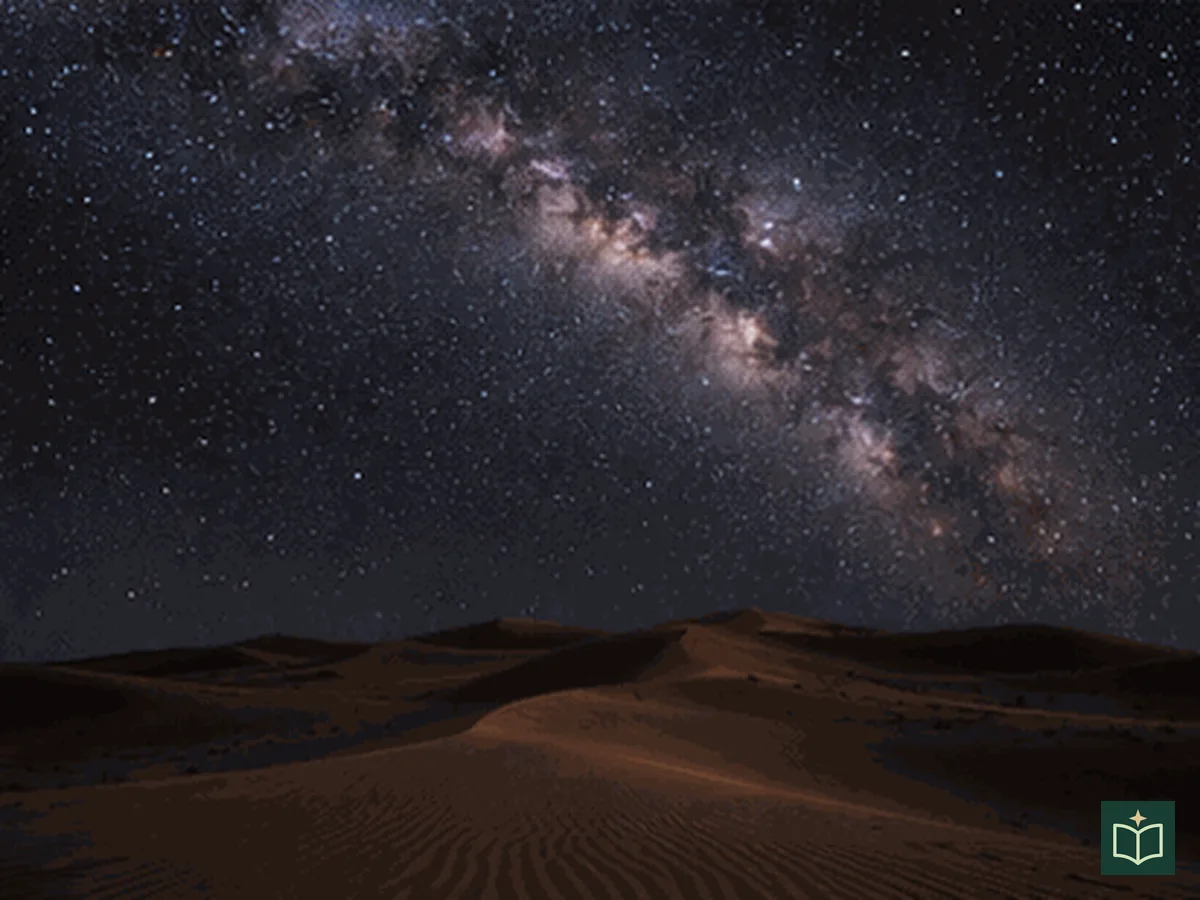
Olbers' paradox shows how an everyday observation can carry deep information. The darkness overhead, visible from any desert campsite away from city lights, is consistent with a universe that had a beginning and has been evolving ever since, the picture described by the Big Bang theory. Few people realise that such a simple glance upward carries evidence about the history of the cosmos. Today, artificial light hides much of the night sky from most of the world's population. Dark-sky reserves, and the deserts of Arabia far from urban glow, still offer views of the Milky Way. In those places the darkness between the stars is as meaningful as the stars themselves.
Sources & further reading
Figures are rounded and widely published; check the linked organisations for the latest editions. These organisations do not endorse this website.