Outrunning your own sound
Anything moving through air pushes the air ahead of it, sending out pressure waves that travel at the speed of sound. For a slow aircraft, these waves race ahead and warn the air to move aside smoothly. The speed of sound depends mainly on temperature. In air at 20°C it is about 343 metres per second, or roughly 1,235 km/h, while in the cold air at airliner cruising heights it falls to about 1,060 km/h. Speed relative to sound is expressed as a Mach number: Mach 1 is the local speed of sound and Mach 2 twice that. Above Mach 1, the aircraft overtakes its own pressure waves.
The Mach cone
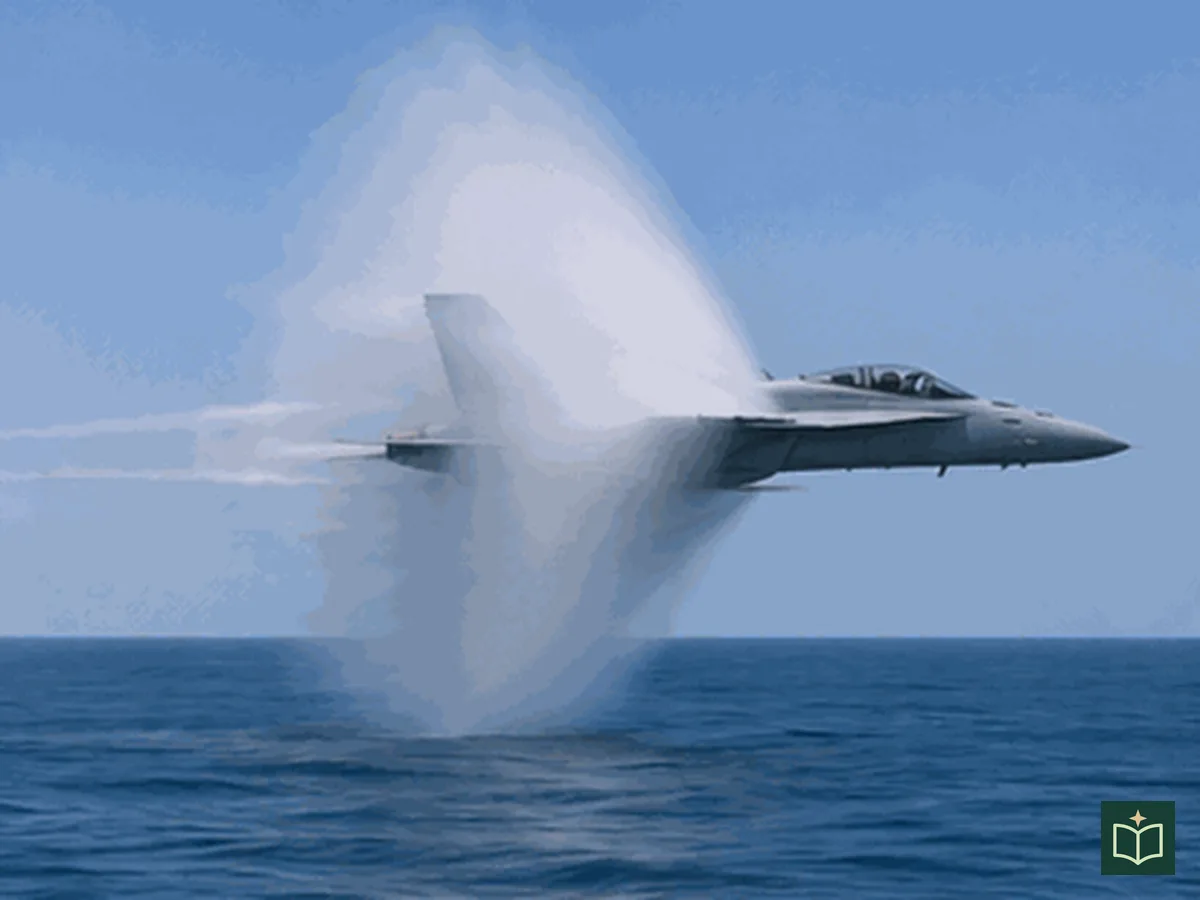
When an aircraft flies faster than sound, the pressure waves it creates cannot move ahead of it. Instead they pile up and merge into a thin zone where pressure, temperature and density jump abruptly. This is a shock wave. It spreads out behind the aircraft in the shape of a cone, with the nose at its tip, much like the V-shaped wake behind a fast boat. The faster the aircraft, the narrower the cone: at Mach 2 its sides make an angle of 30 degrees with the flight path. A second shock forms near the tail, so many people on the ground hear a double boom, a fraction of a second apart.
Not a one-off bang
A common misconception is that the boom happens once, at the instant an aircraft breaks the sound barrier. In fact the shock cone travels with the aircraft for as long as it flies supersonically. As the cone sweeps across the ground, everyone beneath it hears the boom at the moment the cone edge reaches them. Along the flight path the ground experiences a continuous strip of booms, sometimes called the boom carpet, which can be tens of kilometres wide. For an aircraft at Mach 2 and an altitude of 15 kilometres, the cone edge reaches the ground roughly 26 kilometres behind the point directly beneath it, ignoring the bending effects of air.
How loud, and how far
The boom is felt as a sudden rise and drop in pressure, often described as a sharp double crack, like a nearby thunderclap. Its strength depends on the aircraft's size, shape, weight, altitude and manoeuvres. A large supersonic airliner cruising high produced a modest pressure jump, yet enough to rattle windows, startle people and animals and occasionally crack glass or plaster. Turning or accelerating can focus the waves into a stronger super-boom at certain spots. Small objects make booms too. The crack of a whip is a miniature sonic boom, made by the tip moving faster than sound, and so is the sharp snap of a supersonic bullet passing by.
Breaking the barrier
In 1947, the American pilot Chuck Yeager flew the rocket-powered Bell X-1 faster than sound in level flight, proving that aircraft could survive the buffeting near Mach 1. Military jets soon flew supersonic routinely. In 1976, the Anglo-French Concorde began passenger services, cruising at around Mach 2 and crossing the Atlantic in about three and a half hours. Yet its booms limited where it could go. In 1973 the United States banned civil supersonic flight over its land, and many other countries imposed similar restrictions. Concorde therefore flew supersonically mainly over oceans, which, together with high costs and low passenger numbers, helped confine it to a few routes until it retired in 2003.
Quieter booms
Engineers have long known that the shape of an aircraft affects the boom. A long, slender design with carefully shaped surfaces can spread the shock waves out so they do not merge into two sharp cracks, producing a softer thump instead. NASA built an experimental aircraft, the X-59, to test this idea, and it began flight testing in the mid-2020s. The plan is to fly it over communities and measure how people respond, providing data that regulators could use to set noise standards in place of outright bans. Whether quiet supersonic travel becomes common will depend on that research, on fuel use and emissions, and on whether passengers will pay for speed.
Sources & further reading
Figures are rounded and widely published; check the linked organisations for the latest editions. These organisations do not endorse this website.