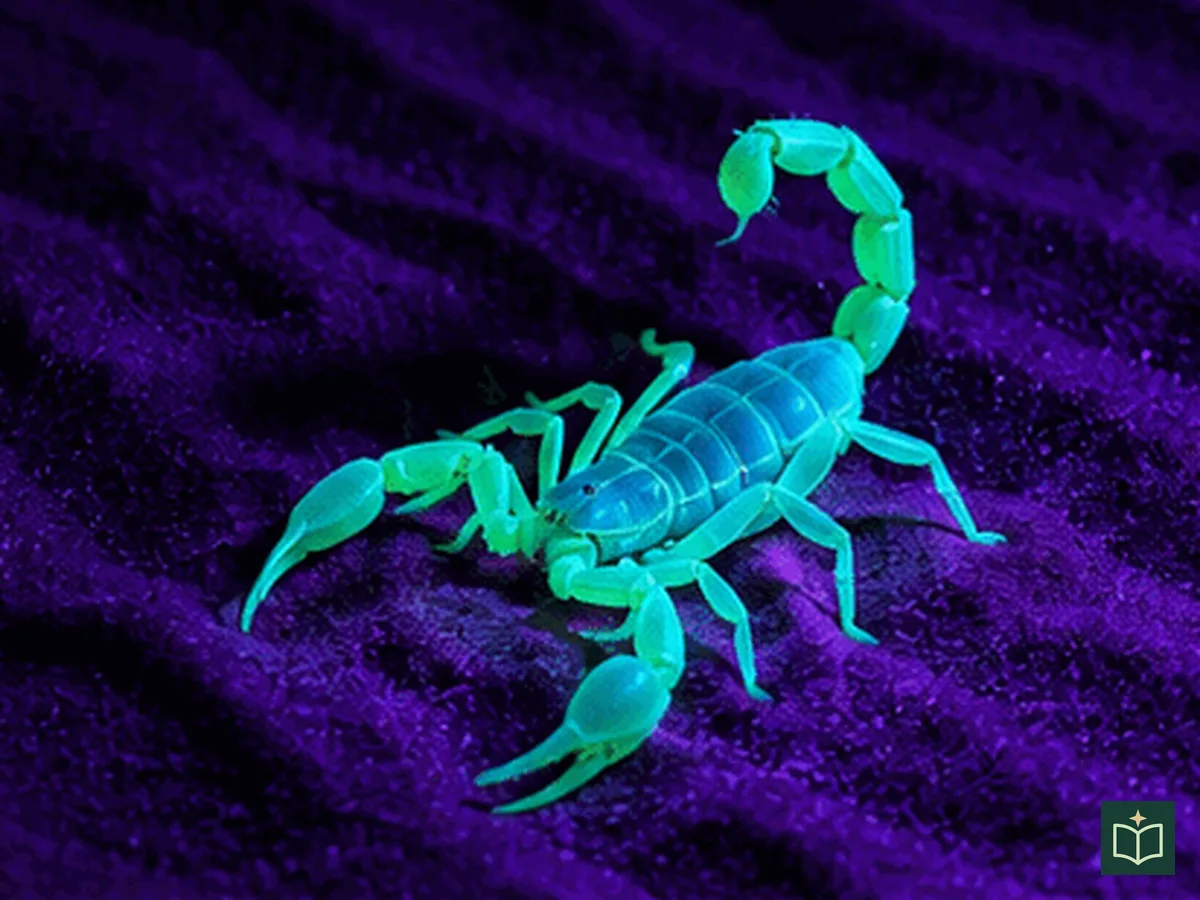
A desert surprise
Shine an ultraviolet torch across desert sand at night and something remarkable can happen. Scorpions, almost invisible in ordinary light, suddenly glow a vivid cyan or blue-green. Nearly every scorpion species does this. The effect is called fluorescence: a material absorbs light at one wavelength and immediately re-emits it at a longer one. Ultraviolet light, which human eyes cannot see, goes in; visible blue-green light comes out. The glow stops the moment the ultraviolet is switched off, so it is not the same as the self-generated light of fireflies. Scorpions produce no light of their own. They simply transform light that falls on them, even faint ultraviolet in moonlight.
Chemistry in the cuticle
A scorpion's body is covered by a tough outer skeleton, the cuticle. The fluorescence comes from a very thin layer within it called the hyaline layer. Chemists have identified compounds responsible, including a beta-carboline and a coumarin, molecules that are naturally good at absorbing ultraviolet and re-emitting it as visible light. The ability builds up as the cuticle hardens. A scorpion that has just moulted its old skin barely glows, and fluorescence strengthens over the following days. The compounds are remarkably durable: preserved specimens still glow strongly, and fluorescence has been reported in the cuticle of fossil scorpions, suggesting that the chemistry is extremely stable over time.
Theories for why
Whether the glow serves any purpose is still debated. One leading idea is that the whole body acts as a light detector. Scorpions avoid light, and their eyes are most sensitive to blue-green. If the cuticle converts ultraviolet into that colour, the animal could sense how much ultraviolet is around and judge whether it is safe to leave its burrow or whether part of its body is exposed. Experiments have shown that scorpions become more active and seek shelter when exposed to ultraviolet. Other suggestions include protection against sunlight, signalling to mates or attracting insect prey. Some scientists argue that it may simply be a by-product of cuticle chemistry with no function.
A tool for researchers
Whatever its purpose, fluorescence has transformed scorpion research. Before ultraviolet lamps became common in the field, finding scorpions meant turning over stones or digging, and population counts were rough. Since portable ultraviolet lights became available, researchers can walk transects through the desert at night and spot glowing scorpions several metres away, counting and identifying them with far less disturbance. The technique has led to the discovery of new species and better estimates of how many scorpions live in a given area. Inexpensive ultraviolet torches mean that campers and residents can use the same trick to check sleeping areas, footwear and outdoor gear for unwanted visitors.
Scorpions of Arabia
The Arabian Peninsula is home to dozens of scorpion species, adapted to sand, gravel plains and rocky mountains. Among the most notable are fat-tailed scorpions of the genus Androctonus, whose venom is among the more dangerous to people, and several species of Leiurus, also medically significant. Many other local species are much less harmful, but telling them apart takes expertise. Scorpions are mainly active at night, hunting insects and spiders, and they shelter by day under rocks, in burrows or inside discarded objects. They can survive long periods without food, reducing their metabolism, and they lose very little water through their waxy cuticle, which suits them to harsh, dry environments.
Staying safe
Most scorpion stings cause sharp local pain rather than serious illness, but stings from certain species can be dangerous, especially for young children and older people. Sensible precautions in desert areas include shaking out shoes, clothing and bedding, wearing closed footwear at night and using a torch, ideally an ultraviolet one, when walking outside after dark. Scorpions should not be handled. Anyone who is stung should seek medical advice promptly, and in the UAE and elsewhere emergency services and poison information centres can provide guidance. Antivenoms exist for medically significant species. The blue-green glow, whatever its natural function, has become one of the simplest ways for people to stay clear.
Sources & further reading
Figures are rounded and widely published; check the linked organisations for the latest editions. These organisations do not endorse this website.