A lizard on the ceiling
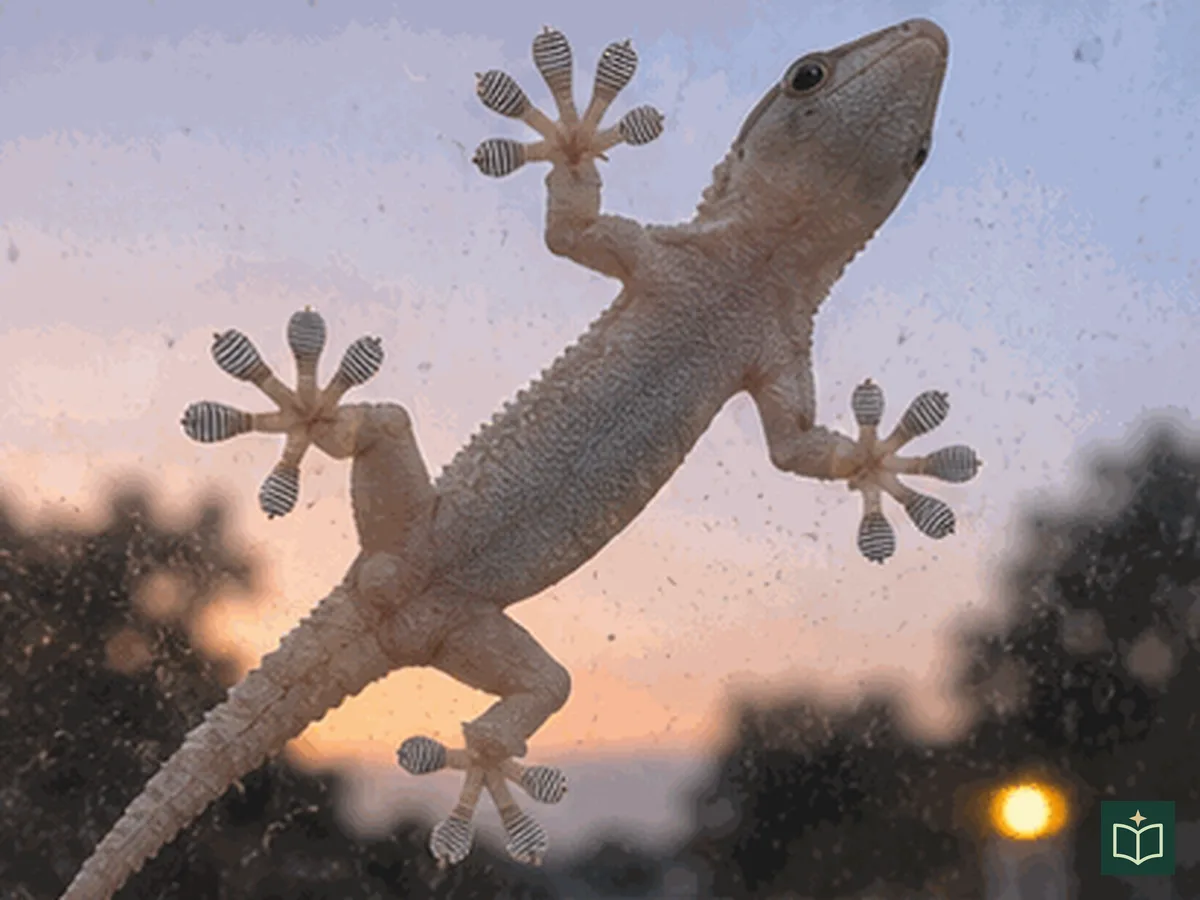
Anyone who has lived in the Gulf has probably seen a small, pale house gecko hunting insects around an outside light, walking up a wall or across a ceiling as easily as across the floor. Geckos can cling to vertical glass and hang from a single toe, then race away without leaving any residue. For a long time, the trick was a mystery. Suction, sticky secretions, tiny hooks and static electricity were all proposed. Research since the 1960s, and especially detailed experiments published from 2000 onwards, showed that the answer lies in the extraordinary structure of the gecko's toe pads and in forces normally too weak to notice.
Hairs that branch and branch
The underside of a climbing gecko's toes is lined with ridged pads called lamellae. Each pad is covered in microscopic hair-like structures called setae. In the tokay gecko, a large Asian species studied closely, there are about 14,000 setae per square millimetre, each around a tenth of a millimetre long. The tip of every seta splits into hundreds of even finer branches ending in flattened plates called spatulae, only about 200 nanometres wide, too small to resolve clearly with an ordinary light microscope. Across all four feet, a tokay has millions of setae and billions of spatulae. That fine branching lets the toe follow every tiny bump on a surface.
Weak forces, added up
The grip comes from van der Waals forces, faint attractions that arise between any two molecules when they are extremely close, within a few billionths of a metre. Individually these forces are almost negligible. But because each spatula is so small and flexible, it can get close enough to the surface for the attraction to work, and billions of spatulae together produce a large force. Experiments showed that geckos stick well even to water-repelling surfaces, which ruled out glue or suction as the main mechanism, although moisture in the air can strengthen the grip. Calculations suggest that if every hair engaged at once, a tokay could hold far more than its own weight.
Letting go is the clever part
A strong adhesive would be useless if the gecko could not detach quickly. The setae are angled, and their grip depends on direction. When the gecko pulls its toe slightly towards its body, the hairs align and adhesion switches on. To let go, it curls its toes upward from the tip, peeling the setae away from the surface. Beyond a certain angle, roughly 30 degrees, the force collapses and the hairs release with almost no effort. That lets a running gecko attach and detach each foot many times a second. The pads are also largely self-cleaning: dirt particles stick more strongly to the surface than to the tiny hairs.
Not every gecko climbs
There are well over a thousand species of gecko, and a majority have adhesive toe pads, but not all. Many desert geckos live on loose sand, where sticky toes would be little help. Some sand-dwelling species of Arabia and North Africa have slender toes fringed with small scales that act like snowshoes, spreading their weight so they can run across dunes. Others dig burrows to escape the heat. Adhesive pads also seem to have evolved, been lost and evolved again several times in gecko history. Smooth, ultra-low-friction materials can defeat even climbing species, and water films on wet surfaces weaken their grip, a reminder that the system has limits.
Learning from geckos
Engineers have tried for years to copy gecko adhesion. Synthetic dry adhesives made from microscopic polymer pillars or carbon nanotubes can now hold objects firmly and release them cleanly, without glue. They have been tested in robot grippers that pick up delicate items, in wall-climbing robots, and in devices proposed for grabbing and moving debris in space, where glues and suction cups do not work. Making them as durable and self-cleaning as a real gecko's foot remains a challenge. The house gecko on the wall outside is therefore a living demonstration of nanotechnology, built by evolution long before humans could manufacture structures a few hundred billionths of a metre across.
Sources & further reading
Figures are rounded and widely published; check the linked organisations for the latest editions. These organisations do not endorse this website.