An eerie desert sound
For centuries travellers have described dunes that roar, drum or hum. Marco Polo heard tales of spirits making music in the Gobi, and explorers crossing Arabia's Empty Quarter in the twentieth century wrote of sands that roared and droned beneath their camels. The phenomenon is real but rare. Scientists distinguish booming, a loud, sustained low note that can last a minute or more, from squeaking, the short chirp some beach sands make underfoot. Booming dunes are found at only a few dozen sites in the world, including deserts in Morocco, Chile, China, the United States and the Arabian Peninsula, and the sound can sometimes be heard a long way off.
What the sand must be like
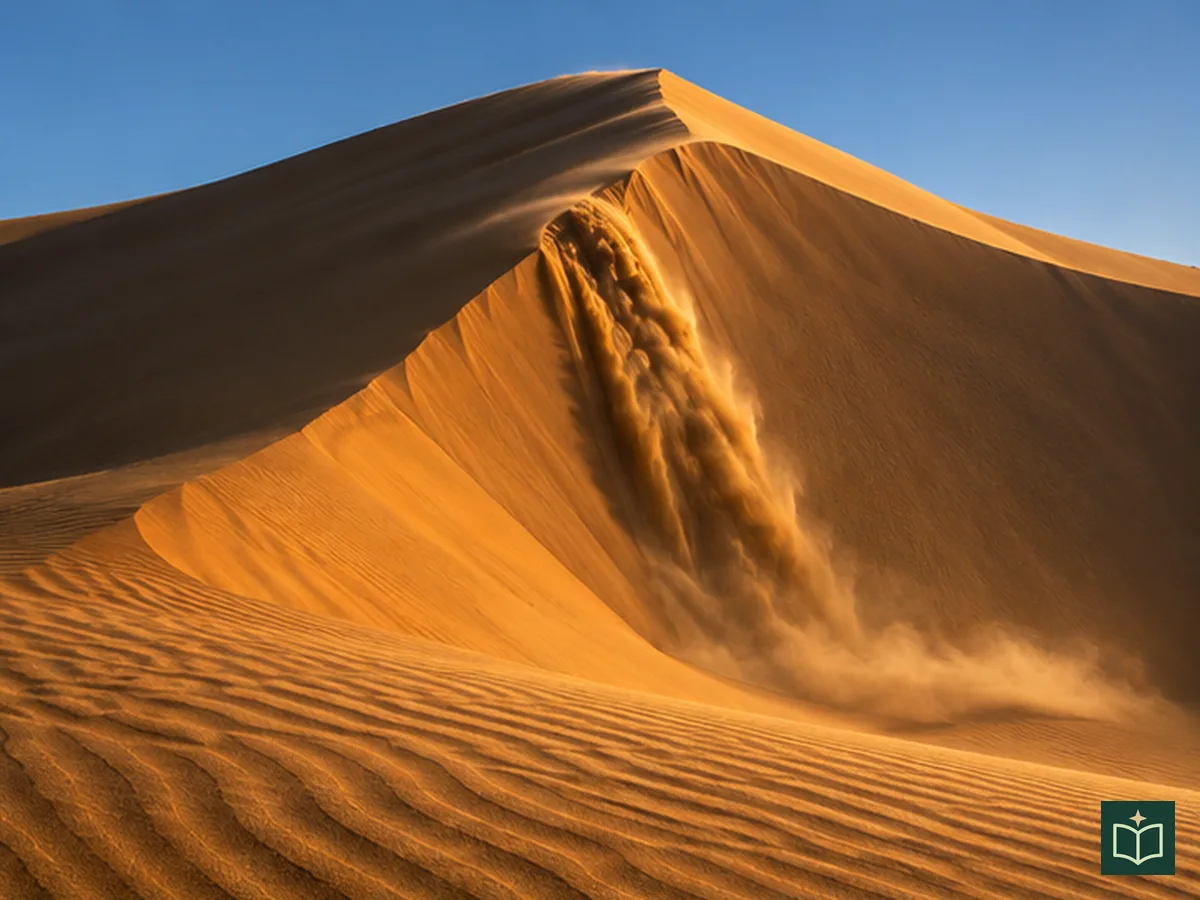
Booming needs particular conditions. The grains must be very dry, because even a little moisture binds them together and silences the dune. They must be well sorted, meaning nearly all of similar size, typically around a few tenths of a millimetre across, and usually rounded and smooth from long transport by wind. Large, tall dunes with steep slip faces, the lee sides where sand settles at its natural angle of about 30 to 35 degrees, work best. Sound is most reliable in the hottest, driest part of the year, often in late afternoon. Take the same sand into a damp room and it usually stays stubbornly quiet.
How the hum is made
The sound comes from avalanches. When wind piles sand at the crest until the slope fails, or when a person slides down pushing sand ahead, a slab of grains flows down the face. As grains tumble over one another, their collisions can fall into step, so millions of tiny impacts add together into a single tone. Researchers have measured frequencies roughly between 70 and 110 hertz, a deep note that is felt as much as heard, at volumes that can exceed 100 decibels near the source. The surface of the dune itself vibrates, acting like the sounding board of a giant instrument and broadcasting the note over long distances.
A scientific dispute
Exactly why the note has a particular pitch is still argued over. One group, working in France and Morocco, proposed that the frequency is set by how quickly grains collide in the sliding layer, which depends mainly on grain size and gravity. Another, based at the California Institute of Technology, argued that the dune's internal structure matters: a dry surface layer sitting on firmer, slightly damper sand traps sound waves, like a waveguide, and fixes the frequency. Experiments support parts of both ideas, and the answer may involve a combination. Both camps agree that synchronised grain motion is essential, and that most dunes lack the right sand to sing.
Singing dunes in Arabia
The Arabian Peninsula is one of the better places to hear booming sand. Reports come from the Rub' al Khali, the vast sand sea spanning Saudi Arabia, Oman, the UAE and Yemen, where Bedouin guides knew of noisy dunes long before scientists studied them. In Qatar, a group of dunes south of Doha has become known to visitors as the singing sand dunes, and people climb them in summer to slide down and set off the hum. The dry heat of the Gulf summer helps by keeping the surface sand completely dry. In cooler, damper months, or after rare rain, the same slopes may be silent.
Why scientists care
Singing dunes are more than a curiosity. Studying them helps physicists understand granular materials, substances made of many separate particles that can behave like a solid, a liquid or a gas depending on conditions. That knowledge applies to grain silos, which can vibrate or even fail when contents flow unevenly, to landslides and avalanches, and to the handling of powders in industries from pharmaceuticals to food. Booming dunes also show how dune structure and moisture vary below the surface, which matters for understanding how dunes move. Similar processes may even occur on Mars, where dunes are widespread, though no one has yet heard a Martian dune sing.
Sources & further reading
Figures are rounded and widely published; check the linked organisations for the latest editions. These organisations do not endorse this website.