A problem of height
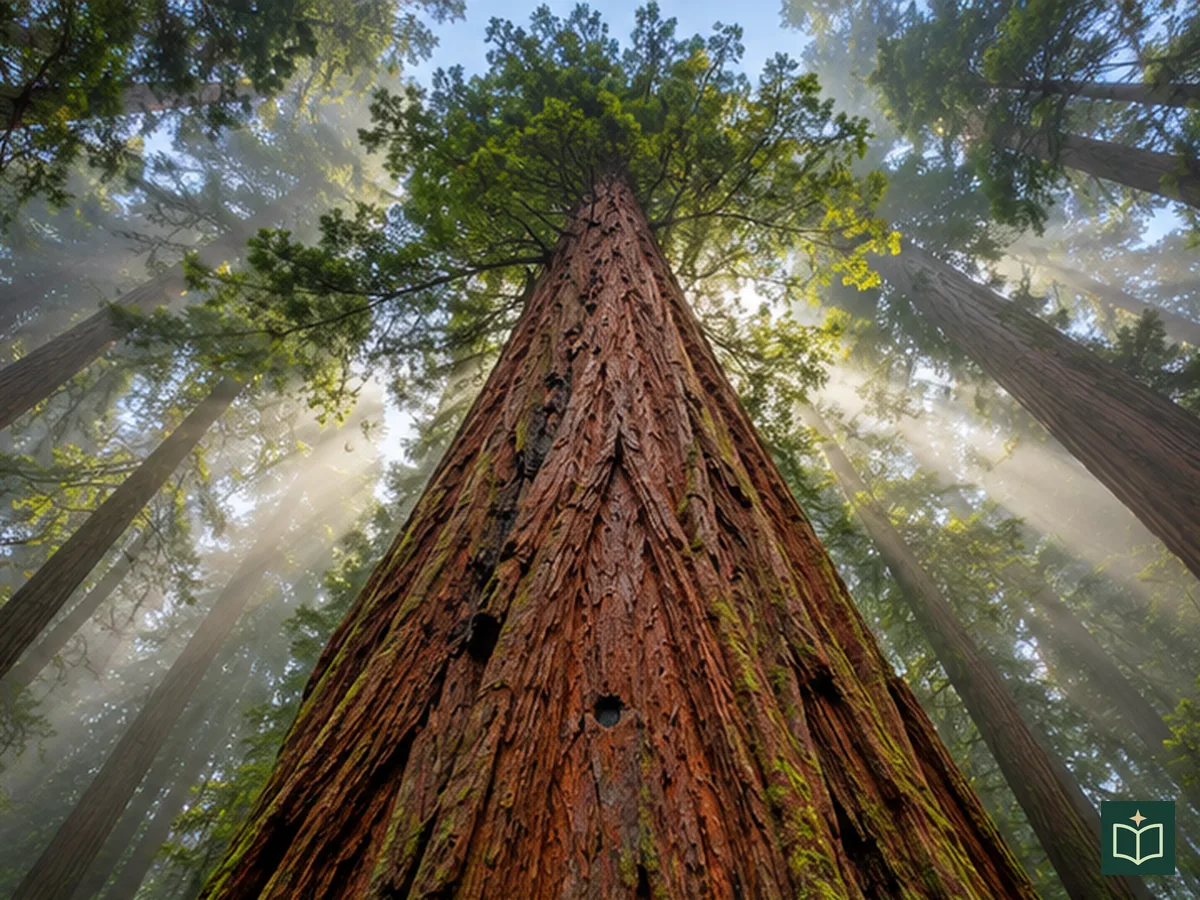
Lifting water to the top of a tall tree is a serious engineering challenge. A suction pump at ground level cannot raise water more than about 10 metres, because beyond that the weight of the column exceeds the push of air pressure. Capillary action, the tendency of water to creep up narrow tubes, lifts it only a fraction of that height in plant vessels. Yet coast redwoods exceed 100 metres, and the tallest measured, nicknamed Hyperion, stands about 116 metres tall. Trees have no heart and no muscular pump. Instead, they rely on a passive process driven by the Sun, in which the leaves, rather than the roots, do the pulling.
Evaporation at the top
Leaves are dotted with tiny pores called stomata, which open to let in carbon dioxide for photosynthesis. Whenever they are open, water evaporates from the moist surfaces inside the leaf and escapes into the drier air, a process called transpiration. As molecules leave, the water film inside the leaf curves into tiny menisci in the cell walls, generating a strong pull. That pull is transmitted down through a network of narrow, dead, hollow cells called xylem, which runs from the leaf veins through the branches and trunk to the finest roots. In effect, the whole tree contains continuous threads of water stretching from soil to sky.
Why the threads do not break
This explanation, called the cohesion–tension theory, depends on a property of water. Water molecules cling strongly to one another through hydrogen bonds, so a narrow column of water can be pulled like a rope without snapping, provided it contains no air bubbles. Water also sticks to the walls of the xylem, helping to support the column. Measurements show that the water in the upper branches of tall trees is under considerable tension, a negative pressure. Just holding a column 100 metres high against gravity requires about one megapascal, roughly ten times atmospheric pressure, and extra pull is needed to overcome friction in the tubes.
Bubbles, the enemy
The weak point is the air bubble. If a column breaks, often during drought or freezing, a bubble forms and blocks that conduit, an event called cavitation or embolism. Trees have built-in defences. Xylem cells are connected by pits with fine membranes that stop bubbles spreading from one tube to the next, and water can be rerouted around blocked sections. Many trees also grow new xylem each year, which is what forms tree rings. Height itself has limits: researchers estimate that the increasing tension and difficulty of moving water may cap the maximum height of trees at roughly 120 to 130 metres, close to the tallest specimens known.
How much water moves
Only a few per cent of the water a plant takes up is used in growth and photosynthesis; the vast majority is transpired. A large tree on a hot day can move hundreds of litres from soil to air. In desert regions such as the Arabian Peninsula, plants have evolved ways to limit this loss. Some close their stomata in the heat of the day, some have small or waxy leaves, and some, like the ghaf, combine deep roots with leaves that lose water sparingly. Cooling is a side benefit of transpiration: evaporating water carries heat away, which is one reason shaded parks with irrigated trees feel noticeably cooler than bare paved areas.
A global water pump
Added together, transpiration from the world's plants is a major part of the water cycle, returning to the atmosphere a large share of the rain that falls on land. Over rainforests such as the Amazon, water transpired by trees helps form clouds that rain again further inland, recycling moisture across a continent. That means deforestation can reduce rainfall far from where trees are cut. On a small scale, the same physics explains why cut flowers wilt when air enters their stems, and why florists recommend trimming stems under water. Understanding how trees move water also helps foresters predict which species will cope as droughts grow more frequent.
Sources & further reading
Figures are rounded and widely published; check the linked organisations for the latest editions. These organisations do not endorse this website.