Five moments in the day
Islamic tradition sets the five daily prayers by the Sun's movement rather than by clock hours. Fajr begins at true dawn, when light first spreads along the horizon. Dhuhr begins just after the Sun passes its highest point. Asr begins in the afternoon when shadows lengthen to a defined amount. Maghrib begins after sunset, and Isha when the last twilight has faded. In earlier centuries these moments were judged by eye and with instruments such as astrolabes and sundials, and Muslim astronomers produced detailed tables. Today the same definitions are turned into equations, and printed timetables and phone apps calculate them from geographic coordinates and the date.
Noon and the meridian
The easiest time to calculate is Dhuhr. Solar noon is the moment the Sun crosses the local meridian, the imaginary north–south line overhead, and stands at its highest. It is not exactly 12 o'clock. Time zones are broad, so a city's position within its zone shifts noon by minutes, and the elliptical shape of Earth's orbit and the tilt of its axis make solar noon drift by up to about 16 minutes through the year, an effect called the equation of time. Dhuhr is set a few minutes after the meridian crossing. Maghrib, at sunset, is also straightforward: it is when the Sun's upper edge disappears below the horizon.
Twilight angles
Fajr and Isha are harder because twilight has no sharp edge. Astronomers define it by how far the Sun's centre lies below the horizon. Calculation methods differ in the angle they use for true dawn, typically between about 15 and 19.5 degrees. The Muslim World League uses 18 degrees for Fajr and 17 for Isha, for example, while Saudi Arabia's Umm al-Qura calendar sets Isha at a fixed 90 minutes after Maghrib, extended during Ramadan. Each country's religious authority chooses a method, which is why two apps can give slightly different Fajr times for the same city. The differences reflect judgements about when the first light becomes visible.
Shadows set Asr
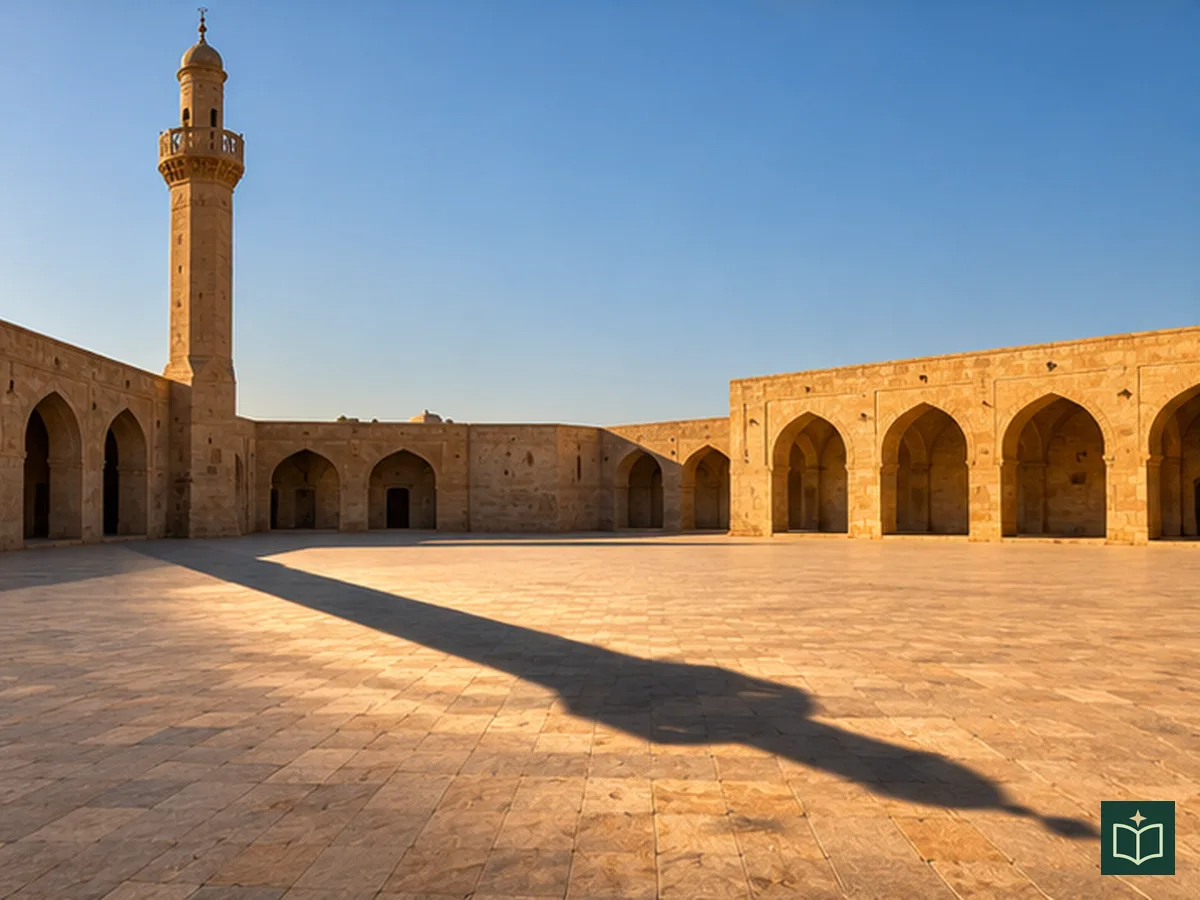
Asr is defined by shadow length. In the method used by most schools of Islamic law, Asr begins when an upright object's shadow equals its own length plus the length of its shadow at noon; the Hanafi school uses twice the length. Take Dubai, near 25 degrees north, at an equinox. At noon the Sun stands about 65 degrees high, so a one-metre stick casts a shadow about 0.47 metres long. Asr begins when the shadow reaches about 1.47 metres, which happens when the Sun has sunk to roughly 34 degrees above the horizon. In summer the noon shadow is shorter, so the threshold arrives at a different solar altitude.
Seasons and latitude
Because the Sun's path changes through the year, prayer times change daily. In the UAE, Fajr in June comes at around 4 am, while in December it falls well after 5 am. The effect grows with distance from the equator. In London or Stockholm, summer days are long and twilight lingers, and at high latitudes the Sun may never sink 18 degrees below the horizon for weeks, so true night never arrives. Scholars have proposed solutions, such as following the times of the nearest latitude where the signs are visible, or dividing the night into fixed portions. Near the equator, by contrast, times stay fairly steady all year.
Precision and practice
Modern calculations are accurate to about a minute, but small factors still matter. Atmospheric refraction lifts the Sun's image near the horizon, so standard sunset calculations allow for it. Altitude also matters: the top of a tall building sees the Sun set a little later than the street below, and in very tall towers some authorities have advised slightly different times for upper floors. Mosques generally follow the official timetable published for their country, so the call to prayer is coordinated across a city. Behind every timetable lies the same idea: the turning Earth and the angle of sunlight mark the hours, just as they did for astronomers centuries ago.
Sources & further reading
Figures are rounded and widely published; check the linked organisations for the latest editions. These organisations do not endorse this website.