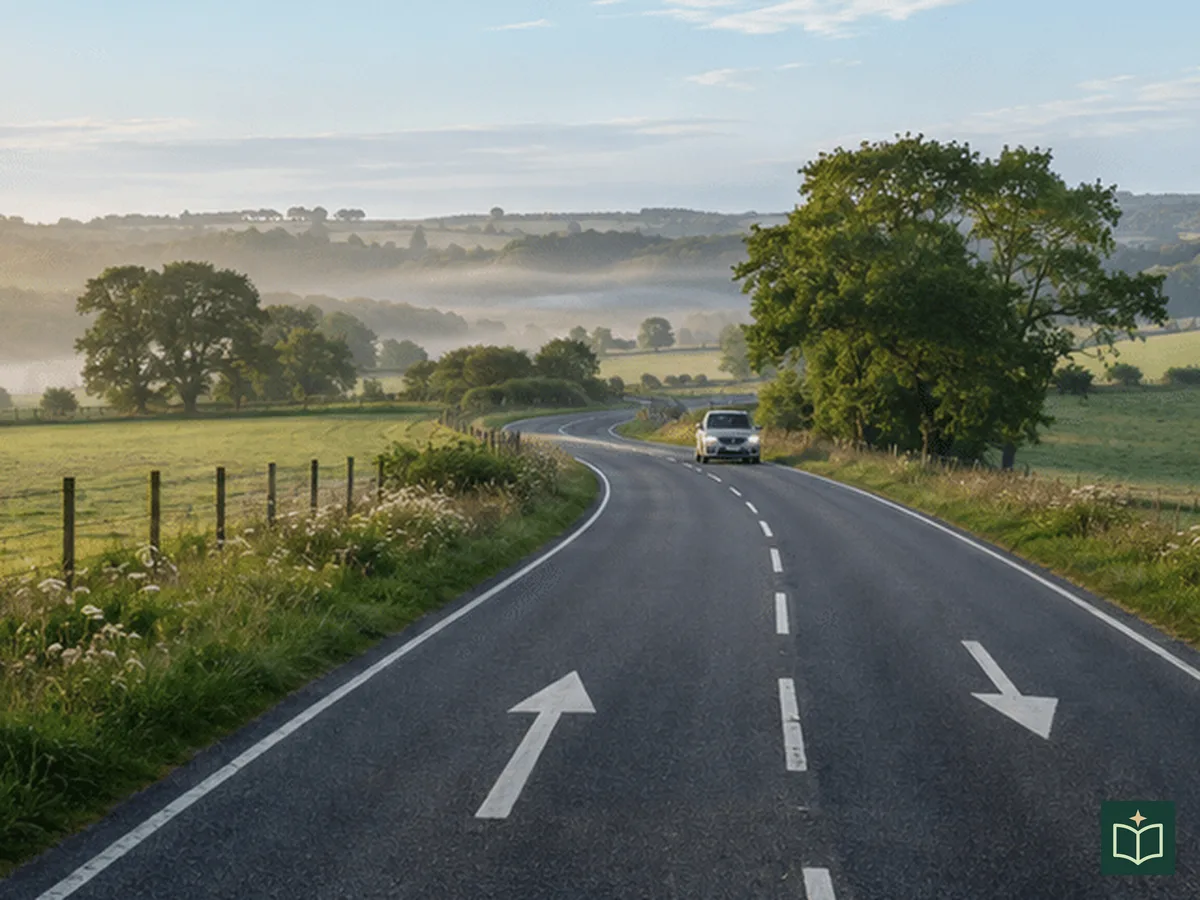
A world split in two
Most countries drive on the right, but a substantial minority, home to roughly a third of the world’s population, drives on the left. Left-hand traffic covers the United Kingdom and Ireland, much of southern and eastern Africa, South Asia including India and Pakistan, Japan, Indonesia, Malaysia, Thailand, Australia, New Zealand and many Caribbean islands. All the Gulf states, including the UAE, drive on the right, like their neighbours. Neither side is inherently safer. What matters is that everyone in a country follows the same rule. The pattern on today’s map is a record of old habits, political decisions and empire, rather than any technical choice.
Swords, carts and habits
A popular explanation holds that in medieval Europe riders kept to the left so their right hand, usually the sword hand, faced oncoming strangers, and mounting a horse from the left was easier at the roadside. Historians treat this as plausible but hard to prove. Better documented is the rise of keep-right customs in some places in the eighteenth century. In North America, large freight wagons pulled by teams of horses had no driver’s seat; the driver often rode the rear left horse to keep his right hand free for the whip, and so preferred to pass oncoming wagons on the left, keeping to the right.
Laws, revolution and Napoleon
As traffic grew, customs became laws. Pennsylvania passed one of the earliest keep-right laws in the United States in 1792, and other states followed. In France, keeping to the right became the rule in Paris in the 1790s, and later French law made it national. Napoleon’s armies and the administrations they installed are often credited with spreading right-hand traffic across much of continental Europe, though practice varied and some regions changed much later. Britain went the other way, formalising keeping left in its Highway Act of 1835. Rail and road rules in many colonies were then set by the governing power.
Empire and its echoes
The British Empire carried left-hand traffic to India, Australia, much of Africa, Southeast Asia and the Caribbean, and most of those countries kept it after independence. Japan, which was never a British colony, also drives on the left, a custom that predates cars and was reinforced when British engineers helped build its early railways. Neighbouring countries often align for convenience, because cross-border traffic is simpler with one rule. That is why most of Africa’s former French and Portuguese colonies drive on the right, while former British colonies such as Kenya, Tanzania and South Africa drive on the left, sometimes on either side of the same border.
Countries that switched
Switching sides is rare and expensive, but it has happened. Sweden drove on the left despite its neighbours driving on the right, and on 3 September 1967, a day known as Dagen H, the whole country changed over in a carefully rehearsed operation. Iceland followed in 1968. Nigeria and Ghana switched to the right in the 1970s to match their French-speaking neighbours. In 2009 Samoa went the other way, moving to the left so residents could import cheaper used right-hand-drive cars from Australia, New Zealand and Japan. Myanmar switched to the right in 1970, yet many of its cars still have the steering wheel on the right.
What it means today
For travellers, the split matters most at borders and in rental cars. Crossing from Pakistan, which drives on the left, into Iran, which drives on the right, or from Thailand into Cambodia or Laos, means changing habits mid-journey, and some border crossings use special road layouts to swap traffic safely. Car makers build vehicles in both left-hand and right-hand drive versions, and used-car trade flows tend to follow the side of the road. Residents of the Gulf who hold licences from left-driving countries in South Asia, the United Kingdom or elsewhere have to adapt when they first drive in the region, often noticing the change most at roundabouts.
Sources & further reading
- Britannica · Rule of the road ↗
- Swedish Transport Administration (Trafikverket) ↗
- UK Legislation · Highway Act 1835 ↗
Figures are rounded and widely published; check the linked organisations for the latest editions. These organisations do not endorse this website.