A loop the size of an ocean
A gyre is a vast, slowly rotating system of surface currents that circles an entire ocean basin. Five large subtropical gyres dominate the map: two in the Atlantic, two in the Pacific and one in the southern Indian Ocean. Those in the Northern Hemisphere turn clockwise; those in the Southern Hemisphere turn anticlockwise. In the North Atlantic, the Gulf Stream, the North Atlantic Current, the Canary Current and the North Equatorial Current form one continuous ring. Gyres are driven by wind and confined to roughly the upper few hundred metres, unlike the deep, density-driven circulation that creeps along the sea floor.
How the wind sets it spinning
The engine is a pair of opposing wind belts. Near the tropics the trade winds blow from the east; further from the equator the westerlies blow from the west. Together they act like two hands rubbing the ocean surface in opposite directions. Earth’s rotation then adds the Coriolis effect, which deflects moving water to the right in the Northern Hemisphere and to the left in the Southern. The net drift of the surface layer, known as Ekman transport, is pushed inwards towards the middle of each gyre. Water piles up there into a broad, gentle mound, and the currents flow around that mound rather than straight downwind.
Fast on the west, slow on the east
Gyres are lopsided. On the western side of each basin the current is squeezed into a narrow, fast and deep stream; on the eastern side it spreads into a broad, sluggish drift. The Gulf Stream off North America and the Kuroshio off Japan are the classic western boundary currents, carrying warm tropical water polewards at walking pace or faster. Their eastern counterparts, such as the California and Canary currents, carry cooler water back towards the equator. This asymmetry, called western intensification, comes from the way the Coriolis effect strengthens with latitude. It explains why Western Europe is mild for its latitude while the coast of California is surprisingly cool.
Where the plastic gathers
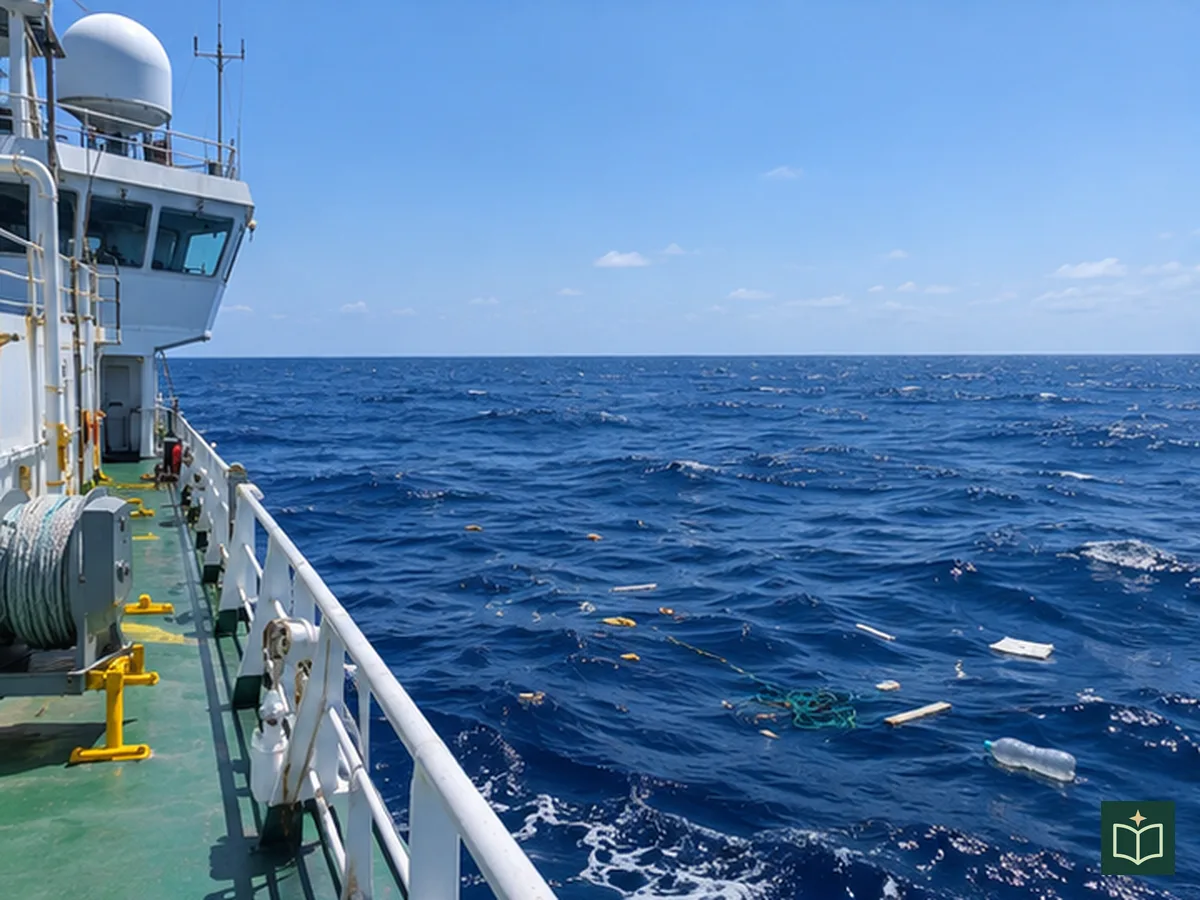
Because surface water converges towards each gyre’s centre, anything that floats tends to collect there. The best-known accumulation zone lies in the North Pacific between Hawaii and California, often called the Great Pacific Garbage Patch. It is not a solid island of rubbish. Most of the debris is broken into small fragments spread through the water, along with abandoned fishing nets, and much of it is hard to see from a ship. Similar zones exist in all five subtropical gyres. The calm centres also explain the Sargasso Sea in the North Atlantic, a sea with no coastline whose floating seaweed is held in place by the currents around it.
The Indian Ocean’s exception
The Indian Ocean behaves differently because land closes it to the north. Its southern half has a conventional anticlockwise gyre, but the northern part, including the Arabian Sea off Oman, is governed by the monsoon. When the seasonal winds reverse, so do many of the currents. The Somali Current off East Africa runs north in summer and south in winter, one of the few major ocean currents to switch direction every year. This is why the waters off the Arabian Peninsula do not sit inside a permanent gyre. Their circulation, temperature and fishing seasons follow the rhythm of the monsoon rather than a fixed, year-round loop.
Why gyres matter
Gyres move enormous amounts of heat from the tropics towards the poles, moderating climates on the coasts they pass. They set the routes that sailing ships followed for centuries, from trade winds outbound to westerlies home, and they still shape shipping, fisheries and search-and-rescue planning. Their centres are among the clearest and least productive waters on Earth, because the sinking mound of water holds nutrients down. They also carry fish larvae between distant reefs. Scientists watch them closely because changes in wind patterns can strengthen, weaken or shift a gyre, altering where heat, nutrients and pollution end up across an entire ocean basin.
Sources & further reading
Figures are rounded and widely published; check the linked organisations for the latest editions. These organisations do not endorse this website.