The second-largest body of ice
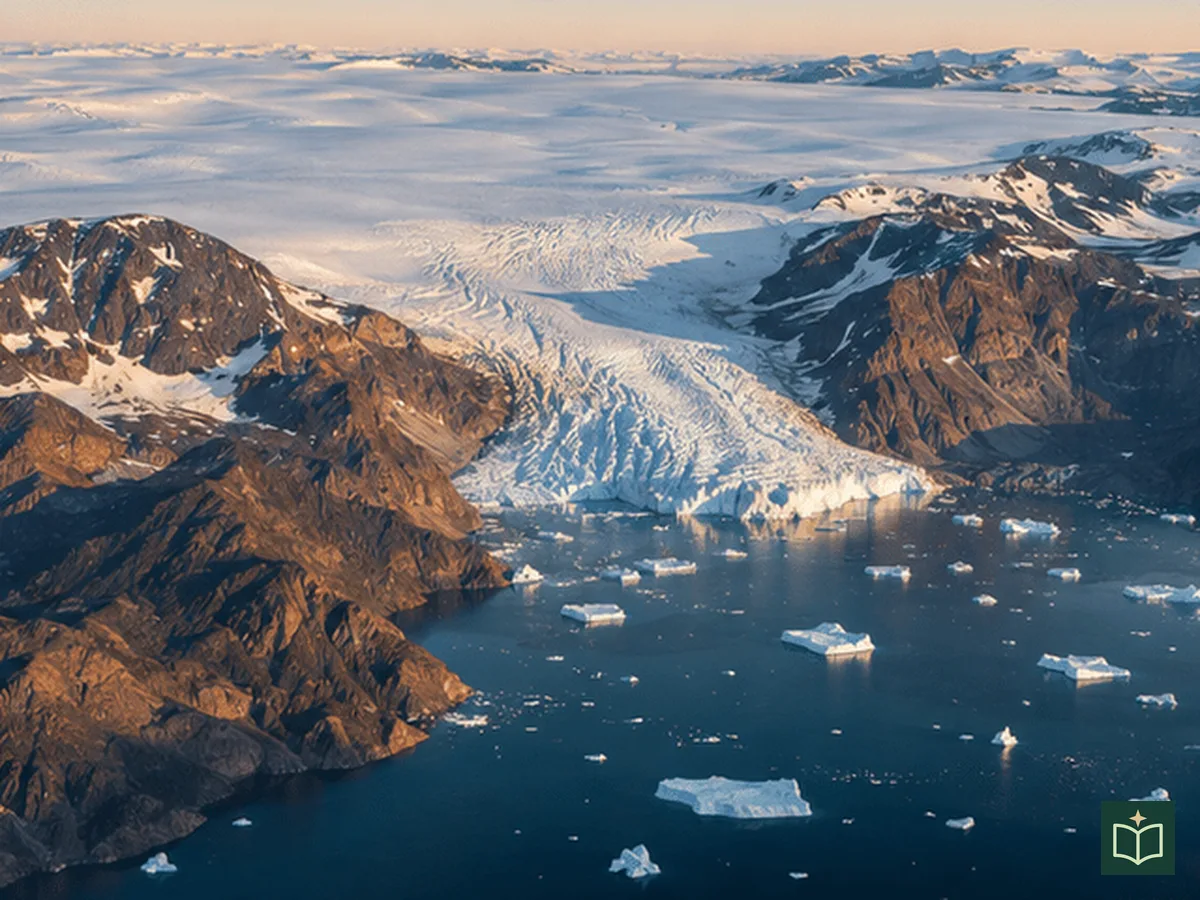
Greenland is the world’s largest island, about 2.2 million square kilometres, and roughly four-fifths of it lies beneath a single ice sheet. That sheet covers about 1.7 million square kilometres and, at its thickest, is more than three kilometres deep. Only Antarctica holds more ice. The ice sheet is shaped like a broad dome, rising gently from the coast to a summit of about 3,200 metres above sea level. Most Greenlanders live along the ice-free coastal fringe, especially in the south-west. The name Greenland is usually traced to the Norse explorer Erik the Red, who is said to have chosen it to attract settlers.
Land pushed below the sea
Ice is heavy. A column of ice three kilometres high presses down on the crust with enormous force, and over thousands of years the crust sinks into the softer mantle beneath it, a process called isostasy. As a result, much of the bedrock under central Greenland lies near or even below sea level, forming a huge basin rimmed by coastal mountains. Radar surveys, which see through the ice, have mapped this hidden landscape in detail, revealing mountains, valleys and a canyon several hundred kilometres long. If the ice vanished, the land would slowly rebound upwards over thousands of years, but for a long time a shallow inland sea might remain.
Working out seven metres
The sea-level figure comes from straightforward arithmetic. The ice sheet holds roughly 2.9 million cubic kilometres of ice. Ice is less dense than water, about 0.917 times, so that equals about 2.66 million cubic kilometres of water. Spread across the world’s oceans, which cover about 361 million square kilometres, that is a layer roughly 7.4 metres deep. The real calculation adjusts for details such as ice already below sea level, but the result is close to the commonly quoted figure of about 7.4 metres. For comparison, Antarctica holds enough ice for almost 60 metres, though far more of it sits in very cold, stable regions.
A frozen archive
Because snow builds up in annual layers that are compressed into ice, the ice sheet is a record of past climate. Scientists have drilled cores more than three kilometres long near the summit, reaching ice more than 100,000 years old. Bubbles trapped in the ice preserve samples of ancient air, while the chemistry of the ice reveals past temperatures, dust storms and volcanic eruptions. Greenland cores showed that the climate during the last ice age swung abruptly, sometimes warming by many degrees within decades. That discovery transformed scientists’ understanding of how quickly climate can change and why the ice sheet itself might respond rapidly.
Gaining and losing ice
Every year, snowfall adds ice to the sheet, while surface melting and the calving of icebergs from outlet glaciers remove it. For most of the twentieth century, these roughly balanced. Since the 1990s the ice sheet has lost more than it gains. NASA and European satellites that measure tiny changes in Earth’s gravity show Greenland losing on the order of a few hundred billion tonnes of ice per year on average this century, making it one of the largest single contributors to current sea-level rise. In exceptionally warm summers, such as 2012 and 2019, melting reached record extents, even briefly at the summit.
Why the Gulf should care
Greenland is far from the Gulf, but its ice affects every coastline. Sea-level rise does not spread evenly: as Greenland loses mass, its gravitational pull on the nearby ocean weakens, so seas actually fall slightly near Greenland and rise more than average far away, including in the tropics and the Indian Ocean. Low-lying Gulf coasts, with their reclaimed islands, ports, desalination plants and waterfront districts, are therefore planning for higher seas. Melting is gradual on human timescales, and losing the entire sheet would take many centuries, but every centimetre of rise still increases flood risk during storms and unusually high tides.
Sources & further reading
- National Snow and Ice Data Center · Greenland ice sheet ↗
- NASA · Vital signs: Ice sheets ↗
- Britannica · Greenland ↗
Figures are rounded and widely published; check the linked organisations for the latest editions. These organisations do not endorse this website.