A spinning starting line
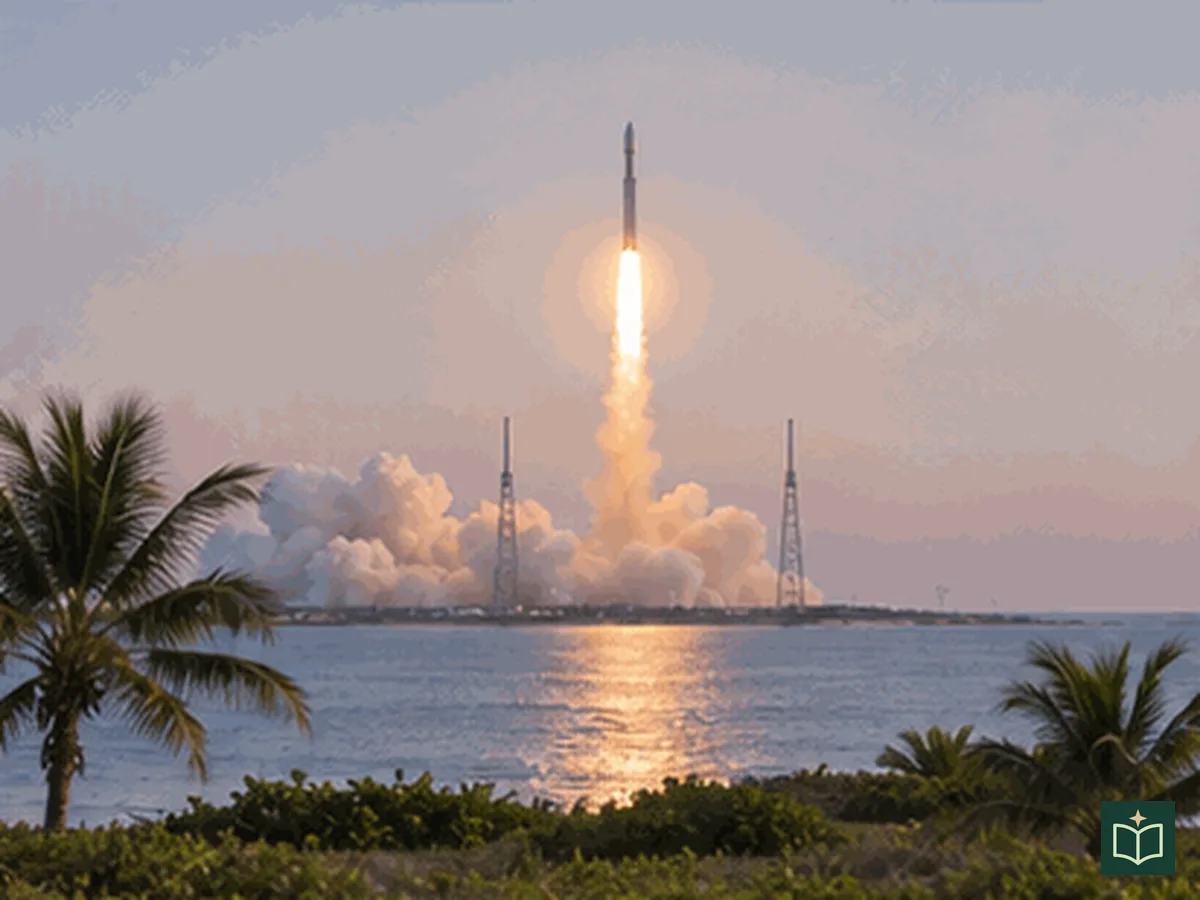
Earth turns once a day, so everything on its surface is already moving eastward. At the equator, the ground travels about 40,000 kilometres every rotation, a speed of roughly 465 metres per second, or 1,670 km/h. Closer to the poles, the circle is smaller and the speed drops, reaching zero at the poles themselves. A rocket sitting on its pad shares this motion. If it launches towards the east, that speed counts towards the roughly 7.8 kilometres per second needed for low orbit. Launching from the equator therefore offers a free boost of about 6 per cent of orbital speed, a significant saving in a business where every kilogram of fuel counts.
Latitude by latitude
The bonus shrinks with distance from the equator, following the cosine of the latitude. Europe’s Guiana Space Centre at Kourou in French Guiana, at about 5 degrees north, gets almost the full 463 metres per second. Cape Canaveral in Florida, at 28.5 degrees north, gets about 409. Baikonur in Kazakhstan, at 45.6 degrees north, gets about 325. These differences matter most for heavy satellites heading to high orbits, where the cost of launch climbs steeply with every extra metre per second needed. They are one reason Europe chose a South American site for its rockets, and why several countries have studied sea-based or near-equatorial launch platforms.
The inclination problem
There is a second, often larger, advantage. A rocket launched due east enters an orbit tilted to the equator by an angle equal to its launch site’s latitude. From Baikonur, the lowest natural tilt is about 46 degrees; from Kourou, about 5. Geostationary satellites, which provide television and communications, must orbit directly above the equator, with no tilt at all. Removing an orbit’s tilt requires an expensive sideways burn, ideally made where the satellite crosses the equator. The further from the equator the launch site, the bigger that burn. A satellite launched from Kourou can therefore carry more fuel for its working life than an identical one launched from a higher latitude.
Why the sea matters
Rockets shed empty stages, fairings and sometimes debris during ascent, and occasionally a launch fails. Safety therefore pushes launch sites towards coastlines, with clear ocean in the direction of flight. Cape Canaveral launches east over the Atlantic; Kourou over the same ocean; China’s Wenchang site on Hainan island over the South China Sea. Inland sites, such as Baikonur and some older Chinese centres, drop stages over sparsely populated land, which requires evacuating drop zones and can leave toxic fuel residues. Seaborne recovery of reusable boosters on drone ships has added another reason to fly over water. Isolation, good weather and political stability also influence where nations choose to build.
When going east is wrong
Not every mission benefits from Earth’s spin. Satellites in polar or sun-synchronous orbits, used for Earth observation and weather, must travel roughly north to south. A rocket heading for such an orbit gains nothing from rotation, and sun-synchronous orbits are tilted slightly backwards, so the rocket must actually overcome some of Earth’s eastward motion. For these missions, launch sites with clear paths north or south over water are valuable. California’s Vandenberg base launches south over the Pacific, and new sites in Scandinavia, Scotland and Australia target this market. The ideal latitude depends on the destination, not just on proximity to the equator.
Spaceports in a changing industry
The launch map is expanding as rockets become cheaper and more frequent. Older spaceports chosen for Cold War reasons are being joined by commercial sites and floating platforms. Countries without equatorial territory still build launch centres for independence and industry, accepting the performance cost. Gulf nations, which have built ambitious space programmes, have so far launched their satellites and the UAE’s Hope probe from established sites abroad, such as Japan’s Tanegashima, while studying future options. The principles behind the choices remain unchanged: use Earth’s spin when it helps, choose a latitude that suits the target orbit, and make sure that whatever falls back lands where it can harm no one.
Sources & further reading
- European Space Agency · Europe’s Spaceport ↗
- NASA · Kennedy Space Center ↗
- Britannica · Launch vehicle ↗
Figures are rounded and widely published; check the linked organisations for the latest editions. These organisations do not endorse this website.