Phones in cars
The first mobile telephones were radios bolted into cars. In 1946, the Bell System launched a service in St Louis in the United States, with equipment that filled much of a car’s boot and a single powerful transmitter covering the city. Calls went through operators, and because each conversation needed its own frequency, only a handful could take place at once across a whole city. Waiting lists were long and prices high. Similar systems appeared in Europe and elsewhere over the following decades. They proved that people wanted to call on the move, but the design could never scale: there simply were not enough frequencies for a city of callers.
The cellular idea
The solution was proposed by engineers at Bell Labs in 1947: divide a city into many small cells, each with its own low-power base station, and reuse the same frequencies in cells far enough apart not to interfere. As a caller moved, the network would hand the call from one cell to the next. The concept was sound, but the switching computers and electronics needed to manage it did not exist for decades. On 3 April 1973, Martin Cooper of Motorola made the first public call on a handheld cellular phone prototype on a New York street. Japan launched the first commercial cellular network, in Tokyo, in 1979.
The brick era
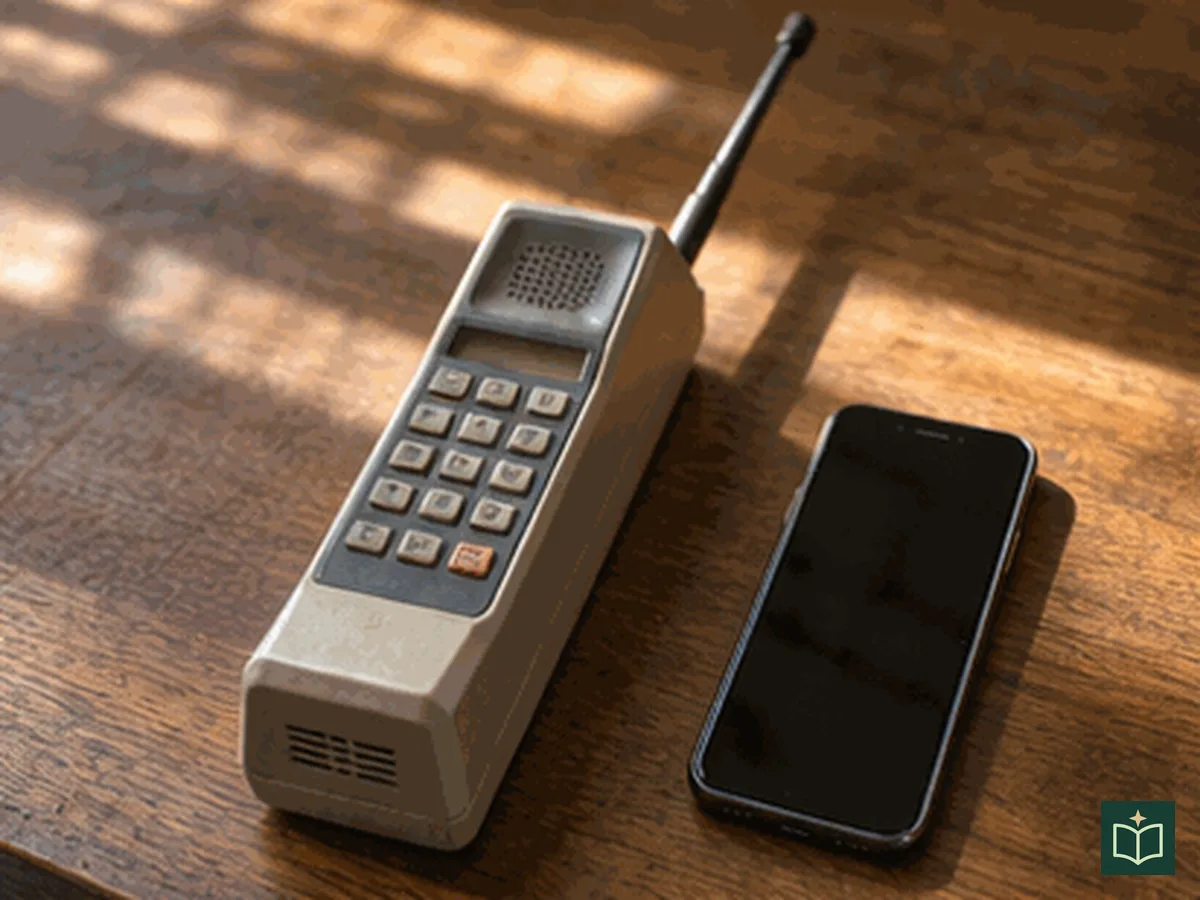
Motorola’s DynaTAC 8000X, the first commercial handheld cellular phone, went on sale in the United States in 1983. It weighed about 0.8 kilograms, offered about 30 minutes of talk time after a charge of around ten hours, and cost almost 4,000 US dollars. These first-generation, or 1G, networks were analogue: voice travelled as a continuously varying radio signal, which was easy to eavesdrop on and used spectrum inefficiently. Different countries built incompatible systems, so phones rarely worked abroad. Even so, the ‘brick’ became a status symbol of the 1980s, and car phones and briefcase-sized portables spread among businesses before prices fell enough for ordinary users.
Going digital
The second generation turned voice into digital data. Europe agreed a common standard, GSM, and the first GSM call was made in Finland in 1991. Digital networks squeezed more calls into the same spectrum, encrypted conversations and introduced the SIM card, which let users move their number between handsets. They also brought text messaging; the first SMS, sent in 1992, read ‘Merry Christmas’. GSM spread rapidly, including across the Gulf, making roaming possible across much of the world. Phones shrank to pocket size, batteries lasted days, and prices dropped. By the end of the 1990s, mobiles had become everyday objects rather than luxuries.
The smartphone
Third-generation networks, first launched in Japan in 2001, offered enough speed for basic web browsing, email and video calls. Devices such as the BlackBerry made mobile email a business essential. In 2007, Apple’s iPhone combined a large touchscreen, a full web browser and, from 2008, an app store, and Google’s Android followed. Fourth-generation, or 4G, networks from 2009 delivered speeds suited to streaming video, maps and ride-hailing apps. The phone became a camera, wallet, navigator and television in one. Today there are more mobile subscriptions than people on Earth, and for billions of people in Africa and Asia a smartphone is their first and only computer.
Each generation’s lesson
Looking back, each generation solved a different bottleneck. The first proved that cells could handle crowds of callers; the second made networks digital, secure and international; the third and fourth turned phones into data devices; and 5G aims to add capacity and lower delay for machines as well as people. Progress depended on many inventions at once: transistors and chips, lithium-ion batteries, touchscreens, compact antennas and international standards that let equipment from different makers work together. The form factor will keep changing, with folding screens, watches and glasses, but the central idea of 1947 still holds: many small cells, reusing scarce spectrum, connecting people wherever they go.
Sources & further reading
- Britannica · Mobile telephone ↗
- Computer History Museum · Mobile computing ↗
- International Telecommunication Union · History ↗
Figures are rounded and widely published; check the linked organisations for the latest editions. These organisations do not endorse this website.