The puzzle
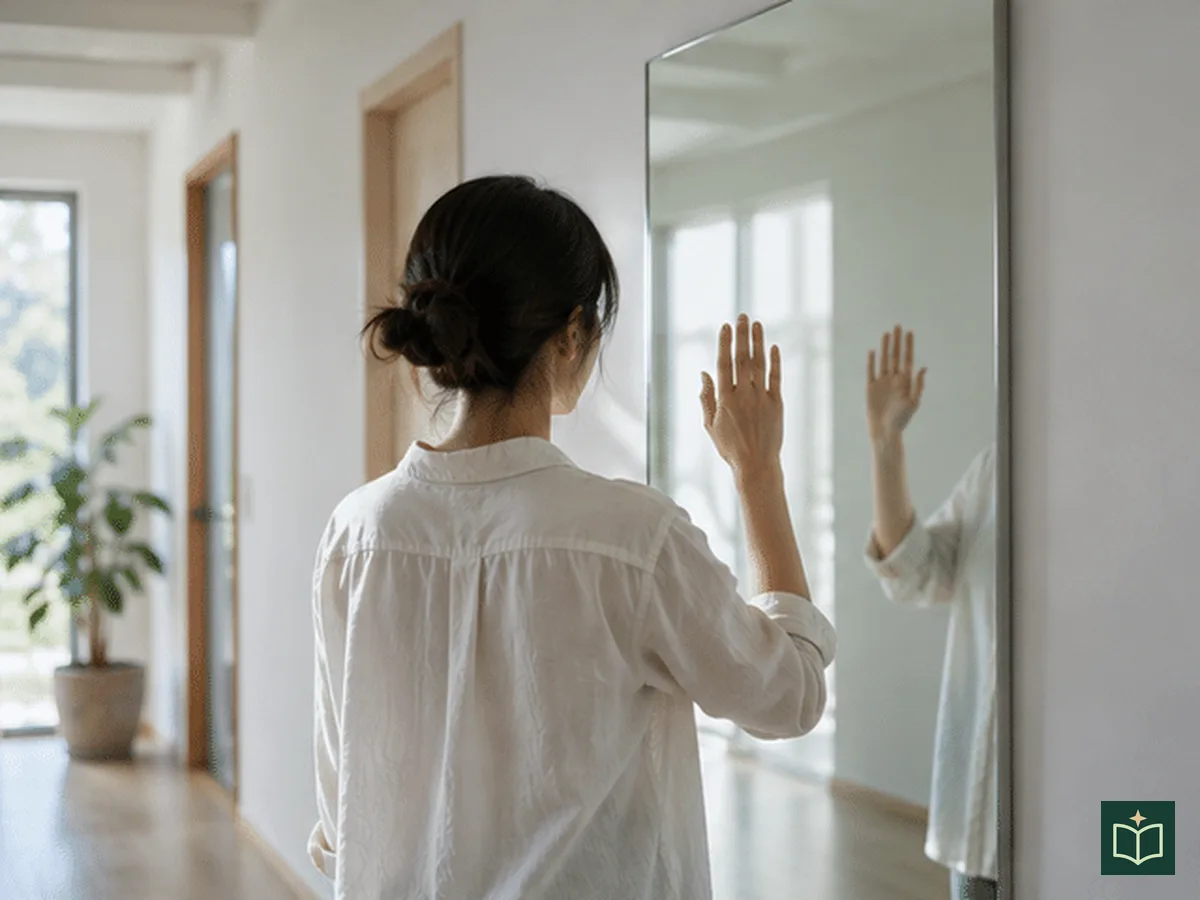
Raise your right hand in front of a mirror and the reflection raises the hand on the same side, which, if it were a real person facing you, would be its left. Text held up to the glass reads backwards. Yet your head stays at the top and your feet at the bottom. How can a flat piece of glass know which way is left and right but not up and down? Philosophers and physicists have enjoyed this question for centuries. The answer is that the mirror does not treat any sideways direction specially at all. The swap we notice comes from geometry combined with the way we describe bodies.
What a mirror actually does
A flat mirror obeys a simple rule: light leaves its surface at the same angle at which it arrived. When you look at the glass, your eyes trace the reflected rays back in straight lines and perceive an image behind the surface, exactly as far behind as you are in front. Every point keeps its height and its sideways position. Your right hand is still on the east side of the image, say, and your head is still at the top. The only direction that changes is the one perpendicular to the mirror. Your nose, closer to the glass than the back of your head, stays closer. The image is reversed front to back.
Why it feels like left and right
The confusion arises when we interpret the image as another person. To face us, a real person would have to walk around and turn about a vertical axis, because that is how humans turn. That rotation would swap their right hand to our left. Since the reflection's right hand is not where we expect, we say the mirror swapped left and right. Had we instead imagined the person flipping head over heels to face us, we would say the mirror swapped top and bottom. Lie on your side in front of a mirror and the effect becomes easier to see: the reversal still happens only through the glass.
Handedness and writing
A front-to-back flip turns objects into their mirror images, and some objects are not identical to their mirror images. A right glove reflected becomes a left glove; a right-handed screw thread becomes left-handed. Scientists call this property chirality, and it matters in chemistry, where some molecules exist in left- and right-handed forms that behave differently in the body. Writing is the everyday example. When you turn a page to face the mirror, you rotate it, and the mirror then shows it reversed. That is why emergency vehicles often carry mirror-written lettering on their bonnets, so drivers ahead read it correctly in their rear-view mirrors.
Mirrors that do not reverse
You can build a mirror that shows you as others see you. Place two flat mirrors at a right angle, like the corner of a book standing open, and look into the join. Light bounces twice, and the two front-to-back reversals cancel. Raise your right hand and the image raises the hand on the opposite side, just as a person facing you would. Many people find this view of their own face oddly unfamiliar, because they are used to the reflected version. The same issue arises with phone front cameras, which often show a mirrored preview while saving an unreversed photograph, which is why selfies can look slightly wrong.
Half a mirror is enough
Simple geometry also explains a surprise about full-length mirrors. To see yourself from head to toe, you need a flat mirror only half your height, with its top roughly level between your eyes and the top of your head. A person 1.7 metres tall therefore needs a mirror about 0.85 metres tall. Moving closer or further away does not change this, because as you step back the image also recedes, and the angles scale together. Try it with a bathroom mirror by marking where your head and feet appear on the glass. These everyday puzzles show how much our sense of direction depends on assumptions we rarely notice.
Sources & further reading
Figures are rounded and widely published; check the linked organisations for the latest editions. These organisations do not endorse this website.