The queen does not rule
It is tempting to picture an ant colony as a kingdom with a queen issuing orders. In reality the queen's job is to lay eggs, sometimes for many years, and she does not direct anyone. The workers, all female, do the foraging, nest building, brood care and defence. Colonies range from a few dozen individuals to many millions, and scientists have described more than 14,000 ant species. A 2022 study combining field surveys from around the world estimated that some 20 quadrillion ants are alive at any time. Coordinating such numbers without a leader relies on a principle biologists call self-organisation, in which order arises from many simple interactions.
Trails of scent
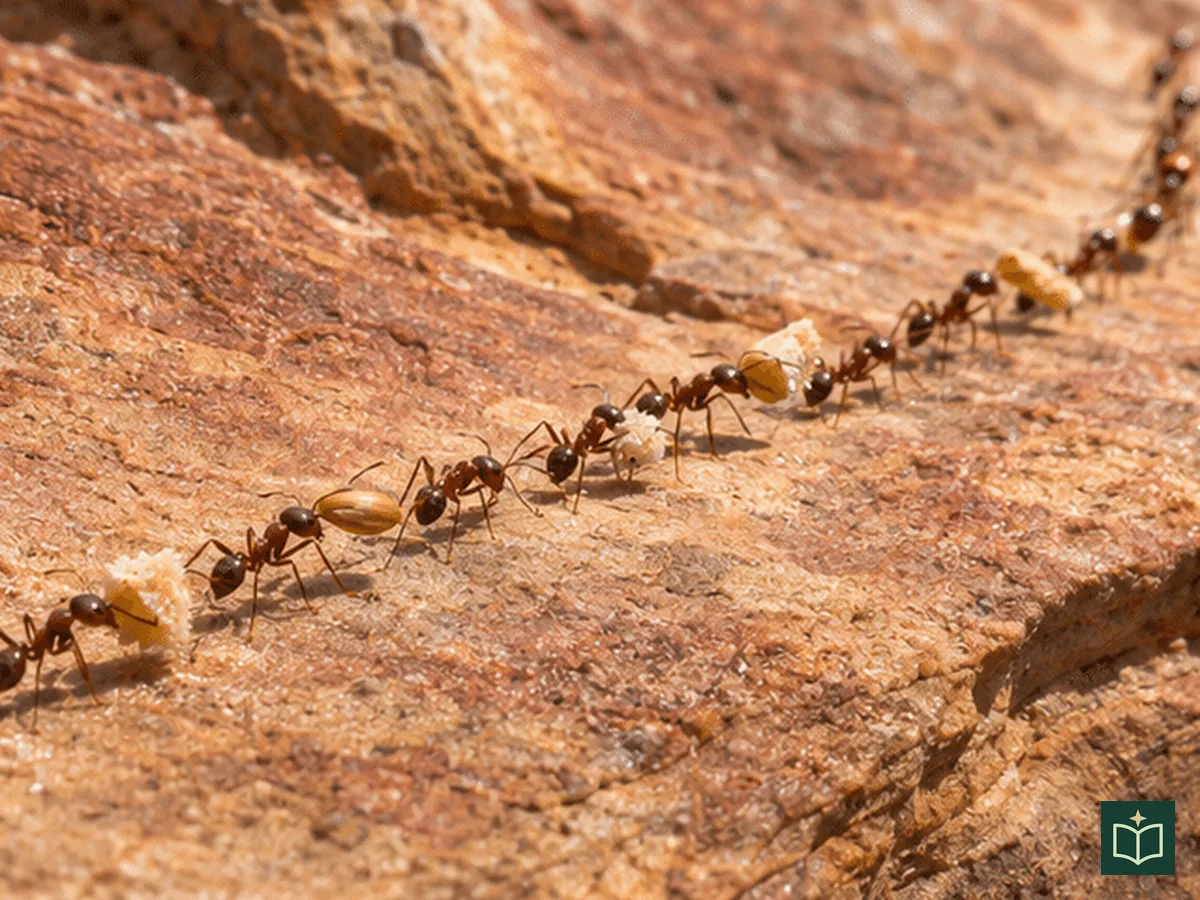
Ants communicate mainly with chemicals called pheromones, sensed with their antennae. When a foraging ant of many species finds food, it lays a scent trail on its way back to the nest. Other ants tend to follow the trail and, if they too find food, reinforce it with their own scent. Because the chemical slowly evaporates, a trail survives only if ants keep using it. The result is a feedback loop: rewarding routes grow stronger and attract more traffic, while poor or exhausted ones fade. Other pheromones signal alarm, attract help to a fight or identify colony members, so a nest is constantly bathed in chemical messages.
Finding the shortest path
Researchers demonstrated the power of trails with a classic experiment in the late 1980s. Argentine ants were given two bridges of different lengths between their nest and a food source. At first ants used both, but those on the shorter route completed round trips sooner, laying scent more often, so that path became stronger and soon attracted most of the traffic. No ant compared the two routes; the choice emerged from the timing of many trips. The idea inspired computer scientists, and algorithms modelled on ant trails, known as ant colony optimisation, have since been used to tackle routing and scheduling problems in telecommunications and logistics.
Dividing the work
Colonies also decide how many workers do each job without any manager. Studies of harvester ants in the deserts of the south-western United States showed that foragers decide whether to leave the nest partly from how often they meet returning foragers carrying food. Frequent encounters mean food is plentiful, so more ants go out; few encounters mean they stay home, saving water in the heat. Workers often specialise by age, caring for the young inside the nest early in life and moving to riskier outside tasks later. Some species have physically different castes, such as large-headed soldiers, but even they respond to local cues rather than commands.
Building and defending
Collective behaviour extends to impressive feats. Leafcutter ants in the Americas grow fungus gardens on cut leaves in underground nests that can house millions of workers. Army ants link their bodies into living bridges and temporary nests. Weaver ants pull leaves together and bind them with silk produced by their larvae. Defence works the same way: a few ants detecting an intruder release alarm pheromone, recruiting nestmates who amplify the signal. Individual skills matter too. Desert ants of the genus Cataglyphis, found across North Africa and the Middle East, navigate alone using the Sun's position and counting their steps, foraging in midday heat that would kill most insects.
Lessons and limits
The study of ants has shaped thinking well beyond biology, influencing robotics, traffic engineering and the design of networks that must work without a central controller. Simple rules can also go wrong: army ants that lose a trail sometimes follow each other in a circle until exhausted, a so-called ant mill. Ants matter ecologically as well. They turn and aerate soil, disperse seeds, prey on other insects and are food for many animals. Some invasive species, such as the red imported fire ant, spread by people's trade, cause serious damage far from home. The colony, in the end, is a reminder that coordination does not always need a coordinator.
Sources & further reading
Figures are rounded and widely published; check the linked organisations for the latest editions. These organisations do not endorse this website.