A tug of war on every hill
Every slope is a contest between two sets of forces. Gravity pulls soil and rock downhill, and the steeper the slope, the stronger that pull. Resisting it are friction between grains and the cohesion that binds them, plus the strength of rock and the grip of plant roots. Engineers express this as a factor of safety: resisting forces divided by driving forces. Above one, the slope stands; below one, it moves. Most hillsides sit comfortably above that line. Landslides happen when something lowers the resistance or increases the pull, often a combination of slow preparation, such as weathering, and a sudden trigger, such as a storm or an earthquake.
Why water is the usual culprit
Heavy or prolonged rain triggers more landslides than anything else. Water adds weight, but its bigger effect is pressure. When pore spaces between grains fill, the water pushes grains apart and reduces the friction between them. A worked example shows the effect. Imagine a slope with resisting forces of 120 units against driving forces of 100, a safety factor of 1.2. If saturation removes 25 units of resistance, the factor falls to 95 divided by 100, or 0.95, and the slope fails. Clay layers that become slippery when wet, and springs that soak a slope from below, make some hillsides especially prone after storms or rapid snowmelt.
Falls, slides and flows
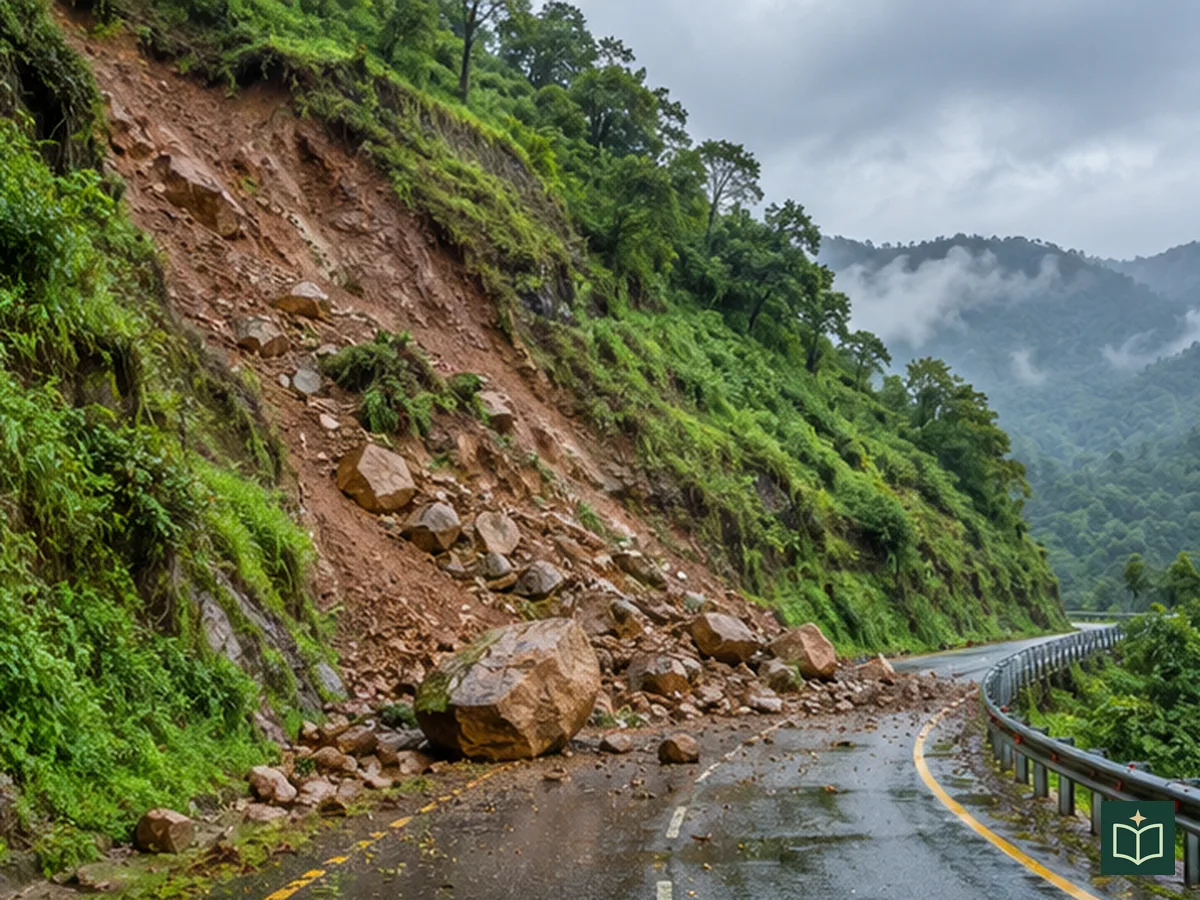
Geologists classify landslides by how material moves. Rockfalls are blocks breaking from cliffs and dropping or bouncing freely. Slides move as a coherent mass along a surface, either a curved one, producing a rotational slump, or a flat plane such as a bedding layer or joint. Flows behave like thick liquids. Debris flows and mudflows mix soil, rock and water into a fast slurry that can travel kilometres down valleys. Lahars are mudflows on volcanoes. At the slow end, soil creep moves only millimetres a year, betrayed by leaning fences and curved tree trunks. The type matters, because a rockfall gives seconds of warning while creep gives years.
Earthquakes and rock type
Strong shaking briefly adds sideways force and can loosen whole mountainsides at once. The 2008 Wenchuan earthquake in China triggered tens of thousands of landslides, and in 1970 an earthquake in Peru sent a vast avalanche of rock and ice from Huascarán that buried the town of Yungay. Rock type and structure set the stage. Layers that dip parallel to a slope provide ready-made sliding surfaces. Shale, weathered volcanic ash and clay-rich soils are weak, while massive granite is strong. Fractured rock, such as the limestone of the Hajar Mountains, can shed blocks onto roads after rain, which is why rockfall nets and catch fences line some mountain routes.
The human hand
People often tip slopes towards failure. Cutting into a hillside for a road or building removes support at its base. Adding weight at the top, through fill or structures, increases the pull. Leaking pipes, poor drainage and irrigation can saturate ground that was once dry. Clearing forest removes roots that bind soil, and in the years after wildfires, burned slopes are especially prone to debris flows. Mining waste heaps and quarry faces are also landslide sources. Equally, people can make slopes safer: drainage channels, retaining walls, rock bolts, terracing and replanting all raise the safety factor. Many landslide disasters occur where towns have expanded onto steep, unstable ground.
Reading the warning signs
Landslides are hard to predict precisely, but the places at risk are often well known. Hazard maps combine slope angle, geology and history, since land that has slid before is likely to move again. Warning signs include new cracks in the ground or walls, tilting trees and poles, doors that suddenly stick, and springs appearing on a slope. Some regions now issue rainfall-based alerts when thresholds linked to past landslides are passed. Satellites can detect slopes creeping by millimetres. For travellers in mountains, including the wadis of the UAE and Oman, the practical lesson is simple: avoid steep valleys and cliff bases during and just after heavy rain.
Sources & further reading
Figures are rounded and widely published; check the linked organisations for the latest editions. These organisations do not endorse this website.