The coast's daily rhythm
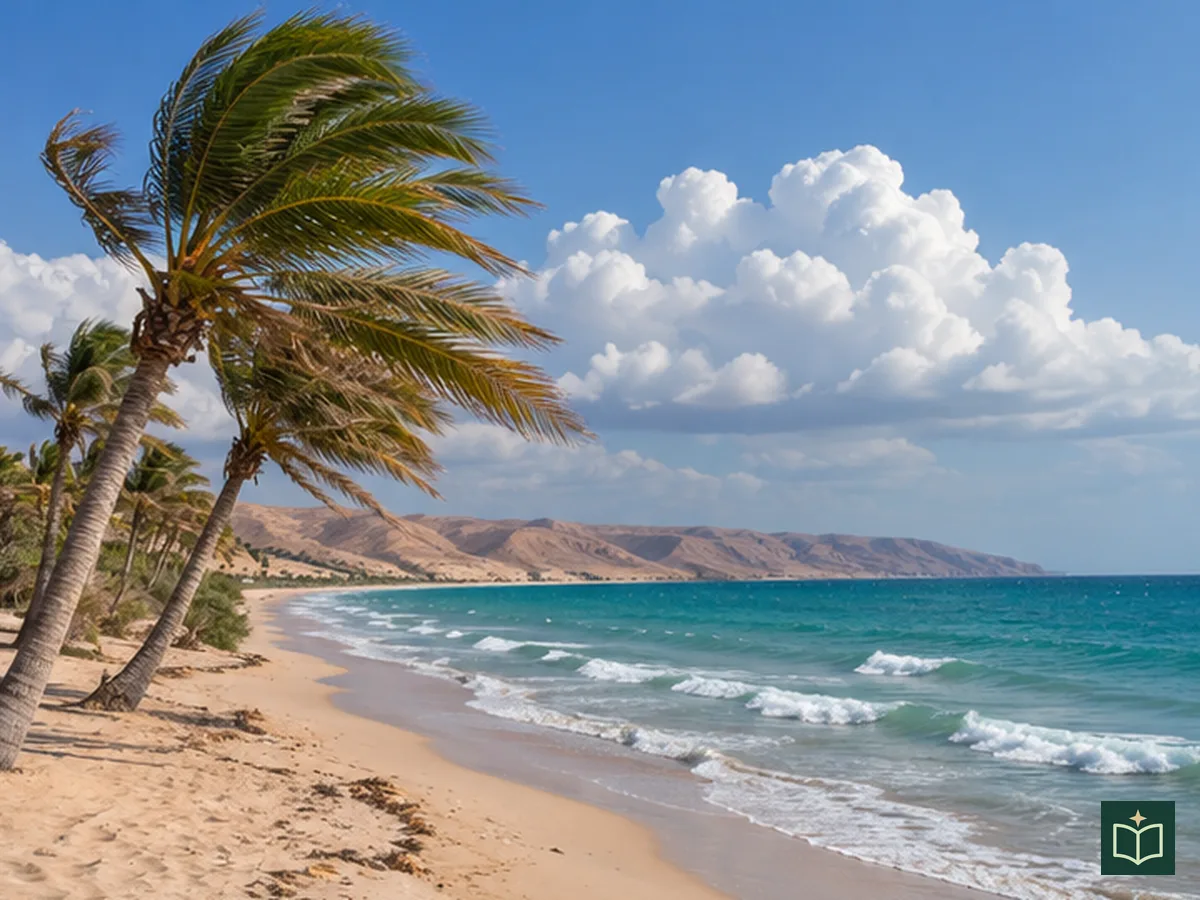
Anyone who has spent a summer day by the sea knows the pattern. Mornings are often still, then around late morning or midday a cool wind begins to blow in from the water, strengthening through the afternoon. After sunset it fades, and on clear nights a lighter wind may drift back out to sea. These are the sea breeze and the land breeze, among the most regular winds on Earth. They are local, reaching from a few kilometres to several tens of kilometres inland, but they shape coastal temperatures, humidity, cloud and even where afternoon thunderstorms form. They occur on lake shores too, wherever land and water sit side by side.
Why land heats faster
The engine is a difference in how land and water respond to sunlight. Water has a high specific heat: it takes about 4,200 joules to warm one kilogram by one degree, roughly five times as much as dry sand. Sunlight also penetrates into water and is mixed through a deep layer by waves and currents, while on land it heats only the top few centimetres. Some energy over the sea goes into evaporation rather than warming. The result is that by early afternoon, a desert coast can be many degrees hotter than the sea just offshore. At night, the land loses its heat quickly, while the sea stays almost unchanged.
How the breeze circulates
Over hot land, warm air expands and rises, lowering pressure near the ground. Over the cooler sea, air is denser, with slightly higher pressure. Air flows from high to low pressure, so a breeze blows from sea to land. Aloft, the rising air spreads back out to sea and sinks, completing a loop. The leading edge of the incoming air, the sea-breeze front, behaves like a small cold front. It can bring a sudden drop in temperature, a shift in wind and a line of cumulus clouds. Earth's rotation gradually turns the breeze through the afternoon, so it rarely blows straight onshore for long.
The Gulf's version
Along the UAE coast the sea breeze is a familiar part of summer. It usually sets in from the north or north-west during the late morning, bringing slightly lower temperatures but much higher humidity, because air arriving from the warm Gulf carries a great deal of moisture. That is why coastal Dubai and Abu Dhabi can feel more oppressive than the hotter but drier interior. On some afternoons the sea breeze pushes far inland and meets air flowing around the Hajar Mountains, helping to lift moisture into towering clouds. At night, a land breeze from the desert can bring drier air back towards the coast, often before dawn.
Storms, fog and sailors
Sea breezes do more than cool beachgoers. In Florida, breezes from the Atlantic and the Gulf of Mexico collide over the peninsula on summer afternoons, forcing air upward and triggering the region's famously regular thunderstorms. Sea breezes can carry coastal fog inland and shift pollution, sometimes trapping smog against hills, as in parts of California. Sailors have long timed departures by these winds: fishing boats in many traditions left on the morning land breeze and returned on the afternoon sea breeze. Pilots and wind-farm operators watch them too, because a sea-breeze front can bring abrupt changes in wind speed and direction within minutes.
When the breeze fails
The sea breeze is not guaranteed. It needs a strong temperature contrast, so it is weakest on cloudy days and in winter, when land and sea temperatures are close. A strong prevailing wind can overwhelm it entirely, or hold it offshore. In some places, such as cities that have spread along a coast, the urban heat island strengthens daytime breezes but can weaken the land breeze at night. A common misconception is that the sea breeze always cools. It lowers temperature, but in humid regions like the Gulf it can make conditions feel worse by raising moisture. Understanding the cycle helps forecasters predict where afternoon heat, clouds and storms will appear.
Sources & further reading
Figures are rounded and widely published; check the linked organisations for the latest editions. These organisations do not endorse this website.