A river of sand along the shore
Beaches look fixed, but their sand is constantly on the move. On many coasts, the largest movement is not on and off the beach but along it, a process called longshore drift. It happens wherever waves approach the shore at an angle, which is common because prevailing winds rarely blow straight onshore. Each wave moves only a few grains a short distance, but waves arrive thousands of times a day. Over a year, the volume shifted along a stretch of coast can amount to many thousands of cubic metres. Geographers describe it as a conveyor belt, and like any conveyor, it builds up material wherever it stops.
How the zigzag works
When a wave breaks at an angle, its rush of water up the beach, the swash, carries sand diagonally in the direction the wave is travelling. As the water loses energy, gravity pulls it back down the steepest path, straight down the slope, as backwash. The grain ends up a little further along the beach than where it started. The next wave repeats the move. In the surf zone, the angled waves also drive a longshore current parallel to the shore, carrying suspended sand with it. Swimmers feel this current as a steady sideways drift that slowly carries them away from where they entered the water.
Spits, bars and tombolos
Where the coast changes direction, such as at a river mouth or bay, the drift carries on in a straight line, depositing sand into deeper water. Over time this builds a spit, a finger of sand or shingle attached to land at one end. Spurn Head on England's east coast and Farewell Spit in New Zealand are well-known examples, and the Arabat Spit in the Sea of Azov stretches about 110 kilometres. Spits often curve at the tip where waves bend around them. If a spit grows right across a bay, it becomes a bar enclosing a lagoon. If it links an island to the mainland, it forms a tombolo.
Groynes and their trade-off
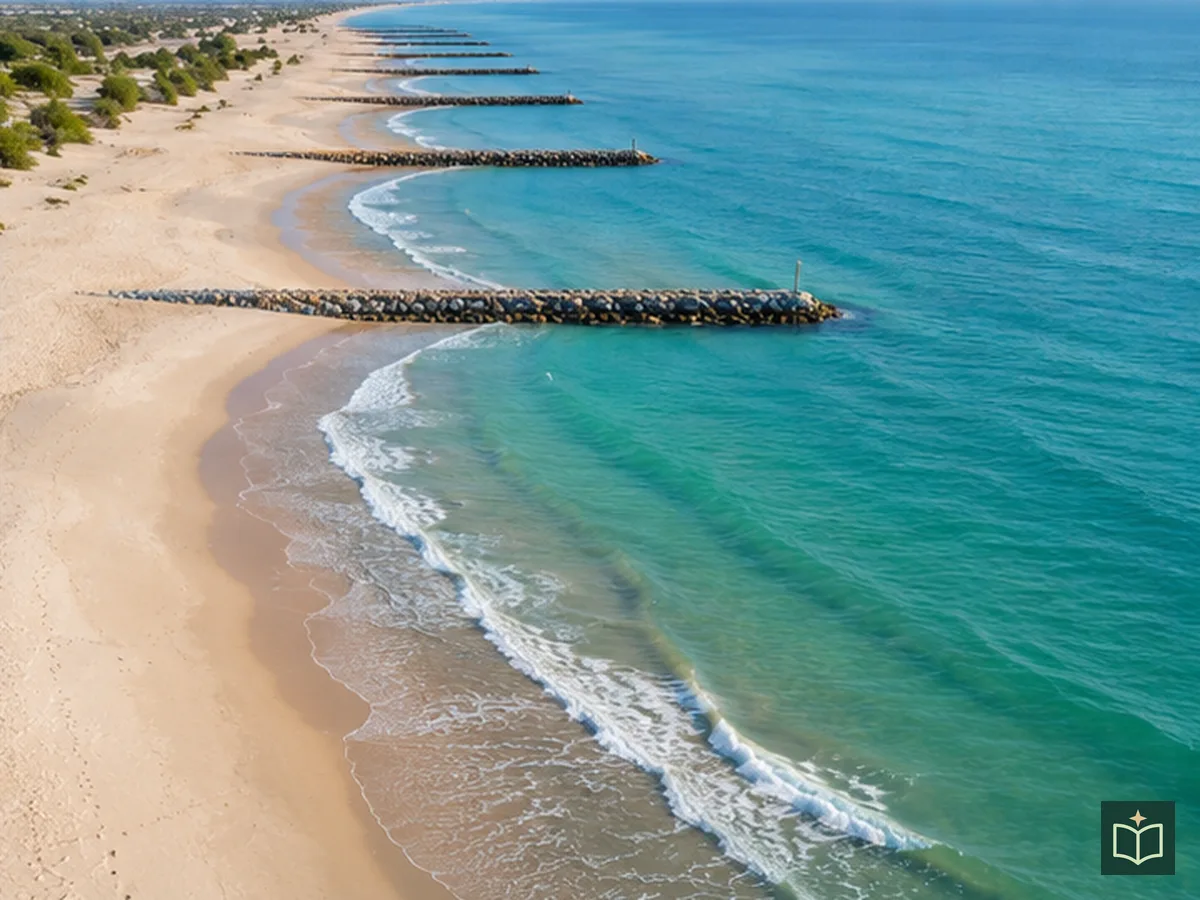
Because drift removes sand as well as delivering it, coastal managers often try to slow it. The commonest tool is the groyne, a low wall of timber, rock or concrete built across the beach. Sand piles up on the side facing the oncoming drift, widening the beach there. The catch is downdrift. Sand trapped by one groyne is sand that no longer reaches the next stretch, so beaches further along can narrow and erode. That is why groynes usually appear in series, giving a sawtooth pattern of beaches. Many coasts, including parts of Dubai's Jumeirah shoreline, combine rock groynes with periodic beach nourishment using sand dredged offshore.
When people block the flow
Large structures can interrupt drift on a regional scale. Harbour breakwaters, jetties and artificial islands act as giant groynes, building beaches on one side and starving them on the other. Engineers sometimes pump or truck sand around harbour entrances, a practice called sand bypassing, to keep the system flowing. Dams on rivers also matter, because rivers supply much of the sand that drift distributes along many coasts. When that supply is cut, beaches downstream of a river mouth can erode for decades. A common misconception is that erosion means sand is lost to sea. Often it has simply moved along the coast to somewhere else.
Why it matters
Understanding longshore drift helps explain why beaches change shape between seasons and after storms, why some resorts must replenish sand every few years, and why one town's sea defence can become another's problem. Planners use measurements of drift direction and volume before building marinas or reclaiming land. Geologists read old spits and beach ridges to reconstruct past sea levels and storm patterns. For beachgoers the lesson is visible: look at which side of a groyne holds the wider beach, and you can tell which way the sand is travelling. The same patient process that builds a 110-kilometre spit is at work on every angled wave.
Sources & further reading
Figures are rounded and widely published; check the linked organisations for the latest editions. These organisations do not endorse this website.